How Does Healthcare Work for Posted Workers in Sweden?
Navigating the Swedish healthcare system as a posted worker often feels like trying to assemble flat-pack furniture without the instructions or the hex key. I remember standing in a pharmacy in Stockholm, waving a foreign prescription and an A1 form, only to be met with a polite but firm head-shake. This guide clarifies exactly how you access care while on assignment.
The Unique Status of Posted Workers in the Swedish System
When you are sent to Sweden by your employer in another country, you occupy a specific administrative middle ground. You are working in Sweden, living in Sweden, and contributing to the local economy, but you aren't necessarily part of the Swedish social security system. This is the fundamental hurdle: Swedish healthcare is residency-based, yet as a posted worker, your "social security home" remains your country of origin.
For most expats, the gateway to everything in this country is the Personnummer. However, as a posted worker, especially if your assignment is for less than a year, you might not be eligible for one. This creates a friction point when you try to use Healthcare in Sweden for Foreign Residents: The Complete System Guide (2027). Without that ten-digit number, you aren't "in the computer," which can lead to confusion at the reception desk of a local clinic.
Validation of your right to care depends heavily on your country of origin. If you are posted from an EU/EEA country, you are protected by EU coordination regulations. If you are coming from outside the EU, your access depends entirely on whether your home country has a bilateral social security agreement with Sweden. Understanding this distinction is the first step to ensuring you aren't hit with a massive bill after a routine doctor's visit.
Accessing Care for EU and EEA Posted Workers
If you are coming from within the European Union, your primary tools for healthcare access are the EHIC (European Health Insurance Card) and the S1 form. For short-term postings, the EHIC is usually sufficient for "medically necessary" care. This doesn't just mean emergencies; it includes chronic condition management or pregnancy care that cannot wait until you return home.
However, for longer postings, the S1 form is your golden ticket. This document allows you to register your right to healthcare in Sweden while your home country continues to foot the bill. Once registered with Försäkringskassan (the Swedish Social Insurance Agency), you should be treated on the same financial terms as a local resident. You will still pay the standard patient fees, but you won't be charged the "uninsured" rate, which can be ten times higher.
When you arrive, you should prioritize Registering with a Vårdcentral: Your Guide to Primary Care in Sweden. Even without a Personnummer, a Vårdcentral (primary care center) can issue you a "reserve number" to track your records. Be prepared to show your passport, your S1 registration or EHIC, and your posting certificate. In my experience, carrying physical copies of these documents is far more effective than trying to show a digital version on your phone, as many regional systems still rely on manual data entry for foreign workers.
| Document Type | Purpose for Posted Workers | Who Needs It |
|---|---|---|
| A1 / E101 Form | Proves you pay social security in your home country | All EU/EEA Posted Workers |
| EHIC Card | Access to necessary care during temporary stays | EU/EEA Workers (Short-term) |
| S1 Form | Registers you for full healthcare rights in Sweden | EU/EEA Workers (Long-term) |
| Certificate of Coverage | Proves insurance status under bilateral treaties | Non-EU Workers (Selected countries) |
| Private Insurance | Covers gaps, repatriation, and faster specialist access | All non-treaty workers |
Healthcare for Non-EU Posted Workers and Bilateral Agreements
For those posted from countries like the USA, Canada, or Australia, the situation is more complex. Access to the Swedish system is governed by specific bilateral agreements. For example, the agreement between Sweden and the United States is primarily focused on pensions and does not generally cover healthcare. This means a US-posted worker may be treated as a non-EU tourist, required to pay the full cost of care upfront.
In these scenarios, your employer’s insurance or a private policy becomes mandatory. Many veteran expats in this situation look toward robust international plans from providers like Cigna Global to ensure they have comprehensive coverage that mirrors what they would have at home. This is particularly important because How Sweden's Tax-Funded Healthcare Works: Regions, Costs, and Coverage is designed for those within the tax net. If you aren't paying into the Swedish system via social security contributions, the system expects your home country or your private insurance to step in.
If your country does have a healthcare treaty with Sweden (such as Australia), you may be entitled to emergency care at the local resident rate. However, "emergency" is a narrow definition. If you need a routine check-up or mental health support, you might find yourself outside the treaty's scope. This is where a flexible plan from SafetyWing can be useful, especially for younger workers or those on shorter, more fluid assignments who need a safety net that covers more than just a broken leg.
Understanding Costs and the High Cost Ceiling
One of the most confusing aspects for posted workers is the payment structure. In Sweden, healthcare is not "free"; it is subsidized. Every time you visit a doctor, you pay a patientavgift (patient fee), which typically ranges from 200 to 400 SEK. If you have registered your S1 form or are covered by a treaty, these visits count toward The Högkostnadsskydd Explained: Sweden's Healthcare Cost Ceiling and Frikort.
The Högkostnadsskydd is a wonderful safety net. Once you have paid a certain amount in a 12-month period (currently around 1,400 SEK for consultations), you receive a Frikort (free card), and all subsequent visits for the remainder of that year are free. For a posted worker managing a chronic condition, reaching this ceiling is a huge relief. However, if you haven't properly registered your status, the system won't track your payments toward this limit. You must insist that the clinic logs your "reserve number" correctly so that your payments are aggregated.
It is also vital to note that dental care is handled differently. Most adult dental care in Sweden is fully private until you reach very high thresholds. Even with an S1 form, you will likely pay significantly more for a filling than you would for a GP visit. If you anticipate needing dental work, check if your posting contract includes supplemental dental insurance.
Navigating Emergencies and Urgent Help
If you find yourself in a crisis, you need to know the hierarchy of care. For life-threatening situations, the number is 112. For everything else that is urgent but not life-threatening, you should use Emergency Medical Care in Sweden: 112, Akutmottagning, and Urgent Help. As a posted worker, the Akutmottagning (Emergency Room) will be your most expensive point of entry if your paperwork isn't in order.
A better first step for non-emergencies is calling 1177 Vårdguiden: Navigating Sweden's National Health Advice Line and Portal. You can call 1177 from any phone, and they have English-speaking nurses available 24/7. They can tell you whether your symptoms require a trip to the hospital or if you can wait for a Vårdcentral appointment. For a posted worker without a local support network, this phone line is an invaluable resource for navigating the "is this normal?" moments of Swedish medical practice.
If you are using private coverage from a provider like SafetyWing, they often have their own 24-hour helplines. It is a good idea to compare the advice from 1177 with your insurance provider's requirements, as some private insurers require pre-authorization before you visit a specialist or an emergency room to ensure the costs are covered.
Practical Steps for a Smooth Posting
To avoid the administrative headaches I faced, follow this checklist the moment you arrive in Sweden. First, ensure your employer has provided you with a copy of your A1 form (for EU) or Certificate of Coverage (for non-EU). Second, if you are an EU citizen on a long-term posting, take your S1 form to a Försäkringskassan office immediately. Do not wait until you are sick to do this; processing can take weeks.
Third, find your local Vårdcentral. You can use the 1177.se website to find clinics in your neighborhood. Walk in, introduce yourself as a posted worker, and ask how they handle patients without a Personnummer. Establishing this relationship early makes it much easier to book an appointment when you actually need one. Some clinics are more "expat-friendly" than others, particularly in major hubs like Stockholm, Gothenburg, or Malmö.
Finally, evaluate if Private Health Insurance in Sweden: When Sjukvårdsförsäkring Is Worth It applies to your situation. While the public system is excellent for major trauma, the waiting times for elective surgeries or specialist consultations can be long. Having a private policy from Cigna Global can bypass these queues, giving you access to private clinics where English is the primary language and appointments are available within days rather than months.
Medications and Pharmacies
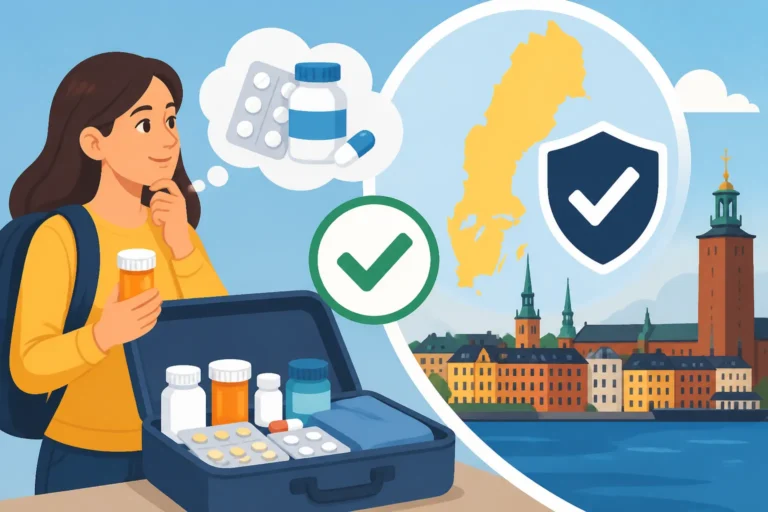
If you take regular medication, the transition to the Swedish Apotek (pharmacy) system can be jarring. Sweden has very strict rules about what requires a prescription. Many items that are over-the-counter in other countries might require a doctor's visit here. As a posted worker, your foreign prescriptions might not be accepted directly.
Generally, a Swedish pharmacist can only dispense medication based on a prescription issued within the EU/EEA. If your posting is from outside the EU, you will need to take your home-country medical records to a Swedish Vårdcentral and have a local doctor "convert" the prescription into the Swedish electronic system.
When you get your medicine, you will encounter the pharmacy high-cost ceiling. Much like the doctor visit ceiling, there is a limit on how much you pay for prescriptions in a year. Once you hit the limit (currently around 2,800 SEK), your medications are free for the rest of the 12-month period. Again, this only works if your status is correctly registered in the national system.
Using Your EHIC for Care While Settling Into Sweden
If you are an EU citizen and your S1 form is still being processed, you can still use your EHIC for urgent needs. This is a common bridge for posted workers in their first few months. However, be aware that the EHIC does not cover you if the primary purpose of your trip was to seek medical treatment. It is strictly for necessary care that arises during your stay.
Always carry your EHIC card and your passport together. If a clinic tries to charge you the full "out-of-country" fee, politely remind them of Transferring EU Health Rights to Sweden with an S1 or EHIC. Sometimes, newer administrative staff at smaller clinics might not be fully versed in the nuances of posted worker regulations, and a gentle reminder of the EU coordination rules can save you thousands of kronor.
Summary of Rights and Responsibilities
Being a posted worker in Sweden means you have the right to care, but you also have the responsibility to prove your eligibility. The system is built on trust and documentation. If you have your paperwork, the healthcare you receive will be world-class. If you don't, you may find yourself navigating a stressful and expensive bureaucratic maze.
Always keep a folder with your posting agreement, your social security certificates, and your insurance details. By taking proactive steps to register with Försäkringskassan and your local Vårdcentral early, you can focus on your professional assignment rather than worrying about what happens if you catch the flu in the middle of a Swedish winter.
Disclaimer
This guide is for informational purposes only and does not constitute legal or medical advice. Healthcare regulations in Sweden and EU coordination rules are subject to change. Always consult with Försäkringskassan, your employer's HR department, or a qualified legal professional to confirm your specific entitlements as a posted worker. Use of any third-party insurance providers should be based on your own assessment of your needs and the specific terms of their policies.