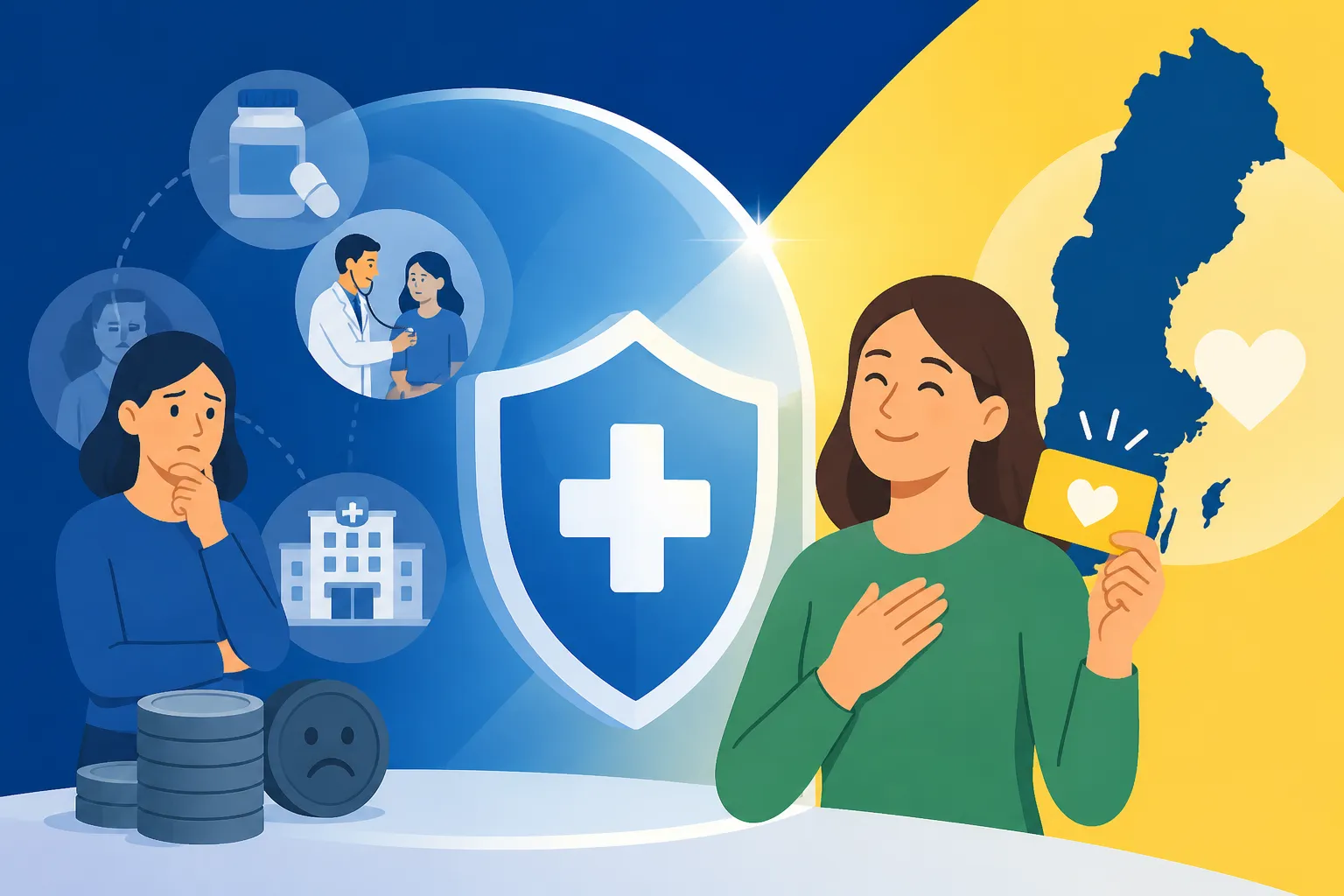
The Högkostnadsskydd Explained: Sweden’s Healthcare Cost Ceiling and Frikort
Staring at a medical invoice in a foreign language is a universal nightmare for any expat, and the fear of a massive bill often keeps people from the doctor. When I first moved here, I spent weeks stressing over a persistent cough because I simply didn't understand how the billing system worked. This guide solves that anxiety by explaining the Högkostnadsskydd, Sweden's ingenious safety net that ensures your healthcare costs never spiral out of control.
Understanding the Philosophy of Universal Coverage
The Swedish healthcare system is built on the principle of solidarity, but it is important to clarify a common misconception: it is not entirely free at the point of use. You will pay a fee for almost every interaction with the medical system until you hit a specific threshold. This is a shock to many who arrive expecting a totally "free" system. However, the Högkostnadsskydd, or high-cost protection, is the mechanism that keeps these fees from becoming a financial burden for those with chronic illnesses or those who face a sudden medical crisis.
One of the most striking things about living here is how the system prioritizes the patient's financial stability. Whether you are a high-earner or a student, the maximum you will pay for outpatient care in a 12-month period is capped at a remarkably low level. This system is designed to prevent "medical bankruptcy," a concept that is virtually non-existent in the Swedish vocabulary. It provides a level of psychological peace that is hard to quantify until you’ve lived through a year of multiple specialist visits and realized your bank account hasn't been drained.
While the public system is robust, many expats choose to supplement this coverage. If you are a digital nomad or waiting for your residency to be finalized, services like SafetyWing can provide a bridge of security. For those who want more comprehensive, global coverage or faster access to private specialists regardless of the public queue, Cigna Global is a frequent choice among the international community. These options often run parallel to the public system, providing an extra layer of comfort while you navigate the nuances of Healthcare in Sweden for Foreign Residents: The Complete System Guide (2027).
Equity in Swedish Healthcare
The core idea is that everyone should have access to the same quality of care regardless of their income. In many countries, the "best" doctors are reserved for those with the most expensive insurance. In Sweden, the doctor treating a CEO at a university hospital is often the same doctor treating a newly arrived immigrant. The high-cost ceiling is the mechanical part of this equity, ensuring that the cost of a visit—usually between 200 and 400 SEK—doesn't prevent anyone from seeking help.
I remember talking to a fellow expat who was terrified of seeing a specialist for a knee injury. They assumed the "specialist" label meant a thousand-euro bill. When they realized the cost was capped and would eventually lead to a Frikort (free card), the relief was visible. This equity extends to everyone who is properly registered in the population register, emphasizing why Getting Your Personnummer: The Gateway to Swedish Healthcare is such a critical first step for every newcomer.
The Role of the Regions
Sweden's healthcare is not managed by one single central authority but by 21 different regions. Each region has the autonomy to set its own exact patient fees. This means a GP visit in Stockholm might cost slightly more or less than one in Skåne. However, the national government sets the maximum limit for the Högkostnadsskydd. This ensures that no matter where you live—from the dense forests of Dalarna to the urban center of Malmö—you are protected by the same national ceiling.
Understanding this regional autonomy is vital because it affects how you interact with the system. You might find that wait times or digital platforms vary slightly. To get a better handle on these nuances, it helps to read up on How Sweden's Tax-Funded Healthcare Works: Regions, Costs, and Coverage. This regional structure is why you can sometimes feel like you’re dealing with a different system if you move across the country, but the financial ceiling remains your constant safety net.
Why Private Insurance Exists Alongside the Public System
You might wonder why anyone would pay for private insurance if there is a cost ceiling. The reality is that while the public system is financially protective, it can be slow. The "Vårdgaranti" (care guarantee) promises care within certain timeframes, but those waits can still be months for non-urgent surgeries. Private insurance, often provided by employers or purchased individually through providers like Cigna Global, allows you to bypass these queues and see a specialist in a matter of days.
For those of us who have lived here long-term, the public system is the backbone of our health, but we often keep an eye on private options for elective procedures or specialized mental health support. It’s about having a choice. If you are a freelancer or working for a startup that doesn't offer a health plan, looking into Private Health Insurance in Sweden: When Sjukvårdsförsäkring Is Worth It can help you decide if the extra cost is justified for your lifestyle.
The Healthcare High-Cost Ceiling for Outpatient Care
The "Öppenvård" or outpatient care high-cost protection covers visits to doctors, nurses, and specialists that do not involve staying overnight in a hospital. This is the part of the system that most expats interact with most frequently. Whether it's a routine check-up at your local clinic or a consultation for a skin condition, every krona you pay is logged toward your personal ceiling.
When you go to a clinic, you pay a "patientavgift" (patient fee). In 2024 and 2025, the national ceiling for these fees was set at 1,400 SEK. By 2026, this may have adjusted slightly for inflation, but the principle remains: once you have paid this amount in fees within a rolling 12-month period, you pay nothing more for the remainder of those 12 months. It is an automatic process in most regions, meaning you don't have to carry a bunch of paper receipts in your wallet like people did twenty years ago.
The Current SEK Threshold and How It Is Tracked
In the modern Swedish system, your payments are tracked digitally through your Personnummer. When you visit a Registering with a Vårdcentral: Your Guide to Primary Care in Sweden, the receptionist can see exactly how much you have paid toward your ceiling across the entire region. If you cross the 1,400 SEK mark during a visit, the system triggers a "Frikort."
I’ve had years where I never hit the limit, and years where I hit it in February due to a series of specialist appointments. The rolling 12-month period starts from the date of your first appointment that you paid for. It doesn't follow the calendar year. This is a crucial detail. If your first visit is in September, your "year" for high-cost protection runs until the following September. If you hit the limit in December, you get free care until your original start date in September.
What Counts Toward the Ceiling
Not every medical expense counts toward this specific ceiling. Generally, any care provided by or referred by the public health system qualifies. This includes visits to a GP, specialists (like a cardiologist or dermatologist), X-rays, and even some types of physiotherapy if the provider is integrated into the regional healthcare system.
However, there are exclusions. Missed appointment fees (the "no-show" fee) do not count toward your ceiling, and they are often more expensive than the actual visit fee! I learned this the hard way after forgetting a dentist appointment and getting a 500 SEK bill that did absolutely nothing for my Frikort progress. Also, preventative health checks or "wellness" certificates for things like driving licenses usually fall outside the protection. For a deeper look at what to expect during a visit, check out Finding a Doctor in Sweden: GPs, Specialists, and the Referral System.
Hypothetical Scenario: The 12-Month Journey
Imagine you move to Sweden in January. In February, you have a flu that won't quit, so you visit your Vårdcentral and pay 250 SEK. This starts your 12-month clock. In April, you see a specialist for an old sports injury and pay 400 SEK (total: 650 SEK). In June, you need three sessions of specialized physiotherapy at 250 SEK each (total: 1,400 SEK).
At this exact moment, you have hit the ceiling. For any further medical visits until the following February, you pay zero. If you suddenly need an emergency visit in November, it's free. If you need a follow-up with your specialist in January, it's free. When February comes around again, the clock resets, and you start paying again until you hit the limit for the new period.
| Service Type | Typical Fee (Approx) | Counts Toward Ceiling? |
|---|---|---|
| Primary Care (GP) | 200 – 300 SEK | Yes |
| Specialist Consultation | 350 – 400 SEK | Yes |
| Emergency Room (Akuten) | 400 SEK | Yes |
| X-rays and Lab Tests | 0 – 200 SEK | Yes |
| Missed Appointment | 400 – 600 SEK | No |
| Inpatient Care (Hospital Stay) | 130 SEK / day | No (Separate cap) |
The Pharmaceutical High-Cost Protection
While the doctor visits have their own cap, the medicine you are prescribed operates under a separate, but equally important, system called "Läkemedelsförmånen." This ensures that no one is priced out of life-saving medication. In Sweden, the cost of prescription drugs is subsidized on a sliding scale. The more you spend, the higher the percentage the state covers, until you reach a total out-of-pocket maximum.
As of the current period, the maximum an individual pays for prescription medication in a 12-month period is 2,850 SEK. Similar to the medical ceiling, this is a rolling 12-month window. This system is a lifesaver for people managing chronic conditions like diabetes or asthma. It’s also incredibly helpful for families with children, as most prescription medications for children under 18 are completely free.
The Sliding Subsidy Scale Explained
The drug subsidy doesn't just kick in at the end; it’s a tiered system. You pay 100% of the cost until you have spent 1,400 SEK. Once you cross that first threshold, the discounts begin. For the next portion of your spending, you might only pay 50%, then 25%, then 10%, until you hit the 2,850 SEK limit. After that, all further prescriptions within that 12-month period are 100% free.
This tiered system means that even if you haven't hit the "free" level yet, your expensive medications become progressively cheaper throughout the year. The pharmacies (Apotek) use a national database that tracks your purchases automatically using your Personnummer. You don't need to do anything; the discount is applied at the cash register. If you’re curious about how to navigate these shops, see Pharmacies and Prescriptions in Sweden: The Apotek System for Newcomers.
Prescriptions That Do Not Count
Not every pill or cream you get from a doctor is part of the high-cost protection. Only medications that are "förmånsberättigade" (eligible for benefits) count. Most essential medications are included, but certain lifestyle drugs, some newer "brand name" versions of generic drugs, and most over-the-counter items like basic ibuprofen do not count toward the 2,850 SEK limit.
If a doctor prescribes a medication that isn't covered, they are usually required to inform you, but it’s always worth asking if there is a "förmånsberättigad" alternative. I've found that Swedish doctors are generally very conscious of cost and will default to the subsidized version whenever medically appropriate. This is one of the many things you can discuss when Finding a Doctor in Sweden: GPs, Specialists, and the Referral System.
High-Cost Protection for Children and Families
Sweden is incredibly generous when it comes to the health of the next generation. As mentioned, most prescription drugs for children are free of charge. This is a massive weight off the shoulders of parents. Furthermore, for the outpatient medical ceiling, children often have their own rules. In many regions, healthcare is free for everyone under the age of 20.
For parents navigating this, it is essential to understand Family and Children's Healthcare in Sweden: BVC, Mödravård, and Beyond. Even if your own costs as an adult are capped, your children's costs are likely non-existent for the most part. This family-centric approach is one of the primary reasons expats choose to stay in Sweden long-term, as it simplifies the financial planning of raising a family significantly.
The Frikort: Your Ticket to Free Healthcare
The "Frikort" is the physical or digital manifestation of having reached your high-cost ceiling. In the past, it was a yellow paper card where receptionists would manually stamp each visit. Today, in almost all regions, it is entirely digital. It is tied to your Personnummer and your record in the "e-frikort" system.
When you reach the payment threshold, the system automatically marks you as having a Frikort. From that moment on, whenever you book an appointment or check in at a clinic, the receptionist will see a notification that your fee is 0 SEK. It feels a bit like having a magic pass, and it's a huge relief when you’re going through a period of intensive treatment.
Transitioning from Paper to Digital
While most of the country has gone digital, some private clinics that are publicly funded might still use paper receipts if their systems aren't fully integrated with the regional database. If you visit a doctor who doesn't use the digital e-frikort system, you must ask for a receipt ("kvitto") that specifically mentions the high-cost protection.
You can then take these receipts to a public healthcare center (Vårdcentral) to have them manually entered into the digital system. It is wise to keep a folder—digital or physical—of your medical receipts for the first year, just in case there’s a sync error between systems. It’s a small administrative task that saves a lot of headache if you need to prove you’ve already spent your 1,400 SEK.
How to Check Your Status on 1177.se
One of the most useful tools for any resident is the 1177.se portal. This is the digital heart of Swedish healthcare. Once you have a BankID, you can log in and see exactly how much you have paid toward your high-cost protection and when your current Frikort expires. This transparency is fantastic for planning.
If you’re wondering why your BankID is taking so long or how to even use the site, 1177 Vårdguiden: Navigating Sweden's National Health Advice Line and Portal is a must-read. Being able to see your "Frikort status" online removes the guesswork. You can also see which prescriptions are currently active and how close you are to the drug cost ceiling, making it easier to manage your monthly budget.
Using Your Frikort at Private-Public Clinics
A common point of confusion is whether a Frikort works at "private" doctors. In Sweden, many private clinics have a contract with the region (Regionen). These are often called "privata vårdgivare med regionavtal." If a clinic has this agreement, they are part of the public fee system, and your Frikort is fully valid there.
However, if you go to a purely private clinic that does not have a regional contract (often used for cosmetic surgery or by people with high-end private insurance like Cigna Global to skip queues), your Frikort will not work. You will pay the full private price, which can be 1,500 SEK or more for a single visit. Always ask "Gäller högkostnadsskyddet här?" (Does the high-cost protection apply here?) before booking if you are unsure.
Inpatient Care and Hospitalization Fees
While the outpatient ceiling protects you from the cost of visits, staying overnight in a hospital—known as "Sluten vård" or inpatient care—operates under a different fee structure. This is another area where Sweden’s system shines in terms of affordability, though it’s not strictly part of the 1,400 SEK outpatient ceiling.
If you are admitted to the hospital, you are charged a daily fee for your bed, food, and care. This fee is currently capped at 130 SEK per day. If you consider the actual cost of a hospital bed, specialized nursing, and meals, 130 SEK is a nominal amount. Even for a week-long stay, your bill would be less than 1,000 SEK, which is staggering compared to the costs in many other developed nations.
The Daily Fee and Regional Caps
Just like outpatient fees, the daily hospital fee is capped. Most regions have a maximum amount you can be charged for inpatient care over a month or a year. If you have a catastrophic injury that requires months of hospitalization, the system ensures you aren't hit with a massive bill upon discharge. The goal is to allow the patient to focus entirely on recovery rather than the financial cost of their bed.
For those concerned about the logistics of hospital stays, Emergency Medical Care in Sweden: 112, Akutmottagning, and Urgent Help provides context on how you get admitted in the first place. Whether you arrive by ambulance or through a specialist referral, the billing process is handled seamlessly afterward, usually via an invoice sent to your home address.
Exemptions for Children and Vulnerable Groups
Inpatient care is often free for children and young adults (usually up to age 20, depending on the region). Additionally, if you are pregnant and admitted for childbirth, the costs are minimal or non-existent for the delivery itself. Some regions may charge the daily fee for the postnatal stay, but the life-changing event of having a baby won't result in a life-changing debt.
Low-income individuals or those on certain types of social support can also apply for exemptions or subsidies if even the 130 SEK daily fee is a hardship. The system is designed to be as inclusive as possible. If you are starting a family, I highly recommend checking out Maternity Care in Sweden: Mödravård, Midwives, and Giving Birth to see how the financial and medical aspects of birth are managed.
What Happens During Long-Term Care
For chronic conditions that require long-term institutionalized care, there are different caps that involve your pension or income level. However, for the average expat or worker, the standard inpatient fee is what you need to know. It’s also worth noting that if you have international insurance like Cigna Global, they may cover these daily fees for you, or provide you with a private room, which is a rare luxury in the public Swedish system where shared rooms are the norm.
Dental Care: The Great Swedish Exception
It is a common "Welcome to Sweden" moment when a newcomer realizes that the wonderful high-cost protection for their body does not apply to their teeth. In Sweden, dental care is treated as a separate system once you turn 24. While it is subsidized, it is significantly more expensive than regular medical care, and the high-cost protection thresholds are much higher.
This is the one area where I tell every expat to budget extra. A simple check-up can cost 1,000 SEK, and a root canal can easily run into the thousands. There is high-cost protection for dental, but it only starts to kick in after you've spent a significant amount (currently 3,000 SEK) in a single year.
Why Dental Is Treated Differently
The historical reasons are complex, but the practical result is that dental care operates more like a regulated market. The state provides a small annual credit called "Tandvårdsbidrag" (usually 300 or 600 SEK depending on your age) to encourage check-ups. Beyond that, you are mostly on your own until you hit the major high-cost thresholds.
For a detailed breakdown of how to handle your teeth, Dental Care in Sweden: Folktandvården, Costs, and the Tandvårdsbidrag is essential. It’s the one part of the Swedish system where people actually "shop around" for prices, as private dentists can set their own rates, unlike the fixed fees of the regional Vårdcentraler.
The Tandvårdsbidrag vs. High-Cost Protection
The high-cost protection for dental care is also on a 12-month rolling basis. Between 3,000 SEK and 15,000 SEK, the state pays 50% of the "reference price." Above 15,000 SEK, the state pays 85%. Note the term "reference price"—if your dentist charges more than the state-set reference price, you pay the difference yourself.
This is why complex dental work can still be very expensive. However, for those with medical conditions that affect their dental health, there is a "tandvård vid viss sjukdom" (dental care for certain illnesses) where you can get dental treatment at the same price as regular medical care, and it counts toward your 1,400 SEK medical ceiling. This requires a specific certificate from your doctor.
Folktandvården and Private Dentists
You have the choice between the state-run Folktandvården and private clinics. Both are subsidized by the national dental insurance. Many people choose private dentists because the wait times at Folktandvården can be exceptionally long in cities like Stockholm or Gothenburg. Regardless of where you go, ensure they are connected to "Tandvårdsstöd" (the dental benefit system) so your spending is tracked toward the high-cost ceiling.
Navigating the System as a Newcomer
When you first arrive, the biggest hurdle isn't the cost—it's the administration. Without a Personnummer, you are technically a "ghost" in the digital system. This makes tracking your high-cost protection much harder, as there is no central ID to link your payments.
If you are an EU citizen, your EHIC (European Health Insurance Card) allows you to access care at the same price as Swedes. However, you will have to manually track your receipts. If you are from outside the EU and don't have your Personnummer yet, you might be charged "full cost" initially, which can be thousands of kronor. This is why having temporary insurance like SafetyWing is absolutely vital during those first few months.
Healthcare Before the Personnummer
If you have to see a doctor before your ID is finalized, you will likely be treated as a "non-resident" unless you have an EHIC. This means you'll pay the actual cost of the visit, not the subsidized 250 SEK. Keep every single receipt. Once you get your Personnummer and are registered in the population register, you can sometimes apply to the region for a retroactive refund of the difference.
This process is tedious and requires patience. You'll need to contact the region's billing office (Patientfakturering) and provide proof of your residency date. For more on the timeline of settling in, see How Long Does It Take to Get a Personnummer After Moving to Sweden?. It is a stressful period, but knowing that the high-cost protection is waiting for you at the end of the tunnel makes it manageable.
Registering with Försäkringskassan
While the healthcare regions manage the doctors, Försäkringskassan (the Social Insurance Agency) manages the dental and pharmaceutical subsidies. Usually, once you get your Personnummer, you are automatically in the system for medical visits, but you should still check Registering with Försäkringskassan: When and Why You Need To to ensure your overall social insurance is active. This is what connects you to the pharmaceutical high-cost protection.
Seeking Reimbursement for Past Fees
If you have hit your ceiling but were charged anyway (perhaps because you visited a clinic in another region that didn't see your status immediately), you are entitled to a refund. You usually have to contact the clinic where the overpayment happened. In my experience, Swedish administrative offices are very honest about this, but they won't come looking for you to give you your money back—you have to ask.
Supplemental Coverage: When Public Care Isn't Enough
Despite the excellent safety nets, the Swedish system is under pressure. Long wait times for specialists and surgeries are the primary complaints. This is where private health insurance comes into play. If you have the means, or if your employer offers it, having a private policy can change your experience from "waiting in a queue" to "choosing your appointment time."
Providers like Cigna Global offer plans that cover you not just in Sweden, but worldwide. This is particularly popular for expats who travel frequently or want the option to seek treatment in their home country. Meanwhile, SafetyWing is a fantastic, flexible option for the "in-between" stage of moving, providing coverage for accidents and emergencies while you wait for the Swedish bureaucracy to process your paperwork.
Private Clinics and Faster Access
Private clinics like Sophiahemmet in Stockholm or various Capio locations offer top-tier care. Many of these accept private insurance. While they are more expensive, the peace of mind knowing you can see a doctor tomorrow instead of next month is worth it for many. However, even at these private clinics, if you are there via a public referral, the Högkostnadsskydd still applies!
Mental Health Support and Referrals
One area where the high-cost protection is particularly vital is mental health. Therapy can be expensive, but if you get a referral (Remiss) from your GP to a psychologist within the regional system, those sessions count toward your 1,400 SEK ceiling. Once you hit the ceiling, your therapy is free.
The downside is that the wait for a public psychologist can be very long. Many people use their Frikort for their GP and basic tests, but pay out-of-pocket or use private insurance for mental health to get immediate support. For a deeper dive into this, see Mental Health Support in Sweden: Psychologists, Therapy, and Referrals.
Disclaimer
This article provides general information for educational purposes and is based on the Swedish healthcare system as of 2024-2026. Healthcare laws, regional fees, and high-cost thresholds are subject to change. Always consult with official sources such as 1177.se, the Swedish Social Insurance Agency (Försäkringskassan), or your local regional authority for the most current regulations. This guide does not constitute legal or professional medical advice.