Comprehensive Sickness Insurance and the Maintenance Requirement in Sweden
Moving to Sweden is an exciting adventure, but let's be honest, the administrative hurdles can feel like navigating a dense, dark forest blindfolded. One of the biggest sources of confusion and anxiety for many non-EU/EEA citizens is undoubtedly the strict requirement for comprehensive sickness insurance and proving you can support yourself financially. This isn't just a suggestion; it's a make-or-break condition for many residence permit applications. This guide will meticulously break down these often-misunderstood requirements, offering clarity and practical advice to help you successfully secure your stay in Sweden.
The Labyrinth of Swedish Healthcare Eligibility for Newcomers
When you first arrive in Sweden, especially if you're coming from outside the EU/EEA, the public healthcare system isn't immediately at your fingertips. This can be a shock for many who are used to universal healthcare in their home countries, or at least a clearer path to access it. Sweden’s system is fantastic once you're in it, but getting in requires meeting certain criteria, and until you do, your health security often falls squarely on your own shoulders.
Why Comprehensive Sickness Insurance is Often Non-Negotiable
For many types of residence permits, particularly for students, self-employed individuals, or those joining a family member who isn't a Swedish citizen or permanent resident, Migrationsverket (the Swedish Migration Agency) demands proof of "comprehensive sickness insurance." This isn't just a formality; it's designed to ensure that you won't become a financial burden on the Swedish state if you fall ill or have an accident before you're registered in the population register and covered by the public healthcare system. Without this, even if all your other documents are perfect, your application will likely hit a brick wall.
It can feel incredibly frustrating to pay for private insurance when you know Sweden boasts excellent public healthcare. Many expats experience a deep sense of injustice or confusion, thinking they've done everything right only to discover this crucial, often expensive, additional hurdle. But it's a non-negotiable step in the immigration process, a temporary bridge you need to cross before you can truly benefit from the Swedish welfare state. The agency needs concrete proof that any medical emergency or long-term illness won't deplete public resources, particularly for those on shorter-term or non-work-related permits.
The Catch-22 of Public vs. Private Coverage
Here's where the real catch often lies: you need a personnummer (personal identity number) to fully access Sweden's public healthcare system and register with Försäkringskassan (the Swedish Social Insurance Agency). But to get a personnummer, you often need a residence permit. And to get certain residence permits, you need comprehensive sickness insurance. See the loop? This is why private insurance becomes so vital in those initial months or even years. It's an interim solution, a safety net that satisfies Migrationsverket's requirements while you work towards getting integrated into the Swedish system.
Many people arrive, assuming their travel insurance will suffice, only to find out it doesn't meet the "comprehensive" criteria. Travel insurance often has caps, exclusions, and limited durations that fall short of what Migrationsverket requires for a long-term stay. The expectation is that you have coverage akin to what a resident would receive, just privately funded. This dual system can be confusing, but understanding that private insurance is a necessary prelude to public healthcare for many is key to avoiding disappointment and delays. To understand the wider system, read our guide on Healthcare in Sweden for Foreign Residents: The Complete System Guide (2027).
Who Needs to Prove Comprehensive Sickness Insurance?
The requirement for comprehensive sickness insurance primarily affects non-EU/EEA citizens applying for residence permits in Sweden, especially if they are not coming to work for an employer with a collective agreement, or if they are students, self-employed, or family members of non-EU citizens. For example, if you're coming to study for more than a year, or if you're joining a partner who is also a non-EU citizen on a permit, this will absolutely be a requirement. If your permit is for less than a year, Migrationsverket often requires comprehensive insurance for the entire duration of your planned stay.
Even for those coming for work, while employers generally provide occupational insurance, this might not fully satisfy the "comprehensive sickness insurance" requirement for the residence permit application itself, especially for the initial period. It’s critical to scrutinize the specific requirements for your type of permit on Migrationsverket's website. Don't assume anything, because the rules can be nuanced and depend heavily on your specific circumstances, duration of stay, and permit type. Our article on Do I Need Private Insurance to Get a Swedish Residence Permit? offers more details specific to this common query.
Understanding the "Comprehensive" in Comprehensive Sickness Insurance
The word "comprehensive" isn't just thrown around lightly by Migrationsverket. It implies a certain standard and scope of coverage that goes beyond basic emergency care. This is where many foreign insurance policies fall short, leading to rejected applications and endless stress. It's vital to ensure your policy ticks all the boxes.
What Migrationsverket Looks For in Your Policy
Migrationsverket is quite particular about what qualifies as "comprehensive." Generally, they expect a policy that covers at least emergency medical care, hospital stays, prescription medicines, and often repatriation costs. It needs to be valid for your entire intended stay in Sweden, or at least for the period your residence permit is granted, and typically without a deductible or with a very low one. The coverage amount should be substantial, often requiring a minimum of SEK 10 million (approximately EUR 1 million) per incident. They want to see a policy that would cover pretty much anything that could happen to you, health-wise, without dipping into the Swedish public coffers.
This is not a space to try and cut corners. A basic travel insurance policy, for example, will almost certainly be rejected because it doesn't cover all these eventualities, or it has too many exclusions. Migrationsverket needs to be confident that, should you face a serious illness or accident, the costs won't fall back on the Swedish state. This means your policy should clearly state its validity period, the types of care covered (inpatient, outpatient, emergency, medication, maternity if applicable, etc.), and the maximum coverage amount. It's a daunting list, but checking each point is essential for a smooth application.
Common Pitfalls and Policy Exclusions
One of the most common reasons for rejection related to insurance is inadequate coverage. Many policies exclude pre-existing conditions, have strict limits on specialist visits, or simply don't cover outpatient care to the extent required. Another pitfall is the policy's geographic validity; it must explicitly cover Sweden. Some policies are global but specifically exclude certain regions or have limitations when you become a resident rather than a tourist. Always read the fine print, and if you're unsure, contact Migrationsverket or an immigration lawyer for clarification before you apply.
For students, a common mistake is relying solely on home country student insurance which may not meet the Swedish standard for a residence permit. Similarly, some policies might look comprehensive but have a maximum duration, making them unsuitable for longer permits. Repatriation for medical reasons (sending you home if you're too ill to stay) and, for some permits, even death are often mandatory inclusions. It sounds morbid, but it's part of the "comprehensive" package that ensures no unexpected costs burden the state. Be vigilant about any exclusions listed in your policy, and question whether they might jeopardize your application.
Finding a Suitable Private Health Insurance Provider
Finding private comprehensive sickness insurance can feel like a hunt for a needle in a haystack, especially from abroad. There are several international insurance providers that are familiar with Migrationsverket's requirements. Companies like EuroCenter (often rebranded by different brokers), Allianz Care, Cigna Global, and BUPA Global are frequently cited by expats as providers whose policies tend to meet the criteria. It's crucial to get a policy that explicitly states it meets the requirements for a Swedish residence permit, if possible, or one that you can clearly demonstrate covers all aspects Migrationsverket lists.
When comparing providers, don't just look at the price. Look at the maximum coverage, the deductible, the specific medical services included, and any waiting periods for certain treatments. Ask for a clear, concise policy summary in English that you can easily submit with your application. Remember, this isn't just about satisfying Migrationsverket; it's about your health and peace of mind in a new country. Investing in a robust policy now will save you countless headaches, and potentially vast sums of money, down the line.
The Maintenance Requirement: Proving You Can Support Yourself
Beyond health insurance, another significant hurdle is proving you have enough money to support yourself during your stay. Sweden wants to ensure that you won't need to rely on public funds for your daily living expenses. This is often referred to as the "maintenance requirement" and is particularly stringent for students, self-employed individuals, and those on family reunification permits where the anchor person is not a Swedish citizen or permanent resident.
Defining "Sufficient Funds" for Residence Permits
Migrationsverket sets specific, regularly updated amounts that it considers "sufficient funds" for different permit types. For students, for example, this is typically a set amount per month (e.g., SEK 9,450 per month, though this number changes, so always check the current figure on Migrationsverket's official website). This amount is calculated to cover basic living expenses like food, accommodation, and local travel. For self-employed individuals, the requirement is often much higher and more complex, needing to show not just personal living funds but also capital for your business operations.
For family reunification, the maintenance requirement applies to the person living in Sweden who wants to bring family members. They must prove they can support themselves and their family members. This isn't just about income; it also includes having adequate housing for the entire family. This requirement often causes significant stress, as the combined income needed for a family can be substantial. It's a core part of Sweden's immigration policy to ensure that new arrivals can integrate economically without straining public services. Our Residence Permits in Sweden: Types, Requirements, and How to Apply guide covers this broadly.
Acceptable Forms of Proof for Maintenance
Migrationsverket is very particular about how you prove your funds. Simply stating you have money isn't enough. For students, this usually means bank statements showing the required amount held in an account that is accessible to you. The funds must be readily available and not tied up in investments that can't be quickly liquidated. For those working, recent payslips and an employment contract confirming your salary are essential. For the self-employed, comprehensive business plans, bank statements for both personal and business accounts, and projected earnings are often required.
The funds must generally be in your name, or demonstrably accessible to you (e.g., in a joint account with your spouse). If funds are in a foreign currency, you'll need to show the equivalent in Swedish Kronor (SEK), and Migrationsverket may convert using their own rates, so it’s wise to show slightly more than the bare minimum. They want to see stability and availability, not just a one-time deposit. This often means providing statements covering a period, not just a single snapshot, to demonstrate a consistent financial situation.
The Impact of Sponsorship and Scholarships
Sponsorships and scholarships can be a fantastic way to meet the maintenance requirement, but they come with their own set of rules. For scholarships, you need an official letter from the scholarship provider clearly stating the amount, duration, and what it covers (e.g., tuition, living expenses). Migrationsverket needs to verify that the scholarship covers at least the minimum required for living costs. If it only covers tuition, you'll still need to show proof of additional funds for your daily expenses.
If you are sponsored by a family member or another individual, this person will need to provide detailed documentation proving their ability to support you. This includes their income, bank statements, and often a signed undertaking stating they are responsible for your financial maintenance. This can be particularly complex, as Migrationsverket will scrutinize the sponsor's financial situation as rigorously as they would your own. All documents from sponsors, especially financial ones, must be official and often translated by a certified translator.
Navigating the Application Process with Insurance and Maintenance Documentation
The application process can feel like a never-ending paper chase. Getting your documents in order for both comprehensive sickness insurance and the maintenance requirement is paramount. Any missing or incorrectly formatted piece of information can lead to significant delays or even outright rejection.
Gathering Your Documents: The Devil is in the Details
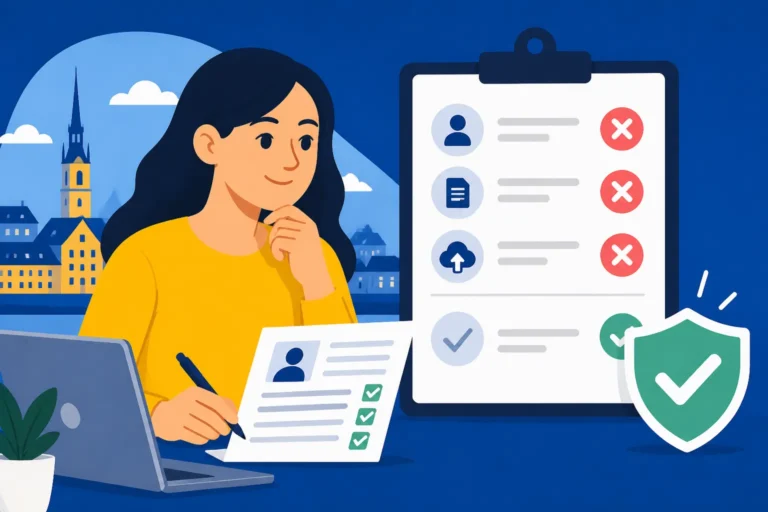
Before you even think about submitting your application, create a comprehensive checklist of every single document Migrationsverket requires for your specific permit type. For insurance, this means the full policy document, proof of payment, and a summary of coverage (if available) that clearly details what is included, the validity dates, and the maximum coverage amount. For maintenance, you'll need official bank statements (often stamped by the bank), salary slips, employment contracts, or scholarship letters. These documents must be current, reflecting your financial situation as close to the application date as possible.
Remember, Migrationsverket is dealing with thousands of applications. Make their job easier by organizing your documents clearly, logically, and in the order they request. Don't hide important information or hope they won't notice a missing detail. They will. It's far better to spend extra time ensuring everything is perfect upfront than to deal with the stress and delays of requests for supplementary information, or worse, a refusal. Our guide on Applying for a Swedish Residence Permit Online with Migrationsverket offers practical steps.
Translating Your Documents: When Professional Help is Essential
If any of your supporting documents are not in Swedish or English, they must be translated by a certified translator. This is non-negotiable. Don't try to save money by doing it yourself or asking a bilingual friend; Migrationsverket will not accept it. The translation needs to be accurate, complete, and bear the stamp and signature of a professional translator. For important documents, such as birth certificates, marriage certificates, or academic transcripts, this is particularly critical.
For quick and reliable translation services, many expats turn to trusted online providers. Companies like RushTranslate and Translayte offer certified translation services that are often recognized by immigration authorities. It's worth comparing prices and turnaround times, but always prioritize certification and accuracy. A poorly translated document can render your entire application invalid, adding weeks or months to your waiting time. Always send both the original document and the certified translation with your application.
Common Reasons for Refusal Related to These Requirements
Applications are frequently refused due to issues with comprehensive sickness insurance or the maintenance requirement. For insurance, common reasons include:
- Insufficient coverage amount: The policy doesn't meet the minimum financial threshold.
- Incomplete coverage: Excludes critical aspects like outpatient care, certain medications, or repatriation.
- Incorrect validity period: Doesn't cover the entire intended stay or has a waiting period before coverage starts.
- Unclear policy terms: Migrationsverket cannot clearly understand what is covered from the submitted documents.
For maintenance, refusals often stem from:
- Insufficient funds: The balance shown is below the required monthly amount.
- Inaccessible funds: Money is in an account that isn't easily accessible or is tied up.
- Outdated proof: Bank statements are too old and don't reflect current funds.
- Unverified sponsorship: Sponsor's financial capacity isn't adequately proven, or the sponsorship letter is not official enough.
These requirements are often the first points of scrutiny for Migrationsverket. Any discrepancy or lack of clarity here can lead to an immediate rejection, leading to the soul-crushing experience of starting the application process from scratch or going through a lengthy appeal. To avoid this, be meticulous.
When You Might No Longer Need Private Comprehensive Sickness Insurance
The good news is that these private insurance requirements are usually temporary. Once you're properly registered in Sweden, you'll generally transition to the public healthcare system. This is often a huge relief for expats, as the public system is comprehensive, high quality, and heavily subsidized.
The Personnummer and Public Healthcare Eligibility
The Getting Your Personnummer: The Gateway to Swedish Healthcare is the key that unlocks access to most public services in Sweden, including healthcare. Once you have your personnummer and are registered in the population register (folkbokförd), you typically become eligible for Swedish public healthcare on the same terms as Swedish citizens. This means you’ll pay standard patient fees (patientavgift) for doctor visits, specialist care, and prescriptions, benefiting from The Högkostnadsskydd Explained: Sweden's Healthcare Cost Ceiling and Frikort which caps your out-of-pocket expenses annually.
However, eligibility is not instantaneous the moment you receive your personnummer. You also need to be registered with Försäkringskassan, which confirms your social insurance affiliation. Only then are you fully integrated into the public healthcare system. The process of getting your personnummer itself usually requires you to intend to live in Sweden for at least one year. For shorter permits, you might remain reliant on your private comprehensive insurance for your entire stay.
Registering with Försäkringskassan and the Population Register
Once you have your residence permit and your personnummer, your next crucial step is to Registering with Försäkringskassan: When and Why You Need To. Försäkringskassan is responsible for social insurance, including healthcare benefits, parental leave, child allowance, and more. They will assess your eligibility for various benefits, including coverage under the public healthcare system. This process confirms your official residence and integration into the Swedish welfare system.
Concurrently, you'll be registered in the population register (folkbokföring) with Skatteverket (the Swedish Tax Agency). This is a fundamental step that establishes your legal residence in Sweden and is tied to your personnummer. Being folkbokförd is what allows you to access a vast array of public services and rights. Without being in the population register, even with a personnummer, your access to certain benefits might be limited. Our guide on The Personnummer, Folkbokföring, and Your Legal Status in Sweden delves deeper into this essential process.
Transitioning from Private to Public Healthcare
Once you are registered with Försäkringskassan and folkbokförd, you can generally discontinue your private comprehensive sickness insurance. You’ll be covered by the region (region) where you live. This means you can How to Register with a Vårdcentral After Getting Your Personnummer for primary care, and your patient fees will be significantly lower. You'll also benefit from the patient ceiling, which limits how much you pay for healthcare within a 12-month period.
It’s always a good idea to confirm your eligibility with both Försäkringskassan and your private insurance provider before cancelling your policy. Ensure there's no gap in coverage during your transition. Sometimes, even after getting a personnummer, there might be a short administrative period before your full public healthcare eligibility kicks in. A quick call to Försäkringskassan or 1177 Vårdguiden (the national health advice line) can provide peace of mind during this period.
Practical Tips for a Smoother Journey
Navigating the Swedish immigration system can be a test of patience and meticulousness. Here are a few practical tips gleaned from years of expat experience to help you avoid common pitfalls related to insurance and maintenance requirements.
Start Early and Double-Check Everything
My best advice for anyone applying for a permit in Sweden is to start preparing your documents months in advance. These aren't last-minute tasks. Research the specific insurance and maintenance requirements for your permit type on Migrationsverket's official website. These amounts and rules can change, so always check the most current information. Then, create a checklist and gather everything systematically.
Before you submit, double-check every single document against your checklist. Is the insurance policy valid for the right duration? Does it clearly state the coverage amount and what it covers? Are your bank statements recent and do they show the correct balance? Is every foreign language document accompanied by a certified translation? Trust me, the time you spend now triple-checking will save you weeks, if not months, of agonizing wait and potential rejection later.
Seeking Expert Advice (Legal or Immigration Consultants)
While this guide provides comprehensive information, individual circumstances can be complex. If your situation is unusual, or if you're struggling to understand specific requirements, don't hesitate to seek professional help. Immigration lawyers or specialized consultants in Sweden are experts in these nuances and can provide tailored advice. They can review your documents, confirm your eligibility, and even assist with the application process itself.
Yes, these services come with a cost, but compare that to the financial and emotional toll of a rejected application, the potential loss of a job offer, or the interruption of your studies. Many expats find the investment worthwhile for the peace of mind and the increased likelihood of a successful application. They can also help you understand Understanding Migrationsverket Processing Times and Delays and how to best navigate them.
Being Prepared for Follow-Up Questions from Migrationsverket
Even if your initial application is flawless, Migrationsverket might have follow-up questions or request additional documentation. This is normal and doesn't necessarily mean there's a problem. They might need clarification on a particular clause in your insurance policy or want more recent bank statements. Respond promptly and thoroughly to any requests.
Keep copies of everything you submit, and maintain a clear record of all communication with Migrationsverket. If you submitted something that didn't quite hit the mark, this is your chance to correct it. Being organized and responsive demonstrates your diligence and commitment, which can certainly help move your application along.
Disclaimer
Please remember that I am a lifestyle blogger and not a legal expert or immigration consultant. The information provided in this guide is based on general knowledge, common expat experiences, and publicly available information from official Swedish sources like Migrationsverket and Försäkringskassan. Immigration laws and requirements in Sweden can change frequently and vary based on individual circumstances. For personalized advice and the most up-to-date regulations, always consult official government websites, accredited immigration lawyers, or qualified legal professionals. This guide is for informational purposes only and does not constitute legal advice.