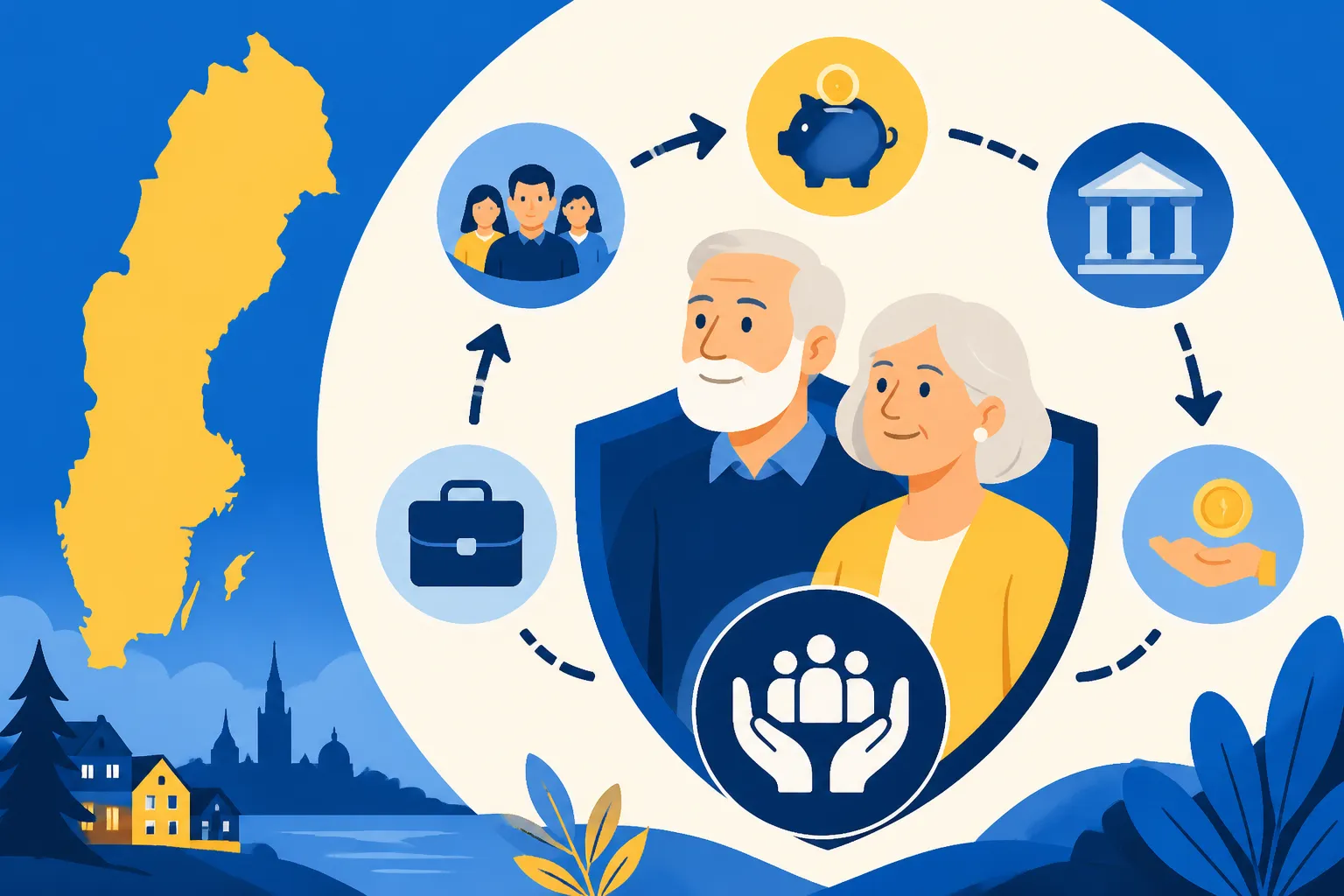
How Does the Swedish Public Pension Actually Work?
Most expats I meet in Stockholm or Gothenburg treat the "Orange Envelope" that arrives in their mailbox every spring like a piece of confusing junk mail. There is a pervasive fear among the international community that any money paid into the Swedish pension system is essentially "lost" if they don't stay for forty years or become a citizen. This guide explains exactly how the public system functions, ensuring you understand your rights and how to eventually claim every krona you have earned.
The Foundation of the Swedish Pension System
The Swedish pension system is often described as a pyramid or a three-layer cake. At the base is the public pension, known as allmän pension. This is the state-managed portion of your retirement savings that is mandatory for anyone working and paying taxes in Sweden. It is managed by the Swedish Pensions Agency (Pensionsmyndigheten) and is built on the principle that 18.5 percent of your pensionable income—the income on which you pay tax—is set aside for your future.
What many newcomers find frustrating is the lack of a traditional "pot of money" that you can see and touch in the same way you might with a private savings account. Instead, the system operates on a combination of current contributions and long-term investments. Many newcomers feel initial anxiety when looking at their first Understanding Your Swedish Payslip and Preliminärskatt and wondering where those deductions were actually going. Rest assured, every month you work and pay taxes, you are accumulating "pension rights" (pensionsrätt), which are recorded in the state's ledger under your name.
This system is designed to be robust, but it is also tied to the overall performance of the Swedish economy. If the economy grows, your pension rights tend to grow with it. However, it is important to remember that the public pension is only the first layer. To have a comfortable retirement in a country with a high cost of living, you will also likely need to look into your Occupational Pension (Tjänstepension): The Employer Layer Explained and potentially some private savings. This guide, however, focuses strictly on that massive, mandatory first layer that every resident interacts with from day one.
The Inkomstpension and the Pay-As-You-Go Model
The largest chunk of your public pension, exactly 16 percent of your pensionable income, goes into the inkomstpension. This is a "pay-as-you-go" system. In simple terms, the money you are paying into the system today is being used to pay the pensions of people who are currently retired. In exchange, you receive a credit in the system. When it is your turn to retire, the workers of that future generation will be the ones funding your monthly check.
This can be a hard concept to swallow if you are used to individualised retirement accounts. You aren't actually "saving" this 16 percent in a vault; you are participating in a social contract. The Swedish government keeps a meticulous record of your contributions linked to your personal identity. This is Why You Need a Personnummer for Almost Every Financial Service in Sweden becomes so critical; without that number, your contributions aren't being tracked under a unified legal identity, which can lead to massive headaches later when trying to claim your rights.
From a realistic perspective, the inkomstpension is the most stable but least flexible part of your retirement. You cannot choose how this money is invested. Its value is indexed annually based on the average income development in Sweden. This means that if Swedish salaries across the board rise by 2 percent, your accumulated inkomstpension rights generally follow suit. It’s a way of ensuring that your future buying power remains somewhat relative to the cost of living in Sweden at the time you stop working.
The Premiepension and the Power of Choice
The remaining 2.5 percent of that 18.5 percent total goes into the premiepension (premium pension). Unlike the inkomstpension, this money is actually invested in funds that you can choose yourself. This is the part of the "Orange Envelope" where you get to have a say. If you do nothing, your money is automatically placed in the AP7 Såfa fund, which is a state-managed, diversified fund with very low fees. For most expats, staying in this default fund is actually a very smart move, as it has historically outperformed many private alternatives.
However, if you are a savvy investor, you can log into the Pensionsmyndigheten website using your digital ID to move this 2.5 percent into different mutual funds. This requires Getting BankID: Sweden's Essential Digital Identity to access the portal. Once inside, you’ll see a list of hundreds of funds. Many expats get overwhelmed here, but the reality is that because it’s only 2.5 percent of your income, it’s a relatively "safe" place to learn about the Swedish market without risking your entire retirement.
The premiepension is a funded system, meaning the money is actually there, invested in stocks and bonds. This is your personal share of the market. Even if you only work in Sweden for a few years, this small percentage can grow significantly over decades. It is one of the reasons why the answer to the question Will I Get a Swedish Pension If I Only Work Here a Few Years? is a resounding "yes." Even a small amount of premiepension capital continues to sit in those funds, growing (or shrinking) with the market, until you reach the age where you can withdraw it.
Eligibility and the Portability of Your Pension
One of the most common questions I get from people who have just moved to Sweden is: "What happens if I leave?" There is a common myth that you need to live in Sweden for at least three or five years to get anything back. This is only partially true and relates specifically to the "guaranteed pension" (garantipension), which is a top-up for those who had very low or no income during their time in Sweden. For the money you actually earned and paid taxes on, there is no minimum time requirement.
If you work for six months, pay your taxes, and then move to Spain or the US, those pension rights stay in the Swedish system. When you reach retirement age (which is currently a flexible window starting from age 63 or 64, depending on your birth year), you can contact the Swedish Pensions Agency from wherever you are in the world and apply to have your pension paid out. The system is designed to be global. Sweden has social security agreements with most EU countries and many non-EU countries like Canada, the US, and India to ensure that your years of work are recognized across borders.
However, actually receiving that money abroad involves some logistical hurdles. Many expats find it easier to keep a Swedish bank account open, but if that isn't possible, you will need a reliable way to receive international transfers. Services like Wise are frequently used by retirees to manage these cross-border payments without losing a significant portion of their pension to the "hidden" exchange rate markups used by traditional high-street banks. When your Swedish pension is paid out in SEK, moving it to a EUR or USD account via Wise can save you thousands over the course of your retirement.
Understanding the Income Ceiling
It is a common shock to high earners in the tech and finance sectors of Stockholm that there is a "cap" on how much you can contribute to the public pension. For 2024, the ceiling for pensionable income is set at 8.07 income base amounts (which fluctuates yearly, but is roughly around 51,000 to 52,000 SEK per month). If you earn 100,000 SEK a month, you are only earning public pension rights on the first ~51,000 SEK.
This is where the Money and Finance in Sweden: A Complete Guide for Foreigners (2027) becomes essential reading. If you are a high earner, you cannot rely solely on the state. The state system is designed to provide a "basic" level of security, not to replicate a six-figure salary in retirement. This is why checking your contract for a solid tjänstepension (occupational pension) is so vital. If your employer isn't contributing to an occupational scheme, you are effectively losing out on retirement savings for every krona you earn above that state ceiling.
Many talented professionals move to Sweden for a high salary, only to realize years later that their "high" income wasn't being translated into a high pension because they didn't understand the ceiling. Always ask your HR department specifically about their "Kollektivavtal" or their private pension plan. If you are self-employed, you must be even more diligent, as you are responsible for paying both the employer and employee portions of these contributions to ensure you aren't left with only the bare minimum.
The Role of the Guaranteed Pension (Garantipension)
For those who have lived in Sweden but had a very low income—perhaps due to a long period of language study, staying home with children, or working in low-paid sectors—the garantipension exists as a safety net. This is funded by the state budget (taxes) rather than your specific contributions. It is meant to ensure that no one who has lived a full life in Sweden falls below a certain poverty line in old age.
To be eligible for the full garantipension, you generally need to have lived in Sweden for 40 years between the ages of 16 and 64. If you have lived here for less time, the amount is pro-rated. For example, if you lived in Sweden for 10 years, you might be entitled to 10/40ths of the guarantee. However, there's a catch for expats: following a recent ruling by the European Court of Justice and subsequent changes in Swedish law, the garantipension is generally no longer paid to people living outside of Sweden (with some very specific exceptions).
This makes it even more important to focus on the "earned" portion of your pension—the inkomstpension and premiepension. Those are yours to keep, regardless of where you live. The garantipension is a social benefit for residents, whereas the earned pension is a legal property right resulting from your labor. Understanding this distinction is the key to planning a move out of Sweden without fear.
| Pension Component | Funding Source | Investment Choice | Portability (Leaving Sweden) |
|---|---|---|---|
| Inkomstpension | 16% of your salary | None (State-managed) | Fully Portable |
| Premiepension | 2.5% of your salary | Choice of mutual funds | Fully Portable |
| Garantipension | General Tax Revenue | None (Safety net) | Generally Not Portable |
| Tjänstepension | Employer Contribution | Usually some choice | Fully Portable |
Tax and Practical Management of Your Pension
Even if you are decades away from retirement, managing your pension starts now. The first thing you should do is ensure you are properly registered with the authorities. This isn't just about the tax office; you should also understand how Registering with Försäkringskassan: When and Why You Need To impacts your overall social security standing, as your pension rights can be affected by periods of illness or parental leave. In Sweden, you actually earn pension rights while you are home with your children on paid parental leave, which is a fantastic benefit that many expats don't realize exists.
When it eventually comes time to collect your pension, you need to be aware of the tax implications. Pension is treated as income in Sweden. If you live in Sweden as a retiree, you will pay municipal and potentially state taxes on those payouts. If you live abroad, you will likely be subject to the SINK tax (Special Income Tax for Non-Residents), which is a flat rate of 25%. However, double taxation treaties usually mean you won't pay tax twice—once in Sweden and once in your new home country.
For American expats or those with complex tax residencies, companies like Taxes for Expats can be a lifesaver. Navigating the reporting requirements of the IRS while receiving a foreign state pension involves specific forms (like the FBAR and FATCA) that can be a nightmare to handle alone. Taxes for Expats specializes in these exact scenarios, ensuring that your Swedish "Orange Envelope" doesn't turn into a red flag for tax authorities back home.
How to Monitor Your Progress
Don't wait for the physical envelope to arrive in the mail. You can check your status at any time. The best tool for this is minpension.se, a collaboration between the state and private pension companies. It provides a "total" view of your retirement, including your public pension, your occupational pension from various employers, and any private savings you’ve linked.
When you log in, you can run simulations. You can see what happens if you retire at 65 versus 67, or what happens if your salary grows by a certain percentage. It is highly recommended to do this at least once a year. I personally check mine every January to make sure my previous year's contributions have been correctly logged. If you see a gap, it’s much easier to fix it with a recent payslip than it is to try and hunt down a defunct employer twenty years from now. This is a core part of The Swedish Tax System Explained: Rates, Returns, and Filing—keeping your own records is your best defense against administrative errors.
For those who are not yet comfortable with Swedish, the Pensionsmyndigheten website has a decent English section, but minpension.se is primarily in Swedish. Using a browser translator can help, but the charts and graphs are fairly intuitive. Seeing that number grow each year—even if it feels small at first—is a great way to feel more settled and secure in your life as a foreign resident in Sweden. You can also find more details in our guide on How Do I Check My Pension Forecast on Pensionsmyndigheten? to walk through the digital portal step-by-step.
The Impact of Parental Leave and Sickness
One of the most empathetic parts of the Swedish system is how it protects your pension during life’s "gaps." If you are on parental leave, the state compensates you by contributing to your pension as if you were working (up to a certain limit). The same applies to periods of long-term illness or even certain types of studies.
This is a stark contrast to many other countries where taking a year off to raise a child can "reset" your retirement clock or leave a permanent hole in your savings. In Sweden, the philosophy is that these activities are socially valuable, and therefore, your retirement security shouldn't suffer. As an expat, this is a huge benefit if you plan on starting a family here. You are essentially being "paid" in future security to spend time with your newborn.
However, you must be earning a "pensionable income" to trigger these benefits. This means you must be working and paying into the system before these gaps occur. If you are here on a spouse visa and never enter the workforce, you won't accumulate these earned rights. It is always better to have even a part-time job to get your foot in the door of the system. You can learn more about how this interacts with your overall tax obligations in our article on Income Tax in Sweden: Municipal, State, and the SINK Regime.
Important Disclaimer
The information provided in this article is for educational and informational purposes only and does not constitute financial, legal, or tax advice. Pension rules, tax rates, and social security agreements in Sweden are subject to change. You should always consult with a qualified financial advisor or the Swedish Pensions Agency (Pensionsmyndigheten) regarding your specific situation before making decisions about your retirement or moving assets across borders.