Using Swish: How Sweden Pays Instantly
You arrive in Stockholm, head to a charming local flea market, and find a vintage Dala horse you love. You reach for your wallet, but the seller points to a small QR code and says, "Just Swish me." This guide solves the immediate "digital wall" foreigners hit by explaining exactly how to navigate Swish, from the technical prerequisites to the social etiquette of instant payments in Sweden.
The Swedish Cashless Revolution and Why Swish Matters
Sweden is famously racing toward becoming the world’s first truly cashless society. For many of us who moved here from countries where "cash is king," the transition is jarring. You will quickly notice signs in shop windows stating Vi är kontantfria (We are cash-free). While credit and debit cards are accepted almost everywhere, Swish fills the massive gap left by the disappearance of physical coins and bills, particularly for person-to-person transactions and small-scale commerce.
From Coins to Code: Sweden's Rapid Digital Transition
The shift away from cash wasn't just a government mandate; it was a cultural embrace of efficiency. In the past, if you wanted to pay back a friend for lunch, you had to find an ATM, hope they had change, or deal with cumbersome bank transfers that took days. Swish, launched as a collaboration between Sweden's major banks, changed that overnight. It turned your phone number into your bank account number. Today, even buskers and churches (for the Sunday collection) use Swish. If you are trying to live here without it, you are essentially trying to participate in a 21st-century economy with 19th-century tools.
For many expats, the realization that cash is obsolete hits hardest during social gatherings. Imagine being the only person at a dinner party who can’t instantly pay their share of the wine. It creates a feeling of being an outsider, an administrative "other." This guide aims to bridge that gap. Understanding the financial landscape is as important as Learning Swedish: SFI, Courses, and Language Paths for Newcomers because money is the language of daily survival.
The Vital Importance of Swish for Daily Survival
Swish isn't just for splitting dinner bills. It is deeply integrated into the Swedish commercial infrastructure. Many "Loppis" (flea markets), food trucks, and small boutiques do not even own a card reader anymore; they only accept Swish. Furthermore, many Swedish websites and apps, such as those for parking (like EasyPark or Betala P) or public transport, use Swish as the primary one-click payment method.
Without it, you might find yourself unable to pay for a parking spot in central Gothenburg or struggling to buy a second-hand sofa on Blocket. The app acts as a social lubricant, making transactions fast, frictionless, and—most importantly—expected. If you are looking for more ways to manage your money before your Swish is active, you might consider using Wise for international transfers, but for local, daily Swedish life, there is no substitute for Swish.
Understanding the Connection Between Swish and BankID
You cannot talk about Swish without talking about BankID. In Sweden, your digital identity is everything. Mobile BankID is the app that proves you are who you say you are. When you "Swish" someone, the app communicates with your BankID to authorize the transfer. This two-factor authentication makes Swish incredibly secure, but it also creates a high barrier to entry for newcomers.
This dependency is why many expats find the first few months in Sweden so frustrating. You are essentially in a holding pattern until your administrative stars align. You cannot have Swish without a bank account, and you usually cannot have a full bank account without a Personnummer. This hierarchy is why Getting Your Personnummer: The Gateway to Swedish Healthcare is often cited as the single most important step for any new resident. Once that number is in your hand, the path to Swish becomes clear.
How to Get Swish: The Step-by-Step Prerequisites
Setting up Swish is not as simple as downloading an app from the App Store and linking a credit card. Because it is a direct bank-to-bank protocol, the security requirements are stringent. You have to prove your residency and your identity through the Swedish banking system.
The Foundation: Getting Your Personnummer and Bank Account
The very first hurdle is the Swedish personal identity number. Without this, you are largely invisible to the digital banking system. Once you have your Personnummer, your next stop is a physical bank branch. While Sweden is digital, opening your first account often requires a face-to-face meeting to verify your ID and residence permit.
When you sit down with the bank clerk, you must specifically ask for three things: a bank account, an internet banking login, and a Mobile BankID. Many newcomers make the mistake of just asking for a "card," but without the digital banking access, you cannot activate Swish later. For a deeper dive into this process, see our guide on Opening a Bank Account in Sweden: A Step-by-Step Guide. It is also worth noting that while Wise is excellent for holding SEK, it does not currently support the Swish protocol because it is not a member of the Swedish central clearing system.
Activating Mobile BankID – Your Digital Key
Once your bank account is active, you will need to install the BankID app on your smartphone. Your bank will provide a "starting code" or a QR code via their web portal to link your phone to your identity. This is a critical step. Treat your BankID with more caution than your physical passport; it allows you to sign contracts, access your medical records, and, of course, send money.
If you encounter issues during this stage, it’s often because your phone’s region settings or your Swedish phone number haven't been properly updated in the bank's system. Ensure that your bank has your current Swedish mobile number on file, as this number will become your "Swish address." If you are still waiting for your permanent number, read up on How to Get Your Personnummer: The Gateway to Swedish Healthcare to understand the timelines you're dealing with.
Linking Your Phone Number to Your Bank Account
The final technical step happens inside your Swedish bank’s own mobile app (e.g., SEB, Swedbank, or Nordea). There is usually a section labeled "Services" or "Swish." Here, you will link your Swedish mobile number to your specific checking account. You can only link one phone number to one bank account at a time.
Once linked, you download the separate Swish app. When you open it for the first time, it will ask for your phone number. It then triggers a BankID verification. After you sign with your BankID, you are officially "Swishable." You can now send and receive money instantly. If you are working and receiving a salary, this setup is vital for Managing Your Swedish Payslip and Preliminärskatt, as it helps you handle the small daily expenses that your main salary account covers.
Everyday Scenarios: Where and How You’ll Use Swish
Once you are set up, the utility of the app becomes apparent within hours. It is used in ways that go far beyond simple payments; it is a communication tool in itself.
Splitting Bills and Personal Transfers (P2P)
The most common use of Swish is the "private transfer." In Sweden, the culture of "splitting the bill" is precise. At a restaurant, the waiter will often ask if you want to pay together or separately. If you pay together to save time, one person pays the whole amount, and everyone else "Swishes" their share immediately. It is considered polite to do this before you even leave the table.
When you Swish a friend, you enter their phone number (or pick them from your contacts) and the amount. You also have the option to write a message. This message field is often used for humor or simply to label the expense (e.g., "Tacos," "Beer," or "Electricity bill"). Because the money arrives in seconds, there is no "I'll pay you back tomorrow" culture. It happens in real-time. For expats managing larger financial obligations, such as Filing Your Swedish Tax Return (Deklaration): What You Need to Know, Swish can even be used to pay back small amounts of kvarskatt (remaining tax) to Skatteverket.
Shopping at Physical Stores and Market Stalls
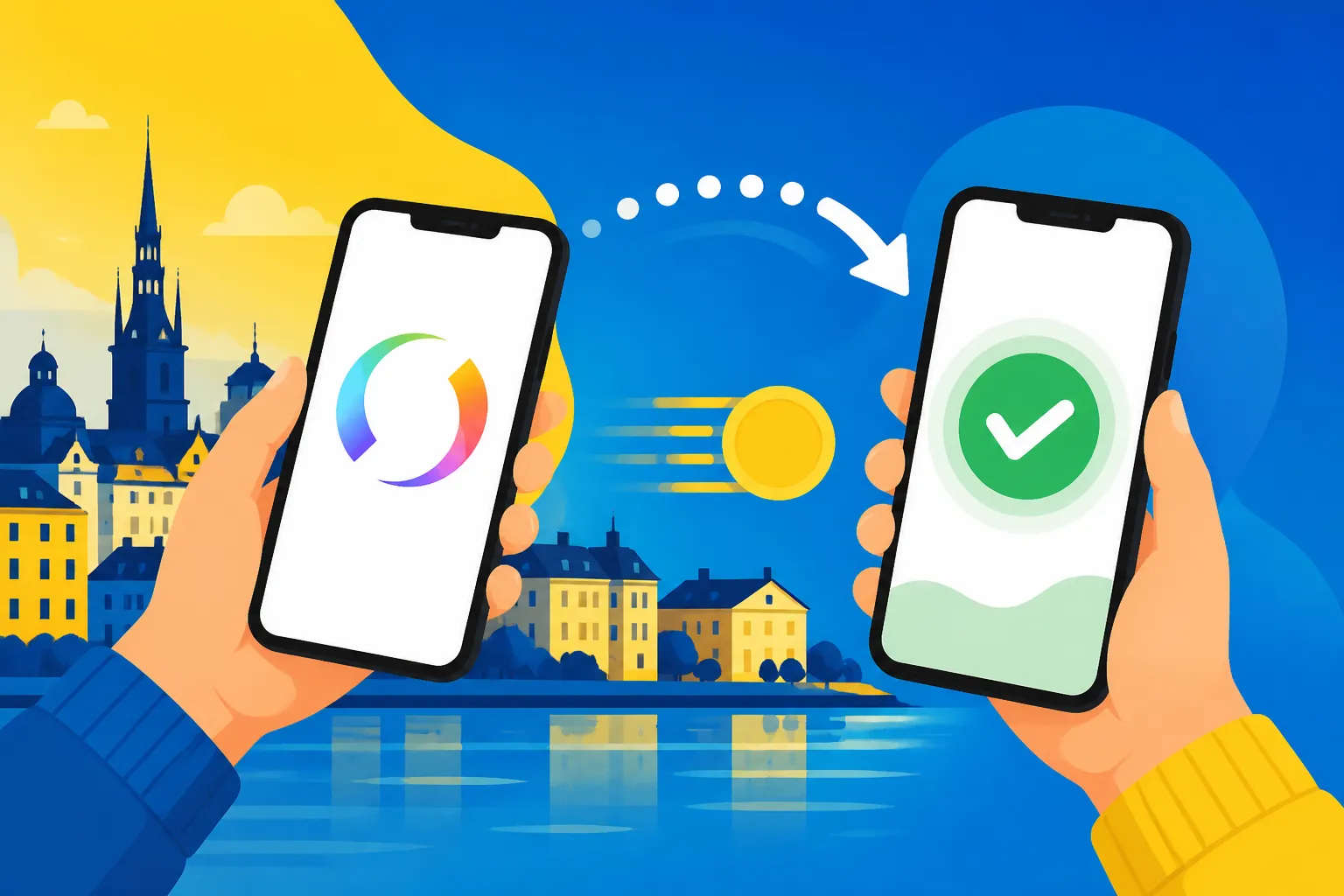
In a retail environment, paying with Swish usually involves scanning a QR code at the checkout. The merchant’s name and the amount (sometimes you enter the amount yourself) will pop up in your app. You verify the details and sign with BankID. The merchant receives a confirmation on their screen or device instantly.
This is particularly common at "popup" shops or sporting events where card readers might have poor signals. You might also see a "Swish number" (starting with 123) printed on a sign. This is a special business version of Swish. Unlike private numbers, you don't need to be in their contacts; you just type in the 7-digit number and pay. If you're a freelancer, you might even use this to receive payments, though you should consult Taxes for Expats to ensure you're tracking these business micro-transactions for your annual declarations.
E-commerce and Online Payments
Online shopping in Sweden is incredibly smooth thanks to Swish. When you reach the checkout of a Swedish website, you select Swish as the payment method. You enter your phone number, open the Swish app on your phone, and a payment request will be waiting for you. You sign it, and the website automatically refreshes to show the order confirmation.
This is much faster than typing in credit card numbers and expiry dates. It’s also safer, as the merchant never sees your bank details. Many expats find this level of integration impressive, but it does require you to keep a close eye on your spending. Because it’s so easy, it can be tempting to overspend. If you’re also trying to save for a future in Sweden, such as Buying Property in Sweden as a Foreigner: A Complete Guide, maintaining a budget despite the ease of Swish is a key skill to master.
Comparing Payment Methods in Sweden
| Feature | Swish | Debit/Credit Card | Cash |
|---|---|---|---|
| Speed | Instant (Seconds) | Fast (Seconds) | Slow (Counting change) |
| Availability | Almost universal (even loppis) | High (except very small stalls) | Very Low (often refused) |
| Security | High (BankID required) | High (PIN/Chip) | Low (Risk of loss/theft) |
| Social Acceptability | The standard for friends | Standard for stores | Often seen as an inconvenience |
| Transaction Limit | Set by your bank | Set by card limit | Physical limit of your wallet |
Common Challenges and Troubleshooting for Expats
Even after you’re set up, you might run into walls. The Swedish system is built for security, which sometimes translates to rigidity for those with international backgrounds.
Dealing with Payment Limits and Security Settings
Every Swish account comes with a default limit—often around 3,000 to 5,000 SEK per week. This is fine for coffee and lunch, but if you go to buy a used bike or a piece of furniture on Blocket, you might get a "Limit Exceeded" error. This can be incredibly embarrassing when you’re standing in someone’s hallway with a sofa.
To fix this, you must log into your internet banking portal (on a computer or via your bank's app). There, you can "temporarily raise your Swish limit." You can set it to 20,000 SEK or more for a specific day. After that window passes, it reverts to your safe lower limit. Learning to navigate these settings is a rite of passage for every expat. If you find yourself frequently making large payments, you should also look into The Swedish Tax System Explained: Rates, Returns, and Filing to ensure your high-volume transfers aren't raising red flags with the tax authorities.
What to Do If You Don’t Have a Personnummer Yet
This is the most common "pain point" for new arrivals. If you are on a shorter permit or still waiting for Skatteverket to process your application, you might be issued a Samordningsnummer (coordination number). While this allows you to work, most major banks are reluctant to give full BankID and Swish access to those with only a coordination number.
In this scenario, you are stuck in the "cash and card" world. You can still use services like Wise to pay bills via IBAN or use your foreign credit card. However, you will have to explain to friends that you "don't have Swish yet." Most Swedes understand this struggle because the delays at Skatteverket are well-known. You can read more about this in Can I See a Doctor in Sweden Before I Get My Personnummer? as the administrative limitations often extend to healthcare as well.
Managing Swish When Moving or Changing Banks
If you decide to switch from, say, Nordea to Handelsbanken, your Swish does not automatically move with you. You must go into your old bank's app, deactivate Swish for that phone number, and then log into your new bank's app to reactivate it.
If you forget to deactivate it at the old bank, you might find yourself unable to link the number to the new account. Similarly, if you get a new phone number, you must update it with your bank first. Swish is tied to the number the bank has "verified." This is a common hurdle when expats move from a temporary prepaid SIM to a permanent phone contract. For more on settling in, check out Registering Your Move (Flyttanmälan) with Skatteverket.
Safety, Security, and Scams in the Swish Era
While Swish is incredibly secure due to its BankID integration, the human element remains a vulnerability. As the system has become universal, scammers have found ways to exploit it.
Recognizing "Swish Scams" and Fake Apps
One common scam involves a buyer (often on a site like Facebook Marketplace) showing you a screen on their phone that looks like a successful Swish payment. They might use a fake app that generates a "Payment Sent" animation without actually moving any money.
Rule number one: Never trust the buyer's screen. Always wait until you receive the notification on your own phone or see the balance increase in your own app. If the money isn't there, the payment hasn't happened. Swish is instant; if it’s "pending" or "delayed," it’s almost certainly a scam. If you're managing your finances carefully, perhaps using Taxes for Expats to stay organized, these small losses can be a major headache to reconcile.
Protecting Your BankID and Swish Information
The most dangerous scams in Sweden involve someone calling you and pretending to be from your bank or the police. they might claim there is "suspicious activity" on your account and ask you to "identify yourself" by opening your BankID and entering your code.
Never do this. No legitimate bank, and certainly not the police or Skatteverket, will ever ask you to use your BankID over the phone during a call they initiated. By entering your code, you are likely authorizing a large Swish transfer or giving the scammer access to your entire bank account. If you ever feel pressured, hang up. Your financial security is paramount, especially when you are building a new life and perhaps looking into Private Health Insurance in Sweden: When Sjukvårdsförsäkring Is Worth It or other long-term investments.
Swish vs. International Alternatives: A Practical Comparison
Many expats arrive thinking they can just use what they used back home—Venmo, CashApp, or Revolut. While these exist, they don't hold the same cultural or technical weight in Sweden.
Why Apps Like Revolut or Wise Aren't "The Swish Killer"
Revolut and Wise are fantastic for international travelers and expats who need to move money across borders. They offer great exchange rates and physical cards that work everywhere in Stockholm. However, you cannot "Swish" someone from a Wise account.
Because Swish is a closed ecosystem owned by the Swedish banks, it requires a Swedish clearing number and account number. If your friend says "Swish me for the pizza," and you offer to "Revolut them," it creates a friction point. They have to give you their IBAN, you have to add a new recipient, and the money might take a few hours to arrive. It turns a 5-second task into a 5-minute task. This is why getting a local account and Swish is essential for true integration.
Comparing Swish to Venmo, Zelle, or MobilePay
If you are from the US, Swish feels like a much faster, bank-integrated version of Venmo. If you are from Denmark, you’ll recognize it as the cousin of MobilePay. The main difference is the level of integration. In many countries, these apps are "add-ons." In Sweden, Swish is a core utility.
It is more akin to a public service than a private app. The fact that it is free for private individuals to use is a major factor in its success. Whether you are paying for a coffee or contributing to a gift for a colleague’s birthday, Swish is the undisputed champion. For those interested in the broader financial system, How Sweden's Tax-Funded Healthcare Works: Regions, Costs, and Coverage provides another example of how centralized, efficient systems define life in this country.
Disclaimer
The information provided in this guide is for informational purposes only and does not constitute financial, legal, or tax advice. While we strive to keep our content up to date with the latest Swedish banking regulations and Migrationsverket policies for 2026, rules can change frequently. Always consult with your bank or a qualified financial advisor before making significant financial decisions in Sweden.