Do New Arrivals Pay More for Hospital Care in Sweden?
One of the most stressful parts of moving to Sweden is the terrifying uncertainty of the "gap period"—that limbo where you’ve arrived but don't yet have your personnummer. I remember sitting in my half-unpacked apartment in Stockholm, worrying that a simple trip to the emergency room would cost me my entire relocation budget. This guide demystifies exactly how much new arrivals pay for hospital care and how your residency status dictates the final bill.
The Reality of Healthcare Costs for Newcomers
When you first step off the plane, your access to the Swedish healthcare system is not determined by your citizenship or your employment contract, but rather by your registration in the national population register. The question of whether you pay more than a local resident depends entirely on whether you have been "folkbokförd" and issued a 10-digit personnummer.
In the Swedish system, healthcare is heavily subsidized by taxes. For a resident, a visit to a specialist or a stay in a hospital is remarkably affordable because the government covers the vast majority of the actual cost. However, if you are a newcomer who has not yet been processed by Skatteverket, you technically sit outside this subsidized bubble. This is where the confusion starts. Depending on your country of origin and your visa type, you might be charged the "subsidized rate," the "EU rate," or the "full cost of care," which can be a significant financial shock. To understand the broader context of these rules, it is helpful to consult Healthcare in Sweden for Foreign Residents: The Complete System Guide (2027).
Understanding the Tiers of Patient Fees
Swedish healthcare isn't free, but it is low-cost for those within the system. The fees you pay at the hospital desk are known as "patientavgift." These fees are set by the 21 individual regions (like Region Stockholm or Region Skåne), so they vary slightly depending on where you live. For a detailed breakdown of these regional differences, see Understanding Patient Fees (Patientavgift) Across Sweden's 21 Regions.
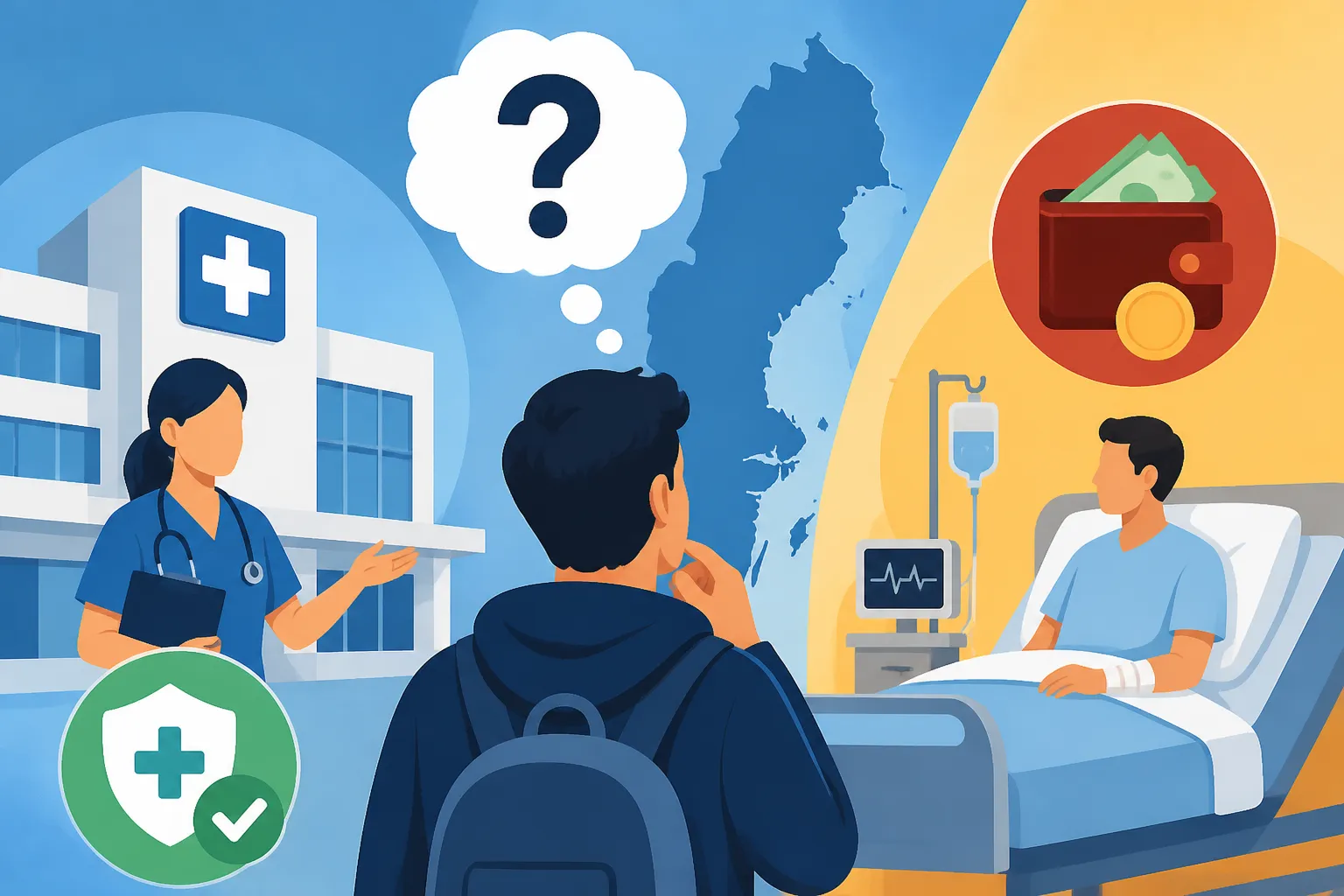
For a registered resident, an emergency room visit usually costs between 250 SEK and 400 SEK. If you are admitted to the hospital, you might pay a daily fee of around 110 SEK to 130 SEK for a bed and meals. However, for a newcomer without a personnummer or an EHIC card, the hospital is required to bill the "actual cost" of the medical service. This is not a "penalty" for being new; it is simply the unsubsidized price of modern medicine.
Resident with Personnummer
Once you have your ID, you pay the standard subsidized rate. You are also protected by the national cost ceiling. If you are still waiting for your ID, you should read up on Getting Your Personnummer: The Gateway to Swedish Healthcare to understand how to speed up the process.
EU/EEA Citizens
If you arrive from another EU country, you are entitled to "medically necessary" care at the same price as a Swede, provided you have a valid European Health Insurance Card (EHIC). The hospital will take a copy of your card and bill your home country.
Non-EU Newcomers on Work or Residence Permits
This is the group most at risk. If you are from a non-EU country and are waiting for your population registration to be finalized, the hospital may initially bill you as a "tourist" or "non-resident." This means a single ER visit for a minor injury could result in an invoice for 3,000 SEK to 5,000 SEK, rather than 400 SEK.
The High Cost of Unsubsidized Hospital Care
If you are classified as a non-resident, the hospital must calculate the total cost of the staff’s time, the equipment used, and the facility overhead. In Sweden, these costs are transparent but high. For example, a standard consultation at an Emergency Medical Care in Sweden: 112, Akutmottagning, and Urgent Help facility might have a base price of 3,500 SEK for non-residents. If you require surgery or an overnight stay, that bill can easily climb into the tens of thousands of kronor.
It is a common misconception that the hospital will refuse to treat you if you cannot pay upfront. Under Swedish law, hospitals must provide "care that cannot be deferred" (vård som inte kan anstå). They will treat you first and figure out the billing later. However, "later" involves a very real invoice sent to your home address. To bridge this financial gap, many expats rely on providers like Cigna Global to ensure they are covered for full medical costs before their Swedish subsidies kick in.
| Patient Category | Primary Care Visit | Emergency Room (ER) | Hospital Stay (per day) |
|---|---|---|---|
| Registered Resident | 100 – 300 SEK | 250 – 400 SEK | ~120 SEK |
| EU Citizen (with EHIC) | 100 – 300 SEK | 250 – 400 SEK | ~120 SEK |
| Non-EU Newcomer (No ID) | 1,500 – 2,500 SEK | 3,000 – 5,000 SEK | 10,000+ SEK |
| Asylum Seekers | 25 – 50 SEK | 50 SEK | 0 SEK |
What Happens at the Akutmottagning Registration Desk?
When you arrive at a hospital's emergency ward (Akutmottagning), the first thing they ask for is your ID or personnummer. If you tell them you are new and don't have one yet, the administrator will look for an alternative way to categorize you.
If you are an EU citizen, show your EHIC immediately. If you are from a country with a reciprocal healthcare agreement (like Australia or Algeria), show your passport. If you have neither, they will likely register you as a "paying patient." It’s important to stay calm; the medical staff are not debt collectors. Their priority is your health. However, you should clarify your status as soon as you are medically stable. Often, if you receive your personnummer shortly after a hospital visit, you can contact the billing department to have the invoice adjusted to the subsidized rate retroactively. For more on this specific hurdle, check out Can I See a Doctor in Sweden Before I Get My Personnummer?.
The Role of Private Insurance During the Transition
Because of the potential for high "non-resident" bills, having a private safety net is highly recommended for the first 3 to 6 months of your stay. Companies like SafetyWing are popular among digital nomads and new arrivals because they provide flexible, month-to-month coverage that handles these large hospital invoices while you wait for your Swedish paperwork.
If you are moving to Sweden on a specific residence permit, such as a permit for self-employed individuals or certain specialist roles, the Migration Agency (Migrationsverket) may actually require you to prove you have comprehensive private insurance. In these cases, Cigna Global offers the type of international coverage that meets the rigorous Swedish legal requirements. Having this insurance doesn't just help with the visa; it means if you end up in a Swedish hospital with appendicitis before your personnummer arrives, you won't be left with a 100,000 SEK debt.
The High-Cost Ceiling: A Benefit You Might Miss Initially
One of the best features of the Swedish system is The Högkostnadsskydd Explained: Sweden's Healthcare Cost Ceiling and Frikort. This is a "safety lamp" that ensures no one pays more than a certain amount (currently around 1,400 SEK) for outpatient care within a 12-month period. Once you hit that limit, the rest of your visits are free.
The catch for new arrivals is that this system is tracked digitally through your personnummer. If you are paying the "full cost" as an unregistered newcomer, those payments usually do not count toward your high-cost ceiling. You are essentially paying "outside the system." This is another reason why getting registered quickly is the most important financial move you can make.
Navigating 1177 Vårdguiden as a Newcomer
Before rushing to the hospital and risking a high bill, every newcomer should become familiar with 1177 Vårdguiden: Navigating Sweden's National Health Advice Line and Portal. This is a 24/7 service where you can speak to a registered nurse about your symptoms.
If you call 1177, they can tell you if your condition requires an expensive hospital visit or if it can wait until you can see a doctor at a local clinic (vårdcentral), which is significantly cheaper. Even without a personnummer, you can call 1177 for advice. They are incredibly helpful and almost all operators speak excellent English. They can also provide information on which hospitals in your region are best equipped to handle patients who are not yet in the system.
Practical Steps to Protect Your Finances
To avoid paying more than necessary for hospital care in Sweden, follow these steps as soon as you land:
- Visit Skatteverket Immediately: Don't wait. The queue for a personnummer can take weeks or even months. The sooner you apply, the sooner you get subsidized care.
- Keep All Receipts: If you are forced to pay the full cost of a hospital visit while waiting for your ID, keep every single piece of paper. Some regions allow you to claim a refund once your residency is backdated.
- Carry Your EHIC or Passport: If you are from the EU or a country with a reciprocal agreement, never leave home without your proof of eligibility.
- Secure Temporary Insurance: Use a service like SafetyWing to cover the "limbo" period. It’s a small monthly cost compared to a 5,000 SEK ER bill.
- Use the Vårdcentral First: Unless it is a life-threatening emergency, try to visit a local clinic first. The fees are lower and the environment is much more manageable for newcomers.
Sweden's healthcare system is world-class, and once you are fully integrated, the costs are among the lowest in the developed world. The "extra" cost paid by new arrivals is a temporary administrative hurdle, not a permanent feature of life here. By understanding the tiers of care and protecting yourself with private options like Cigna Global during the transition, you can focus on your new life rather than worrying about medical bankruptcy.
Disclaimer
This article provides general information for educational purposes and should not be considered legal or medical advice. Healthcare regulations and fees in Sweden can change frequently. Always consult with the Swedish Tax Agency (Skatteverket), the Swedish Social Insurance Agency (Försäkringskassan), or your local regional healthcare provider for the most up-to-date information regarding your specific situation.