Do All Swedish Pharmacies Charge the Same Price for Medicine?
Trying to figure out if you're getting ripped off at a Swedish pharmacy can be an absolute headache when you're first settling in. I remember staring blankly at a shelf in Apotek Hjärtat, clutching my receipt and wondering if the shop around the corner was cheaper. This guide clarifies exactly how medication pricing works so you never overpay for your health.
The Swedish Pharmacy Landscape A Tale of Two Pricing Models
When you walk into a Swedish pharmacy, or "Apotek," you are entering a market that was once a strict government monopoly. Since 2009, the market has been deregulated, leading to a surge of different brands like Apotek Hjärtat, Kronans Apotek, Doz Apotek, and the online-only giants like Apotea. For a newcomer, it looks like a standard competitive retail environment. However, the pricing structure is actually split into two very distinct categories: regulated and unregulated.
The first category covers prescription medications. If your doctor at the Vårdcentral writes you a script, the price you pay is generally identical regardless of which pharmacy you visit. This is because the Swedish state, through the Dental and Pharmaceutical Benefits Agency (TLV), strictly regulates the price of subsidized medicines. This ensures that a patient in a remote village in Norrland pays the exact same price as someone living in central Stockholm.
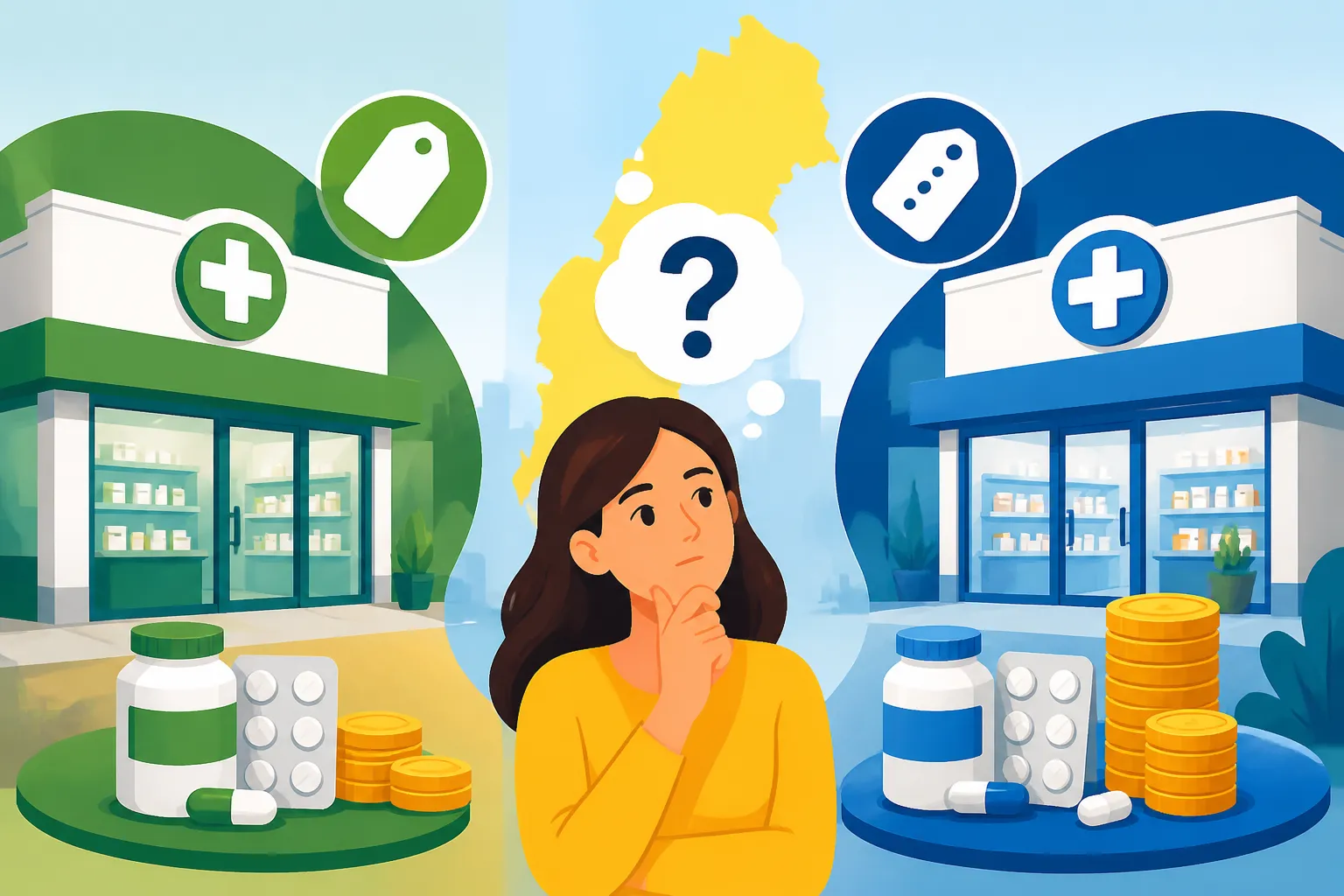
The second category is over-the-counter (OTC) medication. This is where things get interesting and, occasionally, frustrating for your wallet. For items like Alvedon (paracetamol), Ipren (ibuprofen), nasal sprays, or vitamins, pharmacies are free to set their own prices. This is why you might see a pack of painkillers for 35 SEK at a physical pharmacy in a high-traffic train station, while the same pack costs 19 SEK on an online pharmacy platform. Understanding this distinction is the first step toward navigating Healthcare in Sweden for Foreign Residents: The Complete System Guide (2027) without unnecessary stress.
Prescription Medicines and the Regulated Price Shield
For those of us living here long-term, the predictability of prescription costs is a godsend. When you are dealing with Prescription Medicines in Sweden: Recept, Refills, and the Cost Cap, you don't need to shop around. The price is fixed at the national level. The TLV negotiates these prices with pharmaceutical companies, and every pharmacy must adhere to them.
What often confuses expats is the concept of "Periodens Vara" or the "Product of the Month." When you hand over your ID or provide your Personnummer at the counter, the pharmacist might tell you that the specific brand your doctor wrote on the prescription isn't the one they are giving you. Don't worry; they aren't trying to pull a fast one. By law, pharmacies must offer the cheapest generic equivalent available that month. This system keeps costs down for both the state and the individual. If you insist on the brand-name drug, you can usually have it, but you will have to pay the price difference out of your own pocket, and that extra cost won't count toward your high-cost protection.
If you are a newcomer still waiting on your administrative paperwork, you might be worried about these costs. For those without full state coverage yet, having a private plan like Cigna Global can be a lifesaver, as they can often reimburse you for these initial out-of-pocket expenses while you are Getting Your Personnummer: The Gateway to Swedish Healthcare. Once you are in the system, these prescription costs become much more manageable thanks to the subsidy ladder.
The High-Cost Ceiling and How It Impacts Your Bill
The most important thing to understand about prescription pricing in Sweden isn't just the base price, but The Högkostnadsskydd Explained: Sweden's Healthcare Cost Ceiling and Frikort. This is a safety net designed to ensure that no one is financially ruined by the need for chronic medication. It works on a rolling 12-month "ladder" system.
When you start your 12-month period, you pay the full price for your prescriptions until you hit a certain threshold. Once you pass that first mark, the state begins to subsidize a percentage of the cost. The more you spend, the higher the subsidy becomes, until you eventually reach the "Frikort" or free pass level. Currently, once you have paid a total of 2,850 SEK out of pocket within a 12-month period, all subsequent prescription medications covered by the subsidy system are free of charge for the remainder of that year.
This system is tracked digitally through your Personnummer. You don't need to collect paper receipts; the pharmacist can see exactly where you are on the "ladder" the moment they scan your ID. If you are moving here and have concerns about how this applies to your specific situation, it is worth checking 1177 Vårdguiden: Navigating Sweden's National Health Advice Line and Portal for the most current threshold figures, as these can be adjusted slightly by the government each year. For digital nomads or those on shorter stays who might not qualify for this state benefit, SafetyWing provides a reliable alternative for covering medical costs that fall outside the Swedish social security net.
Over-the-Counter Medicines The Wild West of the Apotek
While prescriptions are a bastion of price stability, Buying Over-the-Counter Medicine at a Swedish Apotek is a completely different experience. Since deregulation, pharmacies use OTC products to drive profit margins. This means that location, brand, and retail format (online vs. physical) play a massive role in what you pay for a simple box of allergy pills.
Physical pharmacies in prime locations, such as those inside major shopping malls or near hospitals, tend to have the highest prices for OTC meds. They are banking on your convenience. On the flip side, online pharmacies like Apotea, Meds, and Apohem have revolutionized the market by offering significantly lower prices and door-to-door delivery. I’ve often found that even with delivery fees, buying my winter supply of Vitamin D and cold medicine online is 30-40% cheaper than walking to the Apotek down the street in my neighborhood.
Furthermore, basic medications like paracetamol can now be sold in supermarkets like ICA, Coop, and Willys. Interestingly, these supermarkets are often more expensive for medicine than the online pharmacies, but cheaper than the specialized physical pharmacies. It pays to have a quick look at your phone before you reach for that box of aspirin. If you are ever unsure about whether a medicine is available without a prescription, you can search for the product on the Pharmacies and Prescriptions in Sweden: The Apotek System for Newcomers digital portal to see its status and average price.
Comparison of Common OTC Medicine Prices in Sweden
To give you a better idea of how much these prices can fluctuate, look at the table below. Note that these are estimated averages based on typical retail pricing in Swedish Krona (SEK) and can vary by city and specific store promotions.
| Medication Type | Physical Pharmacy (Average) | Online Pharmacy (Average) | Supermarket (ICA/Coop) |
|---|---|---|---|
| Paracetamol (500mg, 20 tabs) | 35 SEK | 18 SEK | 28 SEK |
| Ibuprofen (400mg, 30 tabs) | 55 SEK | 32 SEK | 45 SEK |
| Nasal Spray (Decongestant) | 65 SEK | 39 SEK | 58 SEK |
| Loratadine (Allergy, 10 tabs) | 45 SEK | 19 SEK | 38 SEK |
| Hydrocortisone Cream (10g) | 50 SEK | 35 SEK | Not usually available |
As you can see, the online options almost always win on price. However, you are paying for the lack of immediate access. If you have a splitting headache right now, that 17 SEK saving doesn't mean much compared to the convenience of a physical store. But for recurring needs, online is the way to go.
Navigating the System Before You Have a Personnummer
One of the biggest hurdles for new arrivals is the "waiting period." Until you are officially registered in the population register, you exist in a bit of a gray zone. If you need medication during this time, you won't have access to the high-cost protection system. You will be charged the full "unsubsidized" price for prescriptions, which can be significantly higher than what a resident pays.
This is where having robust private coverage is essential. Plans from Cigna Global are specifically tailored for expats who need a bridge until they are fully integrated into the Swedish system. They understand the administrative delays at Skatteverket and can help cover the costs of necessary medications in the interim. Similarly, if you are an EU citizen, you should ensure you have your EHIC card ready, though this is primarily for emergency care and might not cover all pharmacy costs in the same way the local system does.
It is also vital to know what you can and cannot bring with you. If you are moving with a pre-existing condition, read up on Can I Bring My Regular Medication into Sweden from Abroad? to avoid having your supply confiscated at the border. Once you arrive, your first priority should be How Do I Register with Försäkringskassan When Moving to Sweden? so that your pharmaceutical spending starts counting toward your high-cost ceiling as soon as possible.
Expert Tips for Saving Money at Swedish Pharmacies
If you want to live like a local and keep your medical expenses down, there are a few "pro-tips" I've picked up over the years. First, join the loyalty programs. Every major pharmacy chain has one. They are free, usually tied to your Personnummer, and they frequently send out "20% off one purchase" coupons or "buy 3 pay for 2" offers on OTC items.
Second, always ask for the generic version. Even for OTC meds, you can ask the pharmacist, "Finns det ett billigare alternativ?" (Is there a cheaper alternative?). Often, the store brand version of a cream or a supplement contains the exact same active ingredients as the expensive global brand but at half the price.
Third, use the "Apoteket" app or the 1177 website to check stock levels. There is nothing more frustrating than traveling to a specific pharmacy to find a cheaper item only for it to be out of stock. The digital infrastructure in Sweden is fantastic; use it to your advantage. For those who travel frequently or work as digital nomads, having a plan like SafetyWing ensures that even if you are outside of Sweden and can't access your usual Apotek, you aren't left stranded with high medical bills in another country.
Important Disclaimer Regarding Medical Advice
The information provided in this guide is for informational and educational purposes only. It is based on personal experience and general knowledge of the Swedish healthcare and pharmacy systems. This content does not constitute professional medical advice, diagnosis, or treatment. Always seek the advice of a qualified healthcare provider or pharmacist in Sweden regarding any medical condition or the use of specific medications. Pharmacy regulations and prices are subject to change by the Swedish government and the Dental and Pharmaceutical Benefits Agency (TLV). While we strive for accuracy, the legal and financial requirements for residents and non-residents may vary based on individual circumstances and updated legislation.