Can I Bring My Regular Medication into Sweden from Abroad?
Standing in the customs line at Arlanda Airport with a suitcase full of prescription bottles is a nerve-wracking experience for any newcomer. I remember clutching my original paper prescriptions tightly, terrified that a Swedish official would seize the medication I literally need to function. This guide provides the exact rules and documentation you need to bring your regular medication into Sweden legally and stress-free.
Navigating the Swedish Medical Products Agency Guidelines
Before you zip your suitcase, you need to understand the authority governing what crosses the border: Läkemedelsverket (the Swedish Medical Products Agency). Sweden is notoriously strict about pharmaceutical imports to prevent the illegal trade of controlled substances, and they do not make exceptions for "I didn't know the rules." The regulations change significantly depending on whether you are arriving from within the European Economic Area (EEA) or from a country outside that zone, such as the United States, Canada, or Australia.
The Distinction Between EU/EEA and Non-EU Arrivals
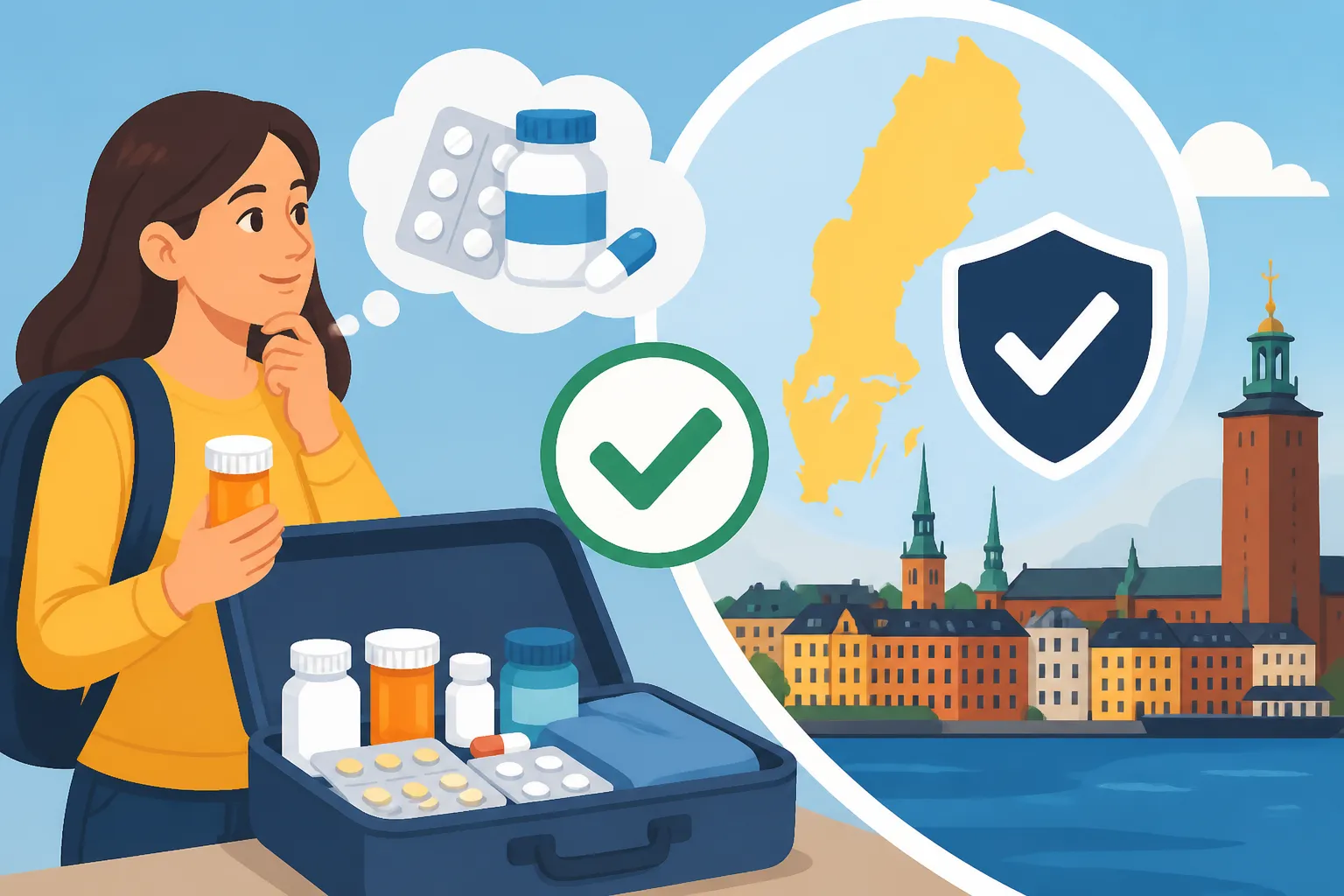
If you are moving from another EU country, the process is considerably smoother due to harmonized regulations. You are generally allowed to bring a one-year supply of non-narcotic medication for personal use. However, for those of us who moved from outside the EU, the limit is much tighter. You are restricted to a three-month supply. I found this particularly challenging when I first arrived, as it takes time to navigate Getting Your Personnummer: The Gateway to Swedish Healthcare and eventually find a local doctor to take over your prescriptions.
When you are in those first few months of transition, having a comprehensive plan is vital. Some expats choose to supplement their initial coverage with international providers like Cigna Global to ensure they have access to private consultations if the public queue is too long. This can be a lifesaver when your three-month supply starts running low and you haven't yet been assigned to a local clinic.
Classifying Your Medication
Not all pills are treated equally in the eyes of Swedish Tullverket (Customs). Most maintenance medications for blood pressure, cholesterol, or asthma fall under "standard" prescription drugs. However, if you take medication for ADHD, chronic pain, or anxiety, your drugs might be classified as narcotics or psychotropic substances. These have much stricter quantity limits—often only a 30-day supply is permitted regardless of where you are coming from. You must check the Swedish "Läkemedelsboken" or contact Läkemedelsverket directly if you are unsure about the classification of your specific meds.
The Essential Documentation Checklist
You cannot simply toss loose pills into a weekly plastic organizer and hope for the best. Swedish customs officials expect a high level of transparency. If you are stopped for a random check and cannot prove the medication belongs to you and was legally prescribed, it will be confiscated, and you could face fines or legal issues.
The Original Packaging Requirement
Every single medication you bring must be in its original pharmacy packaging. This means the box or bottle must have the pharmacy label clearly showing your name, the name of the medication, the dosage, and the prescribing doctor’s details. I learned the hard way that "saving space" by removing boxes is a major red flag for customs. The original packaging serves as the first line of proof that the substance is what you claim it is.
The Importance of a Doctor’s Certificate
In addition to the labels, you should carry a written certificate from your prescribing physician. This document must be in English or Swedish and should clearly state your diagnosis, the necessity of the medication, and the prescribed regimen. Having this on letterhead with a fresh signature is your "get out of jail free" card. If you are traveling with insurance like SafetyWing, keep your policy details handy as well, as they can sometimes assist with emergency medical translations or finding English-speaking providers if your documents are questioned.
Validating Your Prescription for the Long Term
While your foreign prescription is valid for bringing the medicine into the country, it is generally not valid for actually dispensing medicine at a Swedish pharmacy. Only prescriptions written by a doctor within the EEA are technically valid for fulfillment in Sweden, and even then, many pharmacists are hesitant to fill them. You will eventually need to master Finding a Doctor in Sweden: GPs, Specialists, and the Referral System to get a Swedish version of your script. Don't wait until your last blister pack is empty to start this process.
Quantity Limits: Defining Personal Use
One of the biggest points of confusion for new residents is the definition of "personal use." Sweden is generous with some things, but very specific about drug quantities. Bringing enough for yourself is fine; bringing enough for your cousin "just in case" is considered smuggling.
Traveling from Within the EU/EEA
For those moving from a neighbor like Denmark or Germany, the rules allow for a one-year supply of most non-narcotic medications. This gives you plenty of breathing room to settle in. However, if your medication contains any narcotic elements (like certain strong painkillers or stimulants), even EU residents are often limited to a 30-day supply. It is always wise to check if your country is a member of the Schengen Agreement, as you may need a specific "Schengen Certificate" from your local authorities to travel with controlled meds.
Traveling from Outside the EU/EEA
For those of us coming from further afield, the three-month rule is absolute for non-narcotic meds. This 90-day window is intended to give you enough time to Registering with a Vårdcentral: Your Guide to Primary Care in Sweden and have your medical records reviewed by a Swedish physician. If you have a chronic condition, I highly recommend bringing a full copy of your medical history and recent lab results. Swedish doctors are often conservative with prescriptions and will want to see the "why" behind your current treatment before they issue a Swedish equivalent.
Narcotic and Psychotropic Substance Strictness
If you take medications like Adderall, Xanax, or Oxycodone, the threshold drops significantly. For arrivals from outside the EEA, you are generally limited to a 15-day supply, though sometimes 30 days is permitted with extensive documentation. This is where the stress really kicks in. Because the transition to the Swedish system can take longer than 15 days, many expats find they need to use private health services or international insurance like Cigna Global to secure an appointment with a specialist quickly upon arrival.
Arriving in Sweden: Customs and Declarations
When you land at a major hub like Arlanda, Landvetter, or Malmö, you will face the choice of the Red or Green channel. If you are carrying a three-month supply of standard meds and have all your paperwork, the Green channel (Nothing to Declare) is usually appropriate. However, if you are carrying any narcotic medications, or if you are unsure, always choose the Red channel.
Choosing the Red or Green Channel
Choosing the Red channel and declaring your medication is not an admission of guilt; it is a proactive step that protects you. If you go through the Green channel and are stopped, and the officer finds a month’s worth of a controlled substance you didn't declare, they can treat it as a criminal attempt to bypass customs. By declaring it, you allow the officer to review your doctor’s certificate and the original packaging. In my experience, if your paperwork is in order, they simply nod and send you on your way.
What Happens If You Get Stopped?
If a customs officer pulls you aside, stay calm and immediately present your folder of medical documents. Explain that you are relocating to Sweden and are carrying a personal supply for the transition period. If you have valid insurance, such as through SafetyWing, mentioning that you have coverage and a plan to see a local doctor can help demonstrate that you are a responsible resident. Most officers are professional and are looking for traffickers, not expats with blood pressure meds. However, if your medication is confiscated, ask for a receipt and a written reason for the seizure, as you may need this to explain a gap in treatment to your future Swedish doctor.
Replenishing Your Supply Once You Arrive
The moment you arrive, the clock starts ticking on your 90-day supply. Sweden’s healthcare system is excellent, but it can be slow for non-emergencies. Your first priority should be to Can I See a Doctor in Sweden Before I Get My Personnummer? if you don't have your ID yet, though this is often only possible at private clinics or through certain digital providers.
Navigating the Vårdcentral and Pharmacy System
Once you have your identity in order, you must register with a local health center. This is the only way to get a long-term, renewable Swedish prescription. You will need to learn the nuances of Pharmacies and Prescriptions in Sweden: The Apotek System for Newcomers because the way medication is dispensed here might be different than in your home country. For instance, many medications are sold in standardized boxes rather than custom-filled plastic vials.
How to Refill a Prescription at a Swedish Apotek
When you finally get that first Swedish prescription, it will be registered digitally against your Personnummer. You don't usually walk around with a paper slip; you simply go to any Apotek (pharmacy), show your ID, and they pull up your records. To prepare for this, read up on How Do I Refill a Prescription at a Swedish Apotek? so you know what to expect. Keep in mind that Sweden has a high-cost protection system, meaning you’ll never pay more than a certain amount per year for essential prescriptions once you are in the system.
| Medication Type | EU/EEA Arrival Limit | Non-EU Arrival Limit | Documentation Needed |
|---|---|---|---|
| Standard Rx (e.g., Asthma, BP) | 1 Year Supply | 3 Months Supply | Original pack + Dr. Letter |
| Narcotics (e.g., ADHD, Strong Pain) | 30 Days (Schengen Cert) | 15-30 Days | Intensive Dr. Letter + Red Channel |
| Over-the-Counter (OTC) | Reasonable Personal Use | Reasonable Personal Use | Original Packaging |
| Vitamins/Supplements | No specific limit | 3 Months Supply | Must not be "medical" grade |
Final Steps for a Successful Move
The transition is about more than just the pills; it is about ensuring continuity of care. Before you leave your home country, ask your doctor for a final 90-day refill and a digital copy of your entire medical history. Once you land, utilize 1177 Vårdguiden: Navigating Sweden's National Health Advice Line and Portal to understand where your nearest clinic is located.
If you find that the public system is moving too slowly for your specific needs, Private Health Insurance in Sweden: When Sjukvårdsförsäkring Is Worth It is a topic worth exploring. Having private coverage or an international policy like Cigna Global can sometimes allow you to see a specialist in a matter of days rather than months, which is critical if you are managing a complex condition with limited medication on hand. Moving to Sweden is a grand adventure, and with the right paperwork, your health needs don't have to be a hurdle.
Healthcare and Medical Regulation Disclaimer
This guide is for informational purposes only and does not constitute legal or medical advice. Regulations regarding the importation of medication into Sweden are subject to change by the Swedish Medical Products Agency (Läkemedelsverket) and Swedish Customs (Tullverket). Always verify current rules with official government sources before traveling. The mention of specific insurance brands is based on common expat usage and does not replace the need for individual research into policy coverage.