Is It Cheaper to Live Outside Central Stockholm?
Oh, the eternal question for anyone new to Stockholm, or even those who've been here a while but are feeling the pinch: "Is it really cheaper to live outside central Stockholm?" Believe me, as someone who’s navigated this city for years, I’ve asked myself the same thing many times. The short answer is often a resounding "yes," but the longer, more nuanced truth involves weighing those savings against a whole lot of other factors that can seriously impact your daily life and overall experience. This guide will take a deep dive into the real costs and crucial trade-offs of living beyond the city's core.
The Lure of the Suburbs and Beyond: Why Consider Moving Out?
Let's be honest, Stockholm is a beautiful city, but it comes with a price tag that can make your eyes water. Especially for newcomers, the idea of finding an affordable place to call home right in the heart of it can feel like chasing a unicorn. This is where the suburbs and surrounding commuter towns start to look incredibly appealing, offering a tangible escape from the financial pressure cooker.
Rental Market Realities: Central vs. Periphery
The most immediate and impactful difference you'll notice when contemplating a move outside central Stockholm is the significant drop in rental prices. The coveted areas like Vasastan, Östermalm, Södermalm, or Norrmalm are not just expensive; they are notoriously difficult to get into, especially if you're aiming for a first-hand contract. These central districts represent the pinnacle of Swedish urban living, and their rents reflect that, often reaching upwards of 15,000-25,000 SEK for a small one-bedroom apartment, sometimes even more.
As you move outwards, the landscape shifts dramatically. Consider areas within the inner suburbs, still very well connected, like Solna, Sundbyberg, or Liljeholmen. Here, you might find similar-sized apartments for 10,000-15,000 SEK. That's a noticeable saving, potentially thousands of kronor a month! These areas still offer excellent infrastructure, good local amenities, and relatively quick access to the city center via metro or commuter train. For many, these inner suburbs strike a perfect balance between affordability and urban convenience.
Venture further, to the outer suburbs or even full-blown commuter towns, and the prices drop even more. Places like Huddinge, Haninge, or even slightly further afield like Södertälje, Uppsala, or Västerås, can offer substantial savings. In these regions, a decent one-bedroom apartment might be found for 7,000-10,000 SEK, and larger family apartments become a more realistic prospect than in the inner city. The challenge, of course, is the increased commute, which we’ll delve into shortly.
It's also worth noting the reality of the Renting a Home in Sweden: How the First- and Second-Hand System Works. Getting a first-hand contract, especially in desirable areas, is almost impossible without years in the Swedish Housing Queue Explained: Bostadskö and Queue Days. Outside the very core, while still competitive, the chances for a second-hand contract might increase slightly, or at least you'll find more options available through various online platforms. This flexibility, combined with lower rents, makes the periphery much more accessible for new arrivals. Many expats start by exploring options on platforms like Blocket or even through relocation services that might help secure second-hand agreements.
Buying Property: A More Attainable Dream?
For those with a longer-term vision, the dream of owning property in Sweden, particularly a Bostadsrätt: Buying into a Swedish Housing Co-op, becomes significantly more attainable outside the central Stockholm districts. While still a major investment, the entry price for purchasing an apartment or a house drops considerably once you move away from the city's gravitational pull.
In central Stockholm, a small one-bedroom bostadsrätt might start at 3-5 million SEK, and often requires a substantial down payment and a robust income to secure a mortgage. The fierce competition means bidding wars are common, driving prices even higher. However, as you look towards areas like Tyresö, Nacka, or even further into the larger municipalities of Stockholm County, prices for similar properties can be 20-40% lower. For instance, a two-bedroom apartment that costs 5 million SEK in Södermalm might be found for 3 million SEK in, say, Järfälla or Täby.
If you're dreaming of a house, that’s almost exclusively an outer-suburb or commuter-town reality. Freehold houses in Stockholm's central areas are virtually non-existent or astronomically priced. But in places like Sollentuna, Huddinge, or even farther out like Norrtälje or Strängnäs, purchasing a villa or a detached home becomes a tangible goal for many families. These areas offer more space, gardens, and a quieter lifestyle at a price point that, while still high by international standards, is significantly more manageable than anything within the city's inner ring. The lower purchase price naturally translates to a smaller mortgage, which can free up considerable funds in your monthly budget, making homeownership feel less like a distant fantasy and more like a real possibility.
The Hidden Costs and Trade-offs of Suburban Living
While the financial savings on rent or property purchase are undeniably attractive, it’s crucial to understand that cheaper living often comes with a set of hidden costs and lifestyle adjustments. Many enthusiastic newcomers move out to save money, only to find themselves grappling with unexpected expenditures or a lifestyle that doesn't quite fit.
Commuting: Time and Money Investment
This is perhaps the biggest and most overlooked trade-off. What you save on rent, you might very well spend on commuting – both in terms of money and, more importantly, your precious time.
Let's talk about public transport first. Stockholm's public transport system, SL, is efficient but not cheap. A monthly pass covering all zones can cost around 1,000-1,100 SEK. While this might seem reasonable compared to daily ticket costs, if you were living centrally, you might walk or cycle most places, significantly reducing or eliminating this expense. If your new home is further out, say in Tumba or Åkersberga, you'll almost certainly need that monthly pass. The time investment is also critical. A 15-minute walk to work might become a 45-minute bus-and-metro journey, or even an hour-long commuter train ride. That's 1.5 to 2 hours out of your day, every workday, spent travelling. Over a year, that adds up to weeks, even months, of your life spent on a train or bus. For a deeper look into the transit system, check out Getting Around Sweden: Public Transport, Trains, and Driving.
Then there’s the mental toll. Imagine rushing out the door every morning, jostling on crowded trains, and doing it all again in the evening, often in the dark during Swedish winters. That commute can be draining, eroding your energy for hobbies, socialising, or simply relaxing at home. For some, the peace and quiet of a suburban home are worth this trade-off, but for others, the daily grind can become a source of significant stress and frustration.
If you choose to drive, the costs escalate even further. Petrol prices in Sweden are high. Parking in or near the city center is expensive and often hard to find. Car maintenance, especially with winter tyres and general upkeep, adds to the burden. And let’s not forget the environmental impact. While owning a car offers flexibility, it rarely translates to financial savings compared to public transport, especially if you're commuting daily into the city.
Services, Amenities, and Lifestyle Adjustments
Beyond commuting, your daily life will inevitably change when you move away from the urban core. The vibrant, diverse offerings of central Stockholm simply aren't replicated in most suburban areas.
Firstly, grocery prices can be a mixed bag. While larger suburban supermarkets (like an ICA Maxi or Willys) might offer slightly better bulk deals than a central ICA Nära, the overall price difference isn't usually massive enough to offset significant other costs. The variety of specialty stores, international delis, and independent cafes tends to diminish considerably. In the city, a spur-of-the-moment decision for an authentic ramen or a specific ingredient for a new recipe is easy to fulfill. Out in the suburbs, your options are often limited to a few standard chains.
Culturally and socially, the change is palpable. Central Stockholm buzzes with museums, theaters, cinemas, art galleries, and a huge array of restaurants and nightlife. Living there means spontaneous evenings out, quick trips to exhibitions, and meeting friends at a multitude of venues. In the suburbs, while local communities often have their own libraries, sports clubs, and perhaps a local cinema, the sheer volume and diversity of events drop off significantly. Your social life might become more planned, revolving around home visits or requiring a conscious effort (and commute) to head into the city for entertainment. This can be particularly tough if your friends are still living centrally and the effort to meet up becomes asymmetric.
For families, the proximity to nature might be a huge draw, with more parks, forests, and lakes often right on your doorstep. Access to Enrolling Your Child in Förskola Preschool in Sweden and schools is generally good, and often less competitive than in the most sought-after city areas. However, for teenagers, the lack of independent mobility and diverse youth activities compared to the city can be a point of contention.
Ultimately, the lifestyle shift is about priorities. Do you value quiet, green spaces, and a potentially larger home more than immediate access to cultural events, diverse dining, and the constant buzz of city life? This is a highly personal question with no right or wrong answer, but it's one you must seriously consider before making the leap.
Navigating Your Options: Practical Advice for Expats
So, you've weighed the pros and cons, and you're still thinking that moving outside central Stockholm could be the right move for your wallet and your lifestyle. Great! Now, let's get down to the practicalities of making that move as smooth as possible. It's not just about finding a cheaper apartment; it's about finding the right cheaper apartment in the right area that genuinely works for you.
Researching Commuter Towns and Neighborhoods
This is your homework phase, and it's critical. Don't just pick a place because the rent looks good online. You need to understand the nuances of each area.
Start by looking at the inner suburbs. Areas like Solna and Sundbyberg are practically extensions of the city now, with excellent public transport (metro, commuter trains), good shopping (Mall of Scandinavia in Solna!), and plenty of jobs. They offer a good balance but are also trending upwards in price. Nacka, with its beautiful archipelago access and direct bus lines to Slussen, is another popular choice, offering a green escape while still being very close to the city. Liljeholmen and Hammarby Sjöstad, to the south, are modern, vibrant, and well-connected.
Then consider the slightly further-out areas. Huddinge, Botkyrka, or Sollentuna offer more residential vibes, more green spaces, and typically lower prices. The commute might be a bit longer, but often still within 30-45 minutes to T-Centralen. For instance, Huddinge centrum has its own set of shops and services, and good links to Södertörn University, making it popular with students and young families.
And finally, for the true cost-savers, look at actual commuter cities. Uppsala, Sweden’s fourth-largest city, is a major university town about 40 minutes north by fast train. It has its own vibrant scene, culture, and job market, effectively allowing you to live in a city near Stockholm rather than a suburb of Stockholm. Västerås, further west, is another option, with good train links. Södertälje, south of Stockholm, offers a more industrial backdrop but with lower housing costs and diverse communities. When Choosing Where to Live in Stockholm: Neighbourhoods for Newcomers, consider not just the price but the overall feel and amenities of the area.
Crucially, always check the transport links before you commit. How far is the nearest metro station, bus stop, or commuter train station? How frequent are the services, especially on evenings and weekends? Use Google Maps or the SL app to simulate your commute at peak hours to get a realistic idea of travel time. Engage with local Facebook groups or expat forums specific to these areas; residents can offer invaluable, unfiltered insights into what it’s really like to live there.
Finding Your Rental: Tips for Outside the Center
The rental market is competitive everywhere in Sweden, but outside the very center, you might find slightly more breathing room and a wider variety of options. Websites like Blocket Bostad and Qasa are your best friends here. They list countless second-hand rentals (andrahand), which are often the most accessible way for newcomers to find a place. Just remember the complexities of First-Hand vs Second-Hand Rental Contracts in Sweden: Key Differences.
You might even consider using a platform like Spotahome for your initial short-term accommodation or to secure a rental sight unseen if you're moving from abroad. While they might have a slight premium, they can offer peace of mind and verified listings, helping you get a foot in the door before you’re physically present to scout properties yourself. Be extra vigilant for Avoiding Rental Scams in Sweden's Tight Housing Market – if it seems too good to be true, it probably is. Never pay a deposit or sign a contract without seeing the property (or having a trusted representative see it) and verifying the landlord's identity.
It’s also incredibly helpful to get your Swedish ID Card After Your Personnummer as soon as possible. While not strictly necessary for viewing properties, having a Swedish ID makes you look more legitimate to landlords and can streamline the rental process, as it serves as a robust form of identification.
Staying Connected and Settling In
Moving to a new area, especially if it’s quieter than what you’re used to, means being proactive about staying connected. This isn't just about your social life; it's about practical day-to-day living.
First, ensure you have reliable internet and a local phone plan. Providers like Comviq, Hallon, or the larger ones like Telia or Tele2 are widely available. A robust internet connection is non-negotiable for everything from remote work to streaming entertainment, and mobile data will be crucial for navigation and communication during your commute. If you're just arriving and need immediate connectivity to start your housing search or contact potential landlords, using an eSIM service like Airalo can be a lifesaver. It allows you to get online instantly without having to find a physical SIM card, which is perfect for those first crucial days.
Beyond the digital, make an effort to integrate into your new physical community. Suburban areas often have strong local associations, sports clubs, libraries, and parent groups. These are fantastic places to meet people who live nearby, establish local friendships, and truly make the area feel like home. It might take a bit more effort than bumping into fellow expats in central cafes, but the community bonds you form in a suburb can be incredibly strong and supportive. Remember, the true cost of living isn't just monetary; it's also about your quality of life and sense of belonging. Don't underestimate the power of local connections in making a new place feel like home. You can find more comprehensive budgeting advice in our guide on How Much Does It Cost to Live in Stockholm Each Month?.
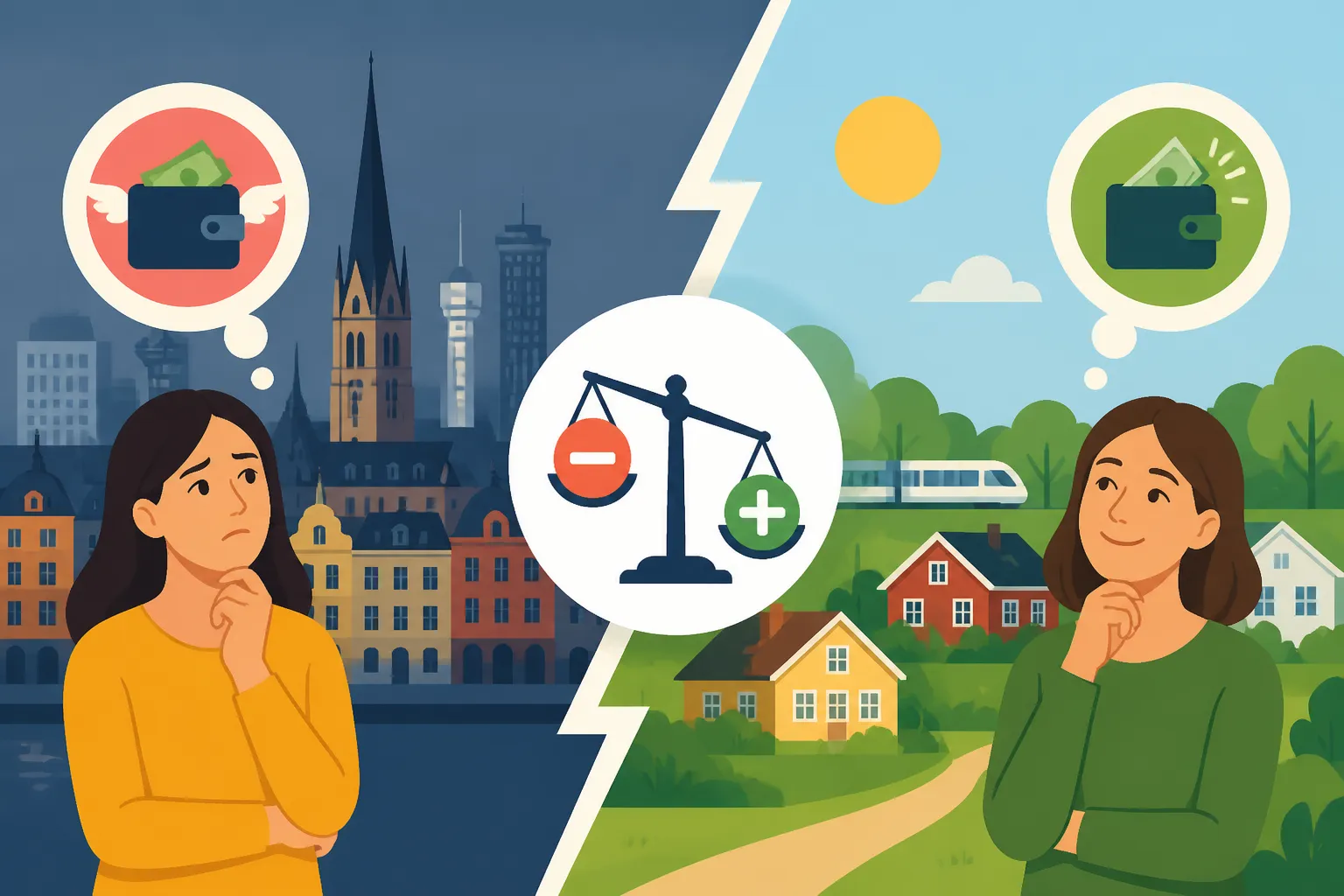
Ultimately, moving outside central Stockholm is a trade-off. It’s almost certainly cheaper financially, but you exchange that for potentially longer commutes and a different pace of life. Carefully consider what you prioritize: maximum savings, urban buzz, family space, or something in between.
Here's a quick comparison to help you visualize the differences:
| Feature | Central Stockholm (e.g., Södermalm, Vasastan) | Outer Suburbs / Commuter Towns (e.g., Huddinge, Uppsala) |
|---|---|---|
| Rent (1-BR) | 15,000 – 25,000+ SEK/month | 7,000 – 15,000 SEK/month |
| Property Price (1-BR) | 3,000,000 – 5,000,000+ SEK | 1,800,000 – 3,500,000 SEK |
| Commute Time to T-Centralen | 0-15 minutes (walk/short metro) | 30-60+ minutes (metro/commuter train/bus) |
| Public Transport Cost | Often minimal (walking/cycling) | Essential, monthly pass ~1,000-1,100 SEK |
| Amenities & Culture | Abundant, diverse, vibrant, spontaneous | Good local options, but fewer, requires planning for city |
| Green Space | Limited, usually parks/waterfront | Often extensive, forests, lakes, larger parks |
| Community Feel | More transient, international, fast-paced | More local, family-oriented, quieter |
| Access to First-Hand Contracts | Extremely difficult, long queue | Difficult, but potentially more second-hand options |
This table provides a generalized overview, and individual experiences will vary, but it highlights the core differences you can expect. For further reading on rentals, you might also find our guide Renting a Home in Sweden: How the First- and Second-Hand System Works useful.
Disclaimer
The information provided in this guide is for general informational purposes only and does not constitute professional advice. While we strive to ensure the information is up-to-date and accurate, regulations and market conditions in Sweden can change rapidly. Always consult with relevant official authorities, real estate agents, or financial advisors for specific guidance pertaining to your individual situation.