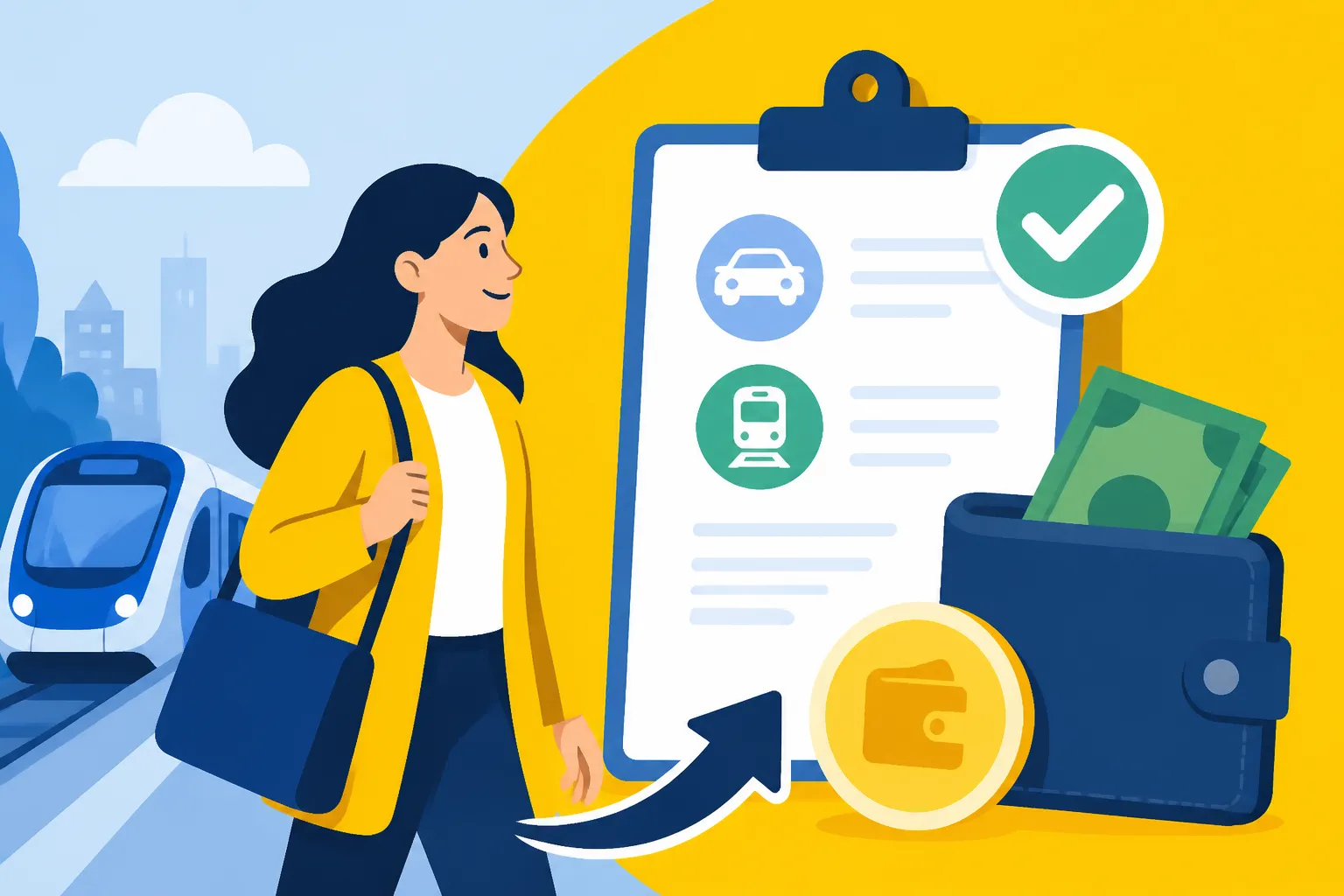
Claiming the Travel Deduction (Reseavdrag) on Your Swedish Taxes
Commuting in Sweden is rarely cheap, whether you are navigating the Stockholm metro system or driving through the snowy landscapes of Norrland. Many international residents view these costs as an unavoidable drain on their monthly budget, unaware that the Swedish tax system offers a significant relief mechanism known as Reseavdrag. This guide explains how to navigate the complex rules of travel deductions to ensure you are not overpaying on your annual tax bill.
Understanding the Fundamental Logic of Reseavdrag
The Swedish tax system is built on the principle that expenses necessary for earning an income should be deductible. However, unlike business expenses that are deducted in full, the travel deduction for individuals is designed to cover only the "extraordinary" portion of your commuting costs. In Sweden, the government expects you to shoulder a baseline amount of your travel expenses yourself. As of the current tax year, this threshold is set at 11,000 SEK. This means you can only deduct the portion of your total annual commuting costs that exceeds this amount.
For a veteran expat, the first time you see your pre-filled tax return, it can be a bit of a shock to realize that Skatteverket (the Swedish Tax Agency) does not automatically know how you get to work. While How Your Swedish Tax Return Is Pre-Filled by Skatteverket is incredibly efficient for salary and interest data, the travel section is almost always left blank for you to complete. This is because the agency has no way of knowing if you biked, took the bus, or drove a fuel-heavy SUV to your office.
If you are just starting to wrap your head around the broader financial landscape, it is helpful to look at Money and Finance in Sweden: A Complete Guide for Foreigners (2027) to see how these deductions fit into your overall fiscal responsibilities. The Reseavdrag is not a "refund" in the sense that you get the full amount back in cash; rather, it reduces your taxable income. If you earn 500,000 SEK and have a 10,000 SEK deduction, you are only taxed on 490,000 SEK. The actual "cash in hand" benefit depends on your municipal tax rate.
Qualifying for Public Transport Deductions
For most expats living in major cities like Stockholm, Gothenburg, or Malmö, public transport is the primary mode of commuting. The rules for deducting these costs are relatively straightforward but require diligent record-keeping. To qualify, the distance between your home and your workplace must be at least two kilometers. While this sounds like a low bar, the 11,000 SEK threshold is the real hurdle.
Consider a typical scenario: You live in Solna and work in central Stockholm. You buy a monthly SL pass, which currently costs around 1,020 SEK. Over twelve months, your total expenditure is 12,240 SEK. Since the deduction only applies to the amount above 11,000 SEK, your actual deduction would be a mere 1,240 SEK. For many city dwellers, this small amount might feel like it isn't worth the paperwork, but every krona counts when you are balancing the high cost of living.
However, if you are commuting between cities—for example, living in Uppsala and working in Stockholm—your costs will be significantly higher. An SJ regional monthly pass can easily exceed 2,500 SEK. In this case, your annual cost would be 30,000 SEK, leading to a deduction of 19,000 SEK. This level of deduction can lead to a substantial tax refund. It is essential to understand The Swedish Tax System Explained: Rates, Returns, and Filing to ensure you are categorizing these costs correctly. Always keep your digital receipts or keep a log of your monthly card purchases in your banking app, as Skatteverket can and does perform spot checks.
The Complex World of Private Vehicle Deductions
The rules for claiming a deduction for using your own car are much stricter than those for public transport. Skatteverket's default position is that you should use public transport if it is available. To claim car expenses, you must meet two primary criteria. First, the distance between your home and your workplace must be at least five kilometers. Second, and most importantly, using a car must save you at least two hours of total travel time per day compared to using public transport.
This "two-hour rule" is the source of much frustration for expats. If the bus takes 60 minutes each way and driving takes 25 minutes each way, your total daily saving is 70 minutes. In the eyes of the Swedish taxman, this is not enough to justify a car deduction, even if the bus is unreliable or crowded. You must prove that the car saves you a full 120 minutes across the round trip. There are exceptions, such as if you use the car for work during the day or if there is no public transport available at all, but these require specific documentation.
The deduction rate for cars is fixed by the government. Currently, for the 2024 and 2025 tax years, the rate is 25 SEK per 10 kilometers for your own car. If you have a company car (förmånsbil), the rates are lower: 12 SEK per 10 kilometers for diesel or petrol, and 9.50 SEK per 10 kilometers for fully electric vehicles. If you are confused about how these rates apply to your specific situation, you might ask Can I Deduct Commuting Costs on My Swedish Taxes? to get a clearer picture of the current figures.
Calculating Car Deductions: A Hypothetical Example
Let’s look at a realistic scenario for a worker living in a more rural area or a suburb with poor connections.
| Factor | Detail |
|---|---|
| Daily Distance (Round Trip) | 60 km |
| Working Days per Year | 220 days |
| Total Annual Distance | 13,200 km |
| Deduction Rate (Private Car) | 2.50 SEK / km |
| Total Calculated Cost | 33,000 SEK |
| Threshold Subtraction | -11,000 SEK |
| Final Claimable Deduction | 22,000 SEK |
In this case, the individual would enter 22,000 SEK in the appropriate box on their tax return. If their local tax rate is 30%, this deduction would result in a tax saving of approximately 6,600 SEK. For those with complex international tax obligations, such as US citizens living in Sweden, using a service like Taxes for Expats can be invaluable for ensuring these local Swedish deductions are correctly reported and don't conflict with home-country requirements.
Special Circumstances: Double Housing and Home Travel
Sweden has a specific set of rules for "Hemresor" (home travel) and "Dubbel bosättning" (double housing). This often applies to expats who may have been recruited to a job in a different city and haven't yet moved their family, or those who maintain a residence in another part of the country for work purposes. If you work in a location that requires you to stay overnight away from your primary home, you can often deduct the cost of one trip home per week.
The distance for home travel must be more than 50 kilometers. The deduction is usually based on the cheapest mode of transport, which is typically second-class rail. However, if no public transport is available, car rates can be applied. Navigating these specific rules can be daunting, so it is worth checking Filing Your Swedish Tax Return (Deklaration): What You Need to Know for a deeper dive into the specific forms required.
Double housing deductions are even more generous but come with a time limit (usually two years for single people and up to five years for those with families). You can deduct the cost of your "work" accommodation and a flat rate for increased living expenses (måltider och småutgifter) for the first month. These rules are designed to ease the administrative and financial burden of labor mobility within Sweden, but they require a "Personnummer" to be fully accessible. If you are still in the process of settling, refer to Income Tax in Sweden: Municipal, State, and the SINK Regime to see how your residency status affects these claims.
How to Submit Your Claim and Use Digital Tools
The actual process of claiming the Reseavdrag is done during the annual "Deklaration" period, typically between mid-March and early May. Most residents use the Skatteverket e-service. To do this, you absolutely need Getting BankID: Sweden's Essential Digital Identity, which serves as your digital signature.
When you log in to the Skatteverket portal, you will see a section for "Avdrag – Resor till och från arbetet." You don't need to send in your receipts at this stage. You simply enter the total calculated deduction (the amount above 11,000 SEK). Skatteverket's system often has a built-in calculator that helps you determine if you meet the two-hour rule for cars. It will ask for your home address, work address, and the time it takes via public transport versus a car.
If you are expecting a significant refund and plan to move that money internationally—perhaps to pay off a student loan back home or invest in a different currency—services like Wise are highly recommended. Wise allows you to receive your SEK refund into a local-tier account and then convert it at the mid-market rate, avoiding the heavy hidden fees often charged by major Swedish banks like SEB or Swedbank.
Common Mistakes and How to Avoid an Audit
The most common mistake expats make is failing to account for days they didn't actually commute. You cannot claim travel deductions for days you worked from home (VOB/VAB), were on sick leave, or were on vacation. Skatteverket assumes a standard working year of about 210 to 230 days, but if you claim 250 days and your employer's records show you worked remotely three days a week, you will likely trigger an audit.
Another pitfall is claiming the car deduction without a "Körjournal" (mileage log). If Skatteverket decides to review your claim, they will ask for a detailed log showing the dates, distances, and purposes of your trips. They might also ask for service records from your mechanic to verify the odometer readings. If you cannot provide this, your deduction will be denied, and you may face a "skattetillägg" (tax penalty) of up to 40% of the avoided tax.
For those who are unsure about the specifics of their situation, it is always better to be conservative. You can find more details in How Do I Add Deductions to My Swedish Tax Return? to ensure you are following the latest procedural updates. Remember that What Is Preliminärskatt and How Is It Calculated? explains how your tax is taken out throughout the year; the Reseavdrag is your chance to correct that balance at the end.
The Impact of the 2026 Salary Threshold and Tax Changes
As we look toward 2026, there are ongoing discussions in the Riksdag regarding the adjustment of the 11,000 SEK threshold to account for inflation and the rising cost of fuel. While the core logic of the Reseavdrag remains stable, the specific "per kilometer" rates are reviewed annually. It is vital for expats to stay updated on these shifts, especially if their commute is a major part of their monthly expenditure.
Furthermore, for those on specific visa types, it is important to ensure that claiming high deductions doesn't inadvertently lower your reported "taxable income" below any requirements set by Migrationsverket for permit renewals. While generally not an issue for the travel deduction, it’s a nuance that veteran expats always keep in the back of their minds.
By taking the time to understand the Reseavdrag, you are participating in a quintessential Swedish ritual: the careful, methodical optimization of one's relationship with the state. It may seem like a lot of work for a few thousand kronor, but in a country with high taxes, taking advantage of every legal deduction is not just smart—it's expected.
Disclaimer
This guide is intended for informational purposes only and does not constitute professional tax or legal advice. Tax laws and deduction rates in Sweden are subject to change. Always consult with Skatteverket or a qualified tax professional regarding your specific financial situation.