Pensions in Sweden: The Public, Occupational, and Private Layers
Moving to Sweden is an adventure, but let's be honest, it often feels like an administrative maze, especially when it comes to things like pensions. You've landed in a new country, you're trying to figure out your day-to-day, and then someone mentions "pensions," and your eyes glaze over. This comprehensive guide is here to untangle the Swedish pension system, explaining its various layers – public, occupational, and private – so you can feel confident about your financial future, whether you plan to stay long-term or just for a few years.
Demystifying the Swedish Pension System for Newcomers
Navigating any country's pension system as a foreigner can be daunting, and Sweden is no exception. It’s a system built on several interconnected parts, which can be confusing even for natives, let alone those of us who are still mastering "fika" etiquette. But fear not, my fellow expat! With a little patience, we can break it down.
The Three Pillars: A Quick Overview
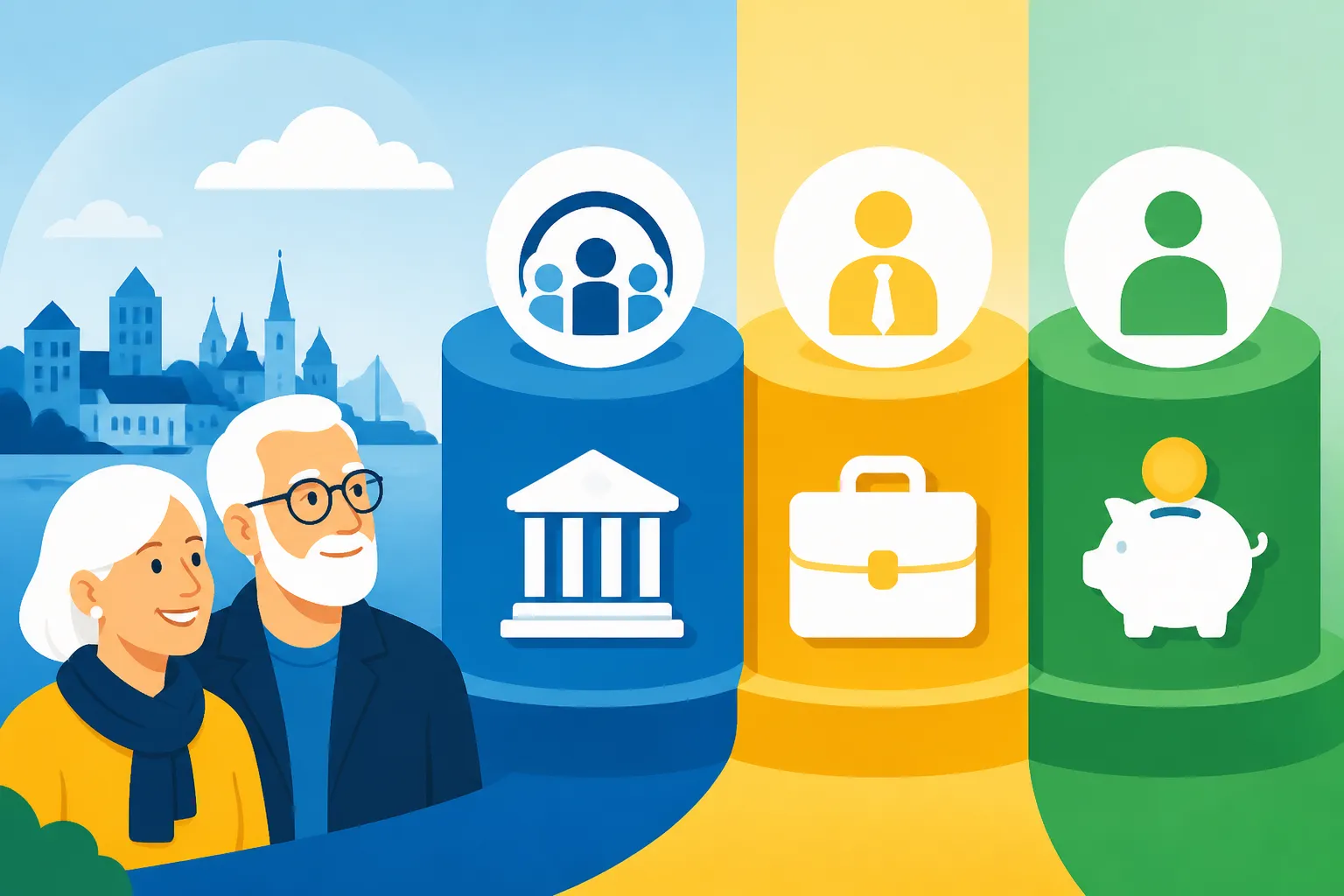
At its core, the Swedish pension system is often described as having three main "pillars," each contributing to your total retirement income. Think of it like building a sturdy house: you need a strong foundation, solid walls, and a good roof to protect everything.
First, there's the public pension (allmän pension). This is the foundation, entirely managed by the state's Pensionsmyndigheten (Swedish Pensions Agency). It’s financed by taxes on your income, and it's the part that almost everyone who works or lives in Sweden for a certain period will be entitled to. It consists of an income-based component and a premium pension component, where you get to choose how a small portion of your contributions are invested. There’s also a guarantee pension for those with little or no income-based pension.
Second, we have the occupational pension (tjänstepension). This is like the sturdy walls of your retirement house. It's paid by your employer as part of your employment benefits, negotiated through collective agreements (kollektivavtal) between unions and employer organizations. Most Swedish employees benefit from an occupational pension, and it can make a significant difference to your retirement income. Many expats, especially those coming from countries where employer-provided pensions aren't as prevalent or are managed differently, might find this a pleasant surprise – or another layer of complexity to understand.
Finally, there's private pension savings (privat pensionssparande). This is your roof, providing extra shelter and comfort. This layer is entirely up to you and is about any additional savings you choose to make personally for your retirement, beyond what the public and occupational systems provide. These could be through various investment vehicles, and they offer flexibility and the potential for greater returns, but also come with their own set of considerations, particularly regarding taxes.
Why Understanding Your Pension is Crucial as an Expat
For many of us, the immediate focus upon arriving in Sweden is simply to get settled: finding a job, securing housing, and navigating the complexities of getting your Personnummer and BankID. These are, of course, absolutely vital first steps. However, pushing pension planning to the back burner can be a costly mistake.
As an expat, your working life might span multiple countries, each with its own pension rules. Understanding the Swedish system from the outset helps you make informed decisions that can significantly impact your financial well-being later on. For instance, knowing how your earnings contribute to the public pension allows you to track your eligibility, and understanding occupational pensions helps you evaluate job offers comprehensively. Furthermore, if you’re planning on a shorter stay, understanding how your pension rights might be affected when you leave Sweden is critical. It also empowers you to ask the right questions of your employer, your bank, and Pensionsmyndigheten. Don't leave your future to chance; take control of your pension planning early.
The Public Pension (Allmän Pension): Your Foundation in Sweden
The public pension system, or allmän pension, forms the bedrock of retirement income for most people in Sweden. It's a universal system designed to provide basic financial security in old age, funded by the taxes you pay on your income throughout your working life. Understanding this component is the first step to truly grasping your pension landscape in Sweden.
Earning Rights: How Your Income Contributes
Every year you work and pay taxes in Sweden, you accumulate pension rights. It's quite straightforward: a portion of your income, specifically 18.5% of your annual pensionable income (up to a certain income ceiling), is allocated to your public pension. This isn't money you see directly, but it's recorded against your name and forms the basis of your future pension. This amount is split between the income pension and the premium pension.
The income ceiling for pensionable income is a crucial detail for many higher earners. As of 2024, pension contributions are calculated on income up to 8.07 income base amounts (inkomstbasbelopp), which translates to an annual income of approximately 599,300 SEK. If you earn more than this, any income above the ceiling does not contribute to your public pension. This is a common point of confusion for those from countries with unlimited pension contributions. It means that if you're a high earner, a larger portion of your retirement planning might need to come from the occupational or private pillars.
It's not just your salary that counts; unemployment benefits, parental leave payments (föräldrapenning), and sickness benefits (sjukpenning) also contribute to your public pension, ensuring that periods of life that aren't spent in active employment still build towards your retirement. This is a testament to the Swedish welfare state's comprehensive approach to social security. For a deeper dive into this, you might find our guide on How Sweden's Public Pension (Allmän Pension) Is Built particularly helpful.
The Income Pension (Inkomstpension) Explained
The inkomstpension, or income pension, is the largest component of your public pension. It accounts for 16% of your pensionable income each year. This money doesn't sit in an individual account accumulating interest like a savings account. Instead, it's part of a pay-as-you-go system. What you contribute, along with everyone else, is used to pay the pensions of current retirees. In turn, when you retire, your pension will be paid by the contributions of the working generation at that time.
The value of your income pension is determined by your accumulated pension rights over your working life, adjusted for inflation and the general economic development of Sweden. It's designed to reflect your lifetime earnings; the more you've earned and contributed, the higher your income pension will be. This system aims for intergenerational solidarity, ensuring a baseline for everyone, while still rewarding higher earners. It's a vital part of the overall allmän pension framework, directly linking your working contributions to your retirement benefits.
The Premium Pension (Premiepension) and Your Choices
The premiepension, or premium pension, is the more unique and interactive part of the public pension. While the income pension is largely passive on your part, the premium pension (which makes up 2.5% of your 18.5% annual contribution) offers you a degree of personal choice. Instead of being part of the pay-as-you-go system, this 2.5% is invested in funds.
When you start contributing, you'll be given the option to choose from a vast array of approved funds managed by various financial institutions. If you don't make an active choice, your money will automatically be placed in a default fund, AP7 Såfa, which is managed by the state and is generally considered a good, low-fee option that adjusts its risk profile as you age.
Making choices for your premium pension can feel overwhelming, especially with hundreds of funds available. It's worth considering your risk tolerance, investment horizon, and ethical preferences. You can switch funds at any time, free of charge, through Pensionsmyndigheten's website. For expats, this is an area where a little research can go a long way, as active management can potentially boost your pension pot. You can even consider seeking advice from a financial advisor or checking resources like Avanza or Nordnet for comparison, though remember, they are investment platforms and not pension advisors.
The Guarantee Pension (Garantipension): A Safety Net
The garantipension, or guarantee pension, serves as a crucial safety net within the Swedish public pension system. It's designed to provide a basic income for those who have had little or no income-based pension (inkomstpension) during their working lives in Sweden. This could be due to low earnings, periods of unemployment, or having lived and worked in Sweden for a relatively short time.
Unlike the income and premium pensions, the guarantee pension is not based on your earned income or contributions. Instead, it's a needs-based benefit, meaning its eligibility and amount depend on your other pension income and how long you've lived in Sweden. To be eligible, you generally need to have lived in Sweden for at least three years, and the full guarantee pension usually requires 40 years of residency in Sweden between the ages of 16 and 64. If you've lived in Sweden for a shorter period, the guarantee pension will be reduced proportionally.
This component is particularly relevant for new arrivals and expats who might not accumulate substantial income or premium pension rights during their stay. It ensures that even with limited working history in Sweden, there's a minimum level of financial support in retirement. It's an important aspect of the Swedish social welfare model, aiming to prevent poverty among retirees, regardless of their work history.
Occupational Pension (Tjänstepension): The Employer's Contribution
Beyond the public pension, the tjänstepension, or occupational pension, is the second vital pillar of your retirement income in Sweden. For many, this employer-sponsored pension will form a significant portion of their total pension benefits, often even exceeding the public pension. It’s a standard benefit in Swedish employment, so if you're working in Sweden, it’s highly probable your employer is contributing to one.
Understanding Collective Agreements (Kollektivavtal)
The vast majority of occupational pensions in Sweden are governed by collective agreements (kollektivavtal). These are agreements negotiated between trade unions (fackförbund) and employer organizations, covering broad sectors of the Swedish labor market. If your workplace has a collective agreement – and most do – then your employer is legally bound to provide an occupational pension according to its terms.
There are four major collective agreement areas for occupational pensions, often referred to by their acronyms: ITP (for privately employed white-collar workers), SAF-LO (for privately employed blue-collar workers), KAP-KL (for municipal and regional employees), and PA 16 (for state employees). Each agreement has its own specific rules regarding contribution levels, eligibility, and investment options. For instance, the ITP agreement typically involves contributions of 4.5% of your salary up to a certain threshold, and 30% on salary above that.
It's crucial to understand which collective agreement, if any, applies to your employment. This information is usually detailed in your employment contract or can be obtained from your HR department or the union representative at your workplace. For more on this, check out our guide on Occupational Pension (Tjänstepension): The Employer Layer Explained. Knowing this information empowers you to understand your benefits and ensures your employer is fulfilling their obligations.
Different Plans and How They Work
Within each collective agreement, there are generally different types of occupational pension plans. The most common types are defined contribution plans (avgiftsbestämd pension) and, less frequently for newer employees, defined benefit plans (förmånsbestämd pension).
In a defined contribution plan, your employer pays a fixed percentage of your salary into a pension scheme each month. This money is then invested, and the size of your pension at retirement depends on how much has been contributed and how well the investments have performed. You usually have a choice of insurance companies and funds to invest your contributions in, similar to the premium pension within the public system. This offers flexibility and potential for growth but also means you bear the investment risk.
Defined benefit plans, on the other hand, guarantee a certain level of pension income upon retirement, often based on your final salary and years of service. These are becoming less common, especially for new hires, as they place a greater financial risk on the employer. If you started your career in Sweden some time ago, you might be covered by such a plan.
Your occupational pension is typically managed by an insurance company chosen by your employer or through the collective agreement. You'll usually receive annual statements detailing your contributions and the performance of your investments. Don't simply file these away! Take the time to review them and ensure everything is correct.
What Happens When You Change Jobs?
One of the excellent aspects of the Swedish occupational pension system is its portability. Generally, your accumulated occupational pension benefits are yours, even if you change jobs. This means that if you switch employers, the money your previous employer contributed remains invested for your retirement.
If your new employer also has an occupational pension scheme (which is highly likely), you'll start accumulating new pension rights with them. It's important to clarify the specifics with each new employer, especially if they are not covered by a collective agreement, as their pension offering might differ. Some employers might offer a "non-collective agreement" pension (kollektivavtalsfri tjänstepension), which can be good, but it's essential to scrutinize the terms and conditions, as they might not offer the same security or cost efficiency as those under a collective agreement.
When moving between jobs, you might also have the option to transfer your occupational pension capital between different providers. This decision should be made carefully, considering fees, investment options, and any guarantees that might be in place. Don't rush into transferring; take the time to understand the implications. Your pension is a long-term asset, and moving it carelessly could impact its growth.
Private Pension Savings (Privat Pensionssparande): Boosting Your Future
While the public and occupational pensions lay a strong foundation, many expats find that private pension savings become an increasingly important component of their overall retirement strategy in Sweden. This is particularly true for high-income earners whose public pension contributions are capped, or for those who plan to work in Sweden for a limited time.
Why Private Savings are Important
For individuals who earn above the public pension ceiling, any income beyond that threshold doesn't contribute to their public pension. This creates a "gap" that, if not addressed through occupational or private means, could lead to a significant drop in income during retirement. Furthermore, if you envision a higher standard of living in retirement than the public and occupational pensions alone might provide, private savings are essential.
Expats, in particular, often have fragmented career paths across different countries. This means they might not accumulate full pension rights in any one country, making supplementary private savings even more crucial. These savings offer flexibility and control, allowing you to tailor your investments to your personal risk profile, financial goals, and timeline for retirement. It also provides a buffer against potential changes in public pension policies or unexpected life events. Thinking about how your money will translate across borders is also important; services like Wise can be invaluable for managing international finances, including when you eventually need to access your retirement funds abroad.
Common Private Saving Vehicles: ISK and Capital Insurance
In Sweden, there are several popular and tax-efficient ways to save privately for your retirement. The two most common are the Investment Savings Account (Investeringssparkonto, ISK) and Capital Insurance (Kapitalförsäkring).
An ISK account is designed to simplify investing in stocks, funds, and other financial instruments. The main benefit is its favourable tax treatment: instead of paying capital gains tax on each sale, you pay a standardized, low annual tax based on the estimated value of the assets in your account, regardless of whether they went up or down. This calculation is based on the government's borrowing rate, plus a risk premium. For many, this means less administrative hassle and often lower overall taxes compared to traditional securities accounts, especially for those who trade frequently. You can open an ISK with most major banks and investment platforms like Avanza or Nordnet. Our guide, The ISK Account: Sweden's Tax-Smart Way to Invest, offers a more detailed explanation.
A Capital Insurance (Kapitalförsäkring) is another popular vehicle, often used for long-term savings, including pensions. Similar to an ISK, it also benefits from a simplified annual taxation based on a standardized return, rather than individual capital gains. A key difference is that a capital insurance policy is a type of insurance product, and the underlying investments are owned by the insurance company, not directly by you. This might offer certain benefits, such as designated beneficiaries that fall outside probate, or the ability to withdraw funds over a set period during retirement. However, it's essential to compare fees and investment options carefully with an ISK.
Tax Implications of Private Pension Savings
Understanding the tax implications of your private pension savings is paramount. With both ISK and Kapitalförsäkring, the main tax advantage lies in the simplified annual taxation mentioned above. This typically means you avoid the 30% capital gains tax on profits from selling investments within these wrappers.
However, it's important to remember that this simplified tax applies to the return on your investments, not necessarily to the contributions you make. Direct deductions for private pension contributions have largely been phased out in Sweden. This means you contribute to private savings with already taxed income. When you eventually withdraw money from your ISK or Kapitalförsäkring in retirement, these withdrawals are generally tax-free, as the annual standardized tax has already been paid.
For expats, the tax situation can become more complex, particularly if you are also tax resident in another country or plan to return to your home country in retirement. You might need to consider how your private Swedish savings will be treated under your home country's tax laws and any double taxation agreements Sweden has in place. Consulting with specialists like Taxes for Expats or a local financial advisor with international expertise is highly recommended to ensure you're optimizing your savings strategy and avoiding unexpected tax liabilities.
Navigating Your Pension: Tools and Information
Understanding the theory behind the Swedish pension system is one thing, but knowing how to access your personal information and forecast your future retirement income is another. Fortunately, Sweden offers robust digital tools and resources to help you keep track of your pensions. These platforms are designed to provide transparency and empower you to make informed decisions.
Pensionsmyndigheten: Your Go-To Resource
Pensionsmyndigheten, the Swedish Pensions Agency, is the central authority for all things related to the public pension system. This is your primary point of contact for information, questions, and managing your public pension. Their website is a treasure trove of information, and while much of it is in Swedish, they do offer some resources in English, and modern browser translation tools can be a lifesaver.
Through Pensionsmyndigheten's website, you can:
- Track your public pension: See your accumulated income and premium pension rights.
- Make premium pension fund choices: Change your premium pension funds or opt for the default fund.
- Apply for different pension benefits: When the time comes, this is where you apply for your public pension.
- Access personalized forecasts: Get an estimate of your future public pension.
It's a good habit to visit their site annually, or whenever you have questions about your public pension. They also handle the garantipension and other benefits related to retirement. For more in-depth information on how to navigate this agency, our guide on How Do I Check My Pension Forecast on Pensionsmyndigheten? is a great starting point.
The Orange Envelope (Orange Kuvert): What It Tells You
Every year, around January or February, millions of Swedes eagerly (or perhaps dreadfully) await the arrival of their Orange Envelope (Orange Kuvert) from Pensionsmyndigheten. This isn't just any piece of mail; it's your personalized annual statement detailing your accumulated public pension rights.
The Orange Envelope provides a snapshot of:
- Your total public pension balance: How much has been contributed to your income and premium pension.
- A forecast of your future public pension: An estimate of what you can expect to receive monthly when you retire, based on current rules and assumptions about your future earnings.
- Information about your premium pension funds: How your chosen (or default) funds have performed.
While the physical envelope is still sent, you can also access this information digitally through Pensionsmyndigheten's website, usually via BankID. For expats, this document is invaluable for understanding your progress towards a Swedish pension and for integrating it into your broader international retirement planning. Don't ignore it – it's a vital health check for your retirement finances.
Using the "Min Pension" Portal
Beyond the Orange Envelope, there's an even more powerful tool: Min Pension (My Pension). This is a unique, collaborative online service that brings together information from Pensionsmyndigheten and various private pension providers, including those managing your occupational and private pensions.
Once you log in to Min Pension using your BankID, you get a comprehensive overview of all your pension savings in Sweden – public, occupational, and private (if reported by your provider). This means you don't have to log into multiple platforms to get the full picture.
With Min Pension, you can:
- See your total projected pension: Get a combined estimate of all your Swedish pensions.
- Run "what if" scenarios: Adjust factors like your retirement age or future income to see how it impacts your pension.
- Identify any gaps: See if your current savings are on track to meet your retirement goals.
- View detailed information: Access specifics about each of your pension accounts.
Min Pension is an indispensable resource for anyone planning their retirement in Sweden, especially expats who might have contributions from multiple employers and different types of schemes. It's the closest thing to a "one-stop shop" for your Swedish pension information and helps you connect the dots between the various layers of the system.
Special Considerations for Expats and International Workers
As an expat, your pension journey is rarely confined to a single country. This international dimension introduces a layer of complexity that requires careful attention. Sweden, being part of the EU/EEA and having numerous social security agreements, offers various provisions to handle cross-border pension accumulation, but it's essential to understand the specifics.
Pension Rights When Moving To and From Sweden
When you move to Sweden and start working, you begin accumulating rights in the public pension system from your very first paycheck, provided you meet the requirements for being covered by Swedish social security. This generally involves being registered in the population register (folkbokförd) and having a Personnummer, which is the gateway to Swedish healthcare and many other benefits. For more on this, check out our guide on Getting Your Personnummer: The Gateway to Swedish Healthcare. Even if you don't get a Personnummer immediately but are working and paying taxes, you may still accrue pension rights, often through a Samordningsnummer (coordination number), though getting your Personnummer is always the smoother path.
The crucial question for many expats is: what happens to these rights if I leave Sweden?
- Public Pension: Your accumulated income pension and premium pension rights are generally preserved, regardless of where you move. When you reach retirement age, you can apply to Pensionsmyndigheten to receive your Swedish public pension, even if you live abroad.
- Occupational Pension: These are also generally portable. The funds your employer contributed remain invested, and you can access them at retirement age according to the terms of the specific plan.
- Private Pension Savings: Your private savings (e.g., in an ISK or Kapitalförsäkring) are entirely yours and can be accessed or transferred according to the rules of the account and any international regulations.
However, the amount you receive might be reduced if you haven't accumulated sufficient years of contributions, particularly for the guarantee pension, which often requires longer residency. This is a common concern for short-term expats, and it's a topic we cover in more detail in our article, Will I Get a Swedish Pension If I Only Work Here a Few Years?
Transferring Pension Rights from Other EU/EEA Countries
One of the significant advantages of Sweden being an EU/EEA member state is the coordination of social security systems. If you've worked in other EU/EEA countries, Switzerland, or the UK (post-Brexit, with specific agreements), your periods of work and social security contributions in those countries can often be taken into account when calculating your eligibility for a Swedish pension, particularly for the guarantee pension.
You won't typically transfer the actual pension capital itself between countries, but rather your periods of insurance. When you apply for your pension in Sweden (or your last EU/EEA country of residence), the relevant authorities will communicate with each other to ensure all your contributions are considered. This helps prevent individuals from losing out on pension rights due to working in different member states. If you're coming from another EU/EEA country, understanding how to utilize your EHIC for care while settling into Sweden might be a related topic to ensure full social security coverage.
Double Taxation Agreements and International Pensions
For expats, the issue of double taxation on pension income can be a real headache. Fortunately, Sweden has an extensive network of double taxation agreements (DTAs) with many countries around the world. These agreements are designed to prevent you from being taxed twice on the same income, including pension income.
The specifics of how pension income is taxed when you retire and live in a different country will depend entirely on the DTA between Sweden and your country of residence. Some agreements might stipulate that the pension is taxed only in the country where you reside, while others might allow for taxation in the country that paid the pension, or a combination. It's not always straightforward, and misunderstandings can lead to unexpected tax bills.
This is an area where seeking expert advice is not just recommended, but often essential. Specialist services, such as Taxes for Expats, can provide invaluable guidance on navigating these cross-border tax complexities, helping you understand your obligations and entitlements. They can help ensure that when you eventually receive your pension, you're not paying more tax than necessary.
Non-EU Citizens and Pension Accumulation
For non-EU/EEA citizens, the rules for pension accumulation and transfer can be different, as Sweden's social security agreements with third countries vary widely. While your public and occupational pension rights earned in Sweden are generally preserved regardless of your nationality, the coordination of those rights with your home country's pension system might not be as seamless as within the EU/EEA.
Some countries have bilateral social security agreements with Sweden that facilitate the coordination of pension rights. It's crucial to check if your home country has such an agreement. If not, you'll still retain your Swedish pension rights, but you'll need to manage them as separate entitlements.
For non-EU citizens, long-term residence and the path to permanent residence in Sweden often hinge on consistent employment and contributions. Understanding how your pension contributions fit into your overall long-term financial planning is therefore particularly important. It's worth noting that if you have a short-term residence permit and do not become folkbokförd (registered in the population register), your access to certain public benefits, including some aspects of the pension system, might be limited, though you will still accrue income-based pension rights from your earnings.
| Pension Pillar | Who Contributes? | Basis of Benefit | Flexibility/Choices | Key Considerations for Expats |
|---|---|---|---|---|
| Public Pension | Employer & Employee (via taxes) | Lifetime income-based contributions, plus a guaranteed minimum | Limited (Premium Pension fund choice) | Accrues rights from first paycheck, generally portable upon leaving Sweden. Guarantee pension depends on residency length. |
| Occupational Pension | Employer | Collective agreement terms, usually defined contribution (invested funds) | Often choice of insurance provider/funds | Employer-provided; check collective agreement details. Portable between Swedish employers. |
| Private Pension | Individual | Personal contributions and investment performance | Full control over investments and providers | Crucial for high earners or short-term expats. Tax-efficient wrappers (ISK, Kapitalförsäkring) exist. Double taxation agreements are key. |
Planning for Retirement in Sweden: Actionable Steps
Now that we’ve delved into the intricacies of the Swedish pension system, it’s time to talk about what you can actually do to ensure your financial future is secure. Proactive planning is key, especially as an expat with potentially complex international financial ties.
Early Registration and Personnummer
One of the most fundamental steps to securing your pension rights in Sweden is to get properly registered from the moment you arrive. This means applying for your Personnummer (personal identity number) as soon as you are eligible. Your Personnummer is your gateway to the Swedish social security system, including the seamless accumulation of public pension rights. It links your earnings to your pension account at Pensionsmyndigheten.
Without a Personnummer, while you may still accrue pension rights through a Samordningsnummer (coordination number) if you're working and paying taxes, the administrative process can be more cumbersome, and accessing information or benefits might be delayed. Ensuring you're officially registered in the Swedish population register (folkbokförd) also ensures you're covered by other vital social security systems, such as sick pay and parental benefits, which also contribute to your pension. For guidance on this critical first step, our article on Registering with Försäkringskassan: When and Why You Need To provides essential information. The earlier you get this sorted, the more smoothly your pension journey in Sweden will be.
Reviewing Your Pension Statement Regularly
Don't let your pension statements gather digital dust! Whether it's the annual Orange Envelope from Pensionsmyndigheten or statements from your occupational and private pension providers, make it a habit to review them thoroughly. These documents are not just bureaucratic mail; they contain vital information about your accumulated rights, investment performance, and future projections.
Regular review allows you to:
- Verify contributions: Ensure that your employer is making the correct contributions to your occupational pension.
- Assess investment performance: For your premium pension and occupational pension where you have fund choices, see how your investments are performing.
- Track your progress: Monitor whether you're on track to meet your retirement income goals.
- Identify discrepancies: Catch any errors or omissions early on.
If anything looks incorrect or unclear, don't hesitate to contact Pensionsmyndigheten or your occupational pension provider. Early detection of issues can save a lot of headaches down the line. It's your money, and you have every right to understand how it's being managed.
Seeking Financial Advice
While this guide provides a comprehensive overview, the nuances of personal finance, especially with an international dimension, can be complex. Seeking professional financial advice is highly recommended, particularly for expats. A qualified advisor can help you:
- Integrate your international pension assets: If you have pensions from multiple countries, an advisor can help you understand how they all fit together.
- Optimize private savings: Help you choose the most suitable private investment vehicles based on your risk tolerance and goals.
- Navigate tax implications: Provide guidance on double taxation agreements and how your pension income will be taxed.
- Plan for different scenarios: What if you leave Sweden early? What if you stay long-term? An advisor can help model these possibilities.
Look for advisors who specialize in expat finances or have a strong understanding of international tax and pension rules. While many Swedish banks offer financial advisory services, they might not always have the deep international expertise required for complex expat situations. Sometimes, it's worth investing in independent advice to ensure your strategy is truly tailored to your unique circumstances.
Common Expat Questions and Misconceptions
It’s natural to have a myriad of questions when trying to understand a new country’s pension system, especially when you come from a different background. Let's tackle some of the most frequently asked questions and clear up a few common misconceptions that expats often encounter regarding pensions in Sweden.
Will I Get a Swedish Pension If I Only Work Here a Few Years?
This is perhaps one of the most common questions, and the answer is generally yes, you will get a Swedish pension, but the amount will depend significantly on how long you've worked and what you've earned.
Disclaimer
This article is for general informational purposes only and does not constitute professional advice. Laws, prices and regulations vary by location and change over time. Consult a qualified professional for guidance on your specific situation.