How Does Mail and Parcel Delivery Work in Sweden?
You’ve just arrived in Sweden, you’ve maybe even landed your apartment and secured that all-important Getting Your Personnummer: The Gateway to Swedish Healthcare. Now, what about your mail? It might seem like a trivial thing, but navigating the Swedish postal and parcel delivery system can be surprisingly tricky for newcomers, especially in a country that’s so digital-first and where physical mail delivery operates quite differently from what many expats are used to. This guide will meticulously break down everything you need to know, from receiving official letters to picking up your online shopping.
Understanding the Swedish Postal System: PostNord and Beyond
When you first start thinking about mail in Sweden, you'll quickly hear the name PostNord. They are, without a doubt, the behemoth of the Swedish postal landscape, but they aren't the only player you'll encounter. Understanding who does what will save you a lot of head-scratching.
The Dominant Player: PostNord
PostNord is the primary postal service in Sweden, a joint Danish-Swedish venture that handles the vast majority of traditional mail and a significant chunk of parcel deliveries. Think of them as the national carrier. For decades, they've been the ones dropping letters through your letterbox and delivering packages. However, their operations have undergone some significant changes over the years, mirroring Sweden's broader shift towards digitalization.
What many newcomers find surprising is that letter delivery isn't daily anymore in many areas. Depending on where you live, you might only get mail a few times a week. This can be a bit of a shock if you're used to daily postal services, and it's a testament to how much Swedes rely on digital communication. Official government agencies, banks, and even many companies are increasingly using secure digital mailboxes (like Kivra) or direct digital communication once you have a Getting BankID: Sweden's Essential Digital Identity. Still, important physical mail, like the initial letters from Skatteverket or specific bills, will come via PostNord.
For parcels, PostNord acts as both a direct delivery service and a crucial intermediary. Many international packages, even those initially handled by other carriers in their origin country, will eventually enter the Swedish system through PostNord. This means that even if you ordered something from Amazon or a smaller e-commerce site, you'll often end up interacting with PostNord for its final delivery or pickup. They've also been at the forefront of digital notifications, meaning you'll rarely get a physical "you missed your parcel" slip anymore; it's almost always an SMS or an update in their app.
Other Key Delivery Services and Their Niches
While PostNord is dominant, they're not alone. The Swedish market has a dynamic ecosystem of other logistics and delivery companies, each with its own niche.
For urban dwellers, you might occasionally see CityMail delivering local mail or even some smaller packages. They often operate in larger cities, sometimes even delivering in the early morning alongside newspapers. Then there are the international giants like DHL, UPS, and FedEx, which handle a significant volume of express and business-to-business shipments. If you're receiving something urgent or very valuable from abroad, it might bypass PostNord entirely and arrive directly via one of these couriers.
Domestically, other players like Schenker (DB Schenker), Bring, and newer, more agile services like Instabox and Budbee have carved out substantial market shares, particularly in the e-commerce sector. These companies often specialize in rapid, scheduled deliveries or offer convenient parcel locker solutions (more on those later). While they might not handle your official government mail, they are very common for online purchases, often giving you more choice and flexibility in delivery options at checkout.
The key takeaway here is that while PostNord is your go-to for traditional mail and many parcels, be prepared to interact with several different companies depending on what you're receiving and from where. Each often has its own app and notification system, which can feel like a bit of a digital jungle at first, but you'll soon get the hang of it.
Receiving Mail and Packages: Your Swedish Address and Beyond
Receiving mail in Sweden isn't just about having an address; it's about being properly registered and understanding the various channels your deliveries might take. This is where many newcomers face their first "Welcome to Sweden" moment of administrative peculiarity.
The Importance of Your Registered Address (Folkbokföringsadress)
In Sweden, your official residential address, or folkbokföringsadress, is paramount. This is the address where you are registered with Skatteverket (the Swedish Tax Agency) and it's essentially your legal home. All official correspondence from government bodies like Skatteverket, Försäkringskassan (the Swedish Social Insurance Agency), and Migrationsverket (the Swedish Migration Agency) will be sent to this address. If you're not properly registered, or if your name isn't clearly on the mailbox at your registered address, you're setting yourself up for a world of pain and missed important documents.
It sounds simple, but ensuring your name is visible on your mailbox – whether it's a slot in your door, a box in the hallway, or a cluster of mailboxes outside – is absolutely crucial. PostNord drivers are instructed only to deliver mail if the recipient's name is clearly marked. If your name isn't there, they often won't deliver it, and it will be returned to sender or held. This is particularly important for newcomers who might be subletting or living in temporary accommodation where their name isn't automatically added. Always, always, make sure your full, official name (as registered with Skatteverket) is on that mailbox. If you've just moved, make sure you've completed your Registering Your Move (Flyttanmälan) with Skatteverket to ensure everything is up to date.
Mailbox Delivery vs. Collection Points (Utlämningsställen)
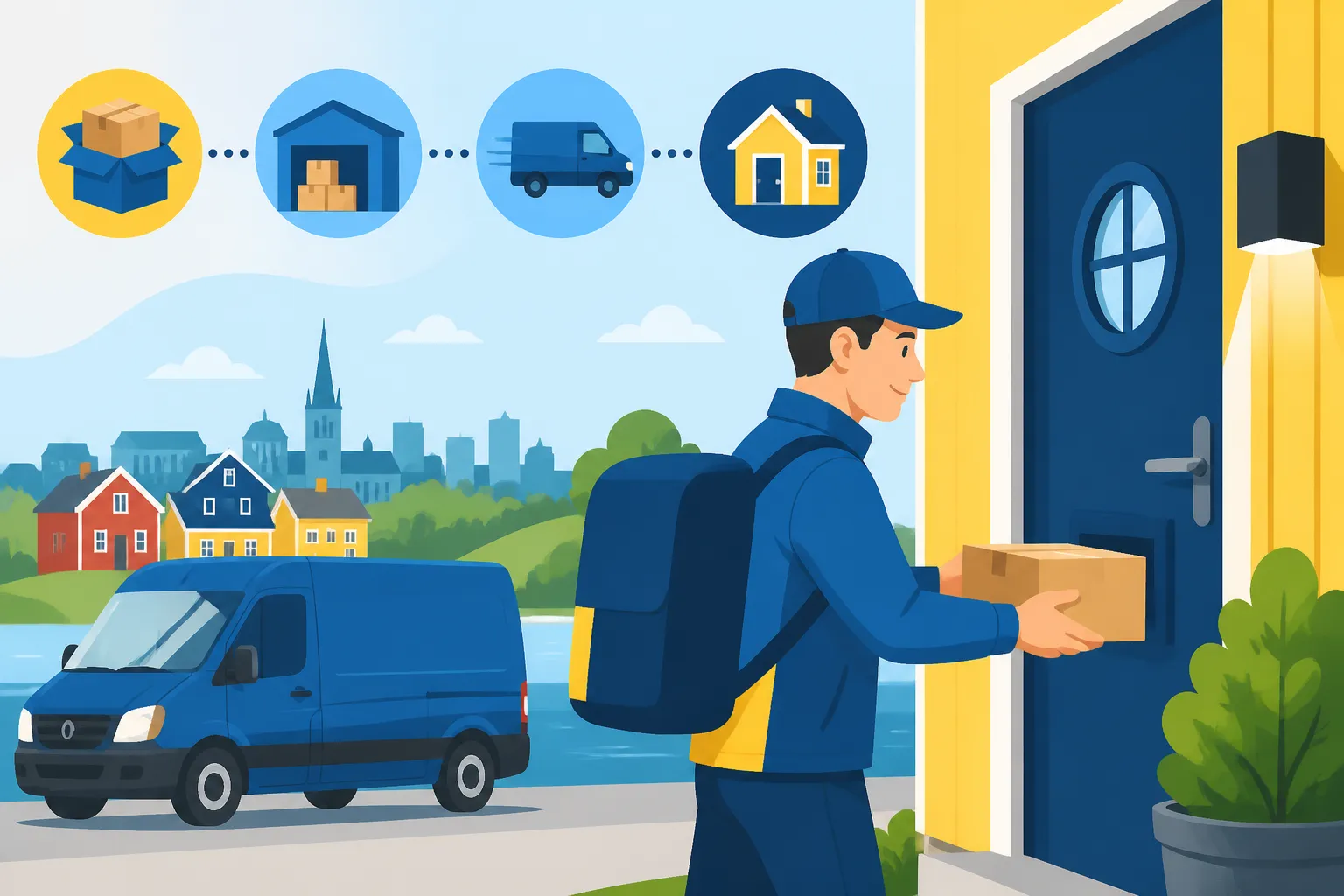
This is perhaps the biggest difference for many coming from countries where parcels are often left on your doorstep. In Sweden, doorstep delivery for parcels is rare, especially for smaller packages that don't fit in your mailbox. Instead, the country operates on an extensive system of utlämningsställen, or collection points.
Standard letters, postcards, and very small, thin packages (that PostNord refers to as "Varubrev") will usually arrive directly in your mailbox, just like normal mail. However, anything larger than a padded envelope, or anything that requires a signature, will almost certainly be sent to a collection point. These utlämningsställen are typically located in local grocery stores (ICA, Coop, Hemköp), convenience stores (Pressbyrån, Direkten), or dedicated PostNord service points.
When a parcel arrives at a collection point, you'll receive a notification. This is almost exclusively done via SMS to the phone number associated with your name and address, or through the PostNord app (or the app of the relevant delivery service, like Instabox or Budbee). Occasionally, for official or non-tracked items, you might still get a physical notification slip (a avi) in your mailbox, but this is becoming rarer. The SMS or app notification will tell you which utlämningsställe your parcel is at and provide a tracking number or a unique pickup code. You typically have about 7-14 days to pick up the parcel before it's sent back to the sender, so don't delay!
It's not uncommon for new arrivals to find themselves receiving a notification for a parcel they didn't even order. This can be confusing, but often it's because someone has accidentally used an old address or made a typo. If you receive a notification for an unknown parcel, simply ignore it. If it’s not yours, it will be returned to the sender after the pickup window expires, and you won’t be liable for anything.
Picking Up Parcels: ID Requirements and Proxies
Okay, so you've received your SMS or app notification that your parcel is ready for pickup. Now what? The process is generally straightforward but requires proper identification.
To pick up a parcel, you'll need:
- Valid Swedish ID: Your Swedish ID card (from Skatteverket) is the gold standard. A Swedish driving license also works. For new arrivals who haven't yet obtained their official Getting a Swedish ID Card After Your Personnummer, your passport is usually accepted, but some smaller utlämningsställen might be less familiar with foreign passports, so be prepared for a potential moment of confusion (though it's rare for major delivery points). It's crucial to get your Swedish ID card as soon as possible, as it simplifies almost all administrative tasks here.
- Pickup Code/Tracking Number: This is usually a string of letters and numbers provided in your SMS or app notification.
The staff at the collection point will scan your ID, confirm your identity, and then retrieve your parcel. Sometimes, they'll ask for your pickup code, other times scanning your ID is enough as the system will show all parcels awaiting you.
What if you can't pick up the parcel yourself? Sweden has a system for proxy pickup, which is incredibly convenient but also requires digital authentication. If someone else (a partner, friend, or family member) is going to pick up a parcel on your behalf, you generally need to authorize them digitally. This is usually done through the PostNord app, where you can select the parcel and "authorize another person" ( ge fullmakt). You'll input their phone number, and they will then receive a notification, allowing them to pick up the parcel using their own valid Swedish ID. Without this digital authorization, they will not be able to retrieve your parcel, even if they have your ID – a measure to prevent theft and enhance security.
Sending Mail and Parcels within Sweden and Internationally
Sending mail and parcels in Sweden is, thankfully, a bit more intuitive than receiving them once you understand the core concepts. Whether it's a simple letter or a large package, the process is well-established.
Domestic Mail: Letters and Small Packages
Sending a letter within Sweden is very similar to many other countries. You write your address and the recipient's address, attach a stamp (frimärke), and drop it in a post box (brevlåda).
- Stamps: You can buy stamps at most PostNord service points (often located within grocery stores or kiosks), at Apotek (pharmacies), and sometimes at larger supermarkets. You can also buy digital stamps directly through the PostNord app, which gives you a code to write on the envelope instead of sticking on a physical stamp. This is a neat digital solution for those who rarely send letters.
- Post Boxes: Post boxes are typically yellow, easily recognizable, and can be found on street corners, outside PostNord agents, and at shopping centers. They have two slots: one for regional mail and one for national/international mail, clearly marked. Make sure you use the correct slot for your destination.
For small, non-urgent packages that fit through a standard mailbox slot (often up to 2 kg, depending on dimensions), you can sometimes send them as "Varubrev" with special postage. Otherwise, for anything larger or requiring tracking, you'll take it to a PostNord agent. They'll weigh it, help you choose a service (tracked, untracked, express), and print a label. Packaging is your responsibility, so make sure your items are securely boxed or wrapped.
International Shipping: Customs and Costs
Sending items internationally from Sweden requires a bit more attention, especially if you're shipping outside the EU.
- Customs Declarations: For any shipment leaving the EU (including the UK post-Brexit), you will need to complete a customs declaration (CN22 or CN23 form). These forms declare the contents, value, and origin of your package. This is crucial for avoiding delays or issues at the destination country's customs. The staff at the PostNord agent can help you with this, or you can often fill out the digital equivalent when creating a shipping label online.
- Costs: International shipping costs from Sweden can vary significantly based on destination, weight, dimensions, and chosen service (e.g., standard vs. express, tracked vs. untracked). Generally, PostNord offers the most economical options for non-urgent shipments, while DHL, UPS, and FedEx will be faster but considerably more expensive. Always compare prices if cost is a concern.
- Potential Fees for Recipients: It's important to remember that if you're sending a gift or goods to a recipient outside the EU, they might be liable for import duties, taxes (like VAT), and handling fees in their own country. Be transparent with the recipient about this to avoid surprises. This is a common point of confusion, and something that applies in reverse if you're receiving goods from outside the EU yourself, so bear in mind for instance if you're ordering specific items like Can I Bring My Regular Medication into Sweden from Abroad?.
A useful tip: If you're frequently sending parcels, especially for business, it might be worth setting up an online account with PostNord or another carrier. This allows you to print labels, track shipments, and manage your deliveries more efficiently from home.
Troubleshooting and Tips for a Smooth Experience
Even with the best preparation, the Swedish mail system can throw a curveball or two. Here are some common issues and practical advice to make your experience as smooth as possible.
Common Issues and How to Solve Them
- Missing Notifications: You know a parcel is coming, but you haven't received an SMS or app notification. First, check your spam folder (for email notifications, though SMS is more common). Double-check the tracking number on the sender's website if available. If nothing, use the PostNord app's tracking feature or their website to manually enter any available tracking numbers. Sometimes, notifications are just delayed, or your phone number wasn't correctly linked to your name/address by the sender.
- Lost Parcels: If a parcel seems genuinely lost (tracking hasn't updated in a long time, or it says "delivered" but you don't have it), your first point of contact should usually be the sender. They are the customer of the postal service and have the contractual right to file a claim. If it's something you sent, then contact PostNord or the specific carrier directly with your tracking number and details.
- Delayed Mail: As mentioned, letter delivery is no longer daily everywhere. Patience is key. If official mail (e.g., from Skatteverket) is significantly delayed (more than a week past an expected arrival date), it might be worth contacting the sender to ensure they had the correct address.
- Customer Service: Dealing with PostNord customer service can be a mixed bag. Their digital channels (website FAQs, chat) are often the most efficient starting point. Calling them can involve waiting times. Be prepared to speak Swedish or ask for assistance in English.
Essential Tips for Newcomers
To truly make peace with the Swedish delivery system, embrace these golden rules:
- Get a Good Mailbox: Seriously, this can't be stressed enough. Ensure your name (and your family's names, if applicable) is clearly and legibly written on your mailbox. If you're in an apartment building with mail slots, ensure your name is on the name tag. If your name isn't there, mail might not be delivered.
- Download the PostNord App: This is your absolute best friend for managing deliveries in Sweden. Register your phone number, and it will automatically detect most incoming parcels addressed to you. It provides real-time tracking, pickup notifications, and allows you to authorize others to pick up parcels on your behalf. There are also apps for other services like Instabox and Budbee if you use them frequently.
- Understand Utlämningsställe: Get comfortable with the idea that most parcels will go to a collection point. Know where your nearest ones are and how to get there. It's just part of the Swedish lifestyle.
- Consider a Postal Address Forward: If you're moving house, setting up a mail forwarding service (efteradressering) with PostNord is a smart move. This redirects mail from your old address to your new one for a specified period, ensuring you don't miss anything important during the transition. You can learn more about this in How Do I Set Up a Postal Address Forward in Sweden?.
- Be Patient and Proactive: Things might not work exactly like home. Check apps, track your parcels, and don't hesitate to contact senders if something seems amiss. Your first week in Sweden will involve a lot of setting up, including this, so integrate it into your "to-do" list as part of What Should I Do in My First Week After Moving to Sweden? and Settling In: Registration, ID Cards, and Everyday Admin in Sweden.
Parcel Lockers: A Growing Convenience
Beyond the traditional utlämningsställe at a store, Sweden has seen a rapid expansion of parcel lockers (paketboxar). Companies like PostNord, Instabox, Budbee, and Early Bird operate networks of these self-service lockers, often located outside grocery stores, apartment buildings, or in public spaces.
These lockers are incredibly convenient because they offer 24/7 access. When your parcel arrives, you receive a code or QR code via their app. You simply go to the locker, enter the code or scan the QR, and the door to your compartment pops open. It's quick, contactless, and ideal for those with irregular schedules. Many online retailers now offer parcel locker delivery as an option during checkout, and it's a popular choice due to its flexibility. If you're intrigued by this option, dive deeper into How Do I Open a Parcel Locker Account in Sweden? for specific steps.
Popular Parcel Delivery and Collection Options in Sweden
To help you visualize the different ways parcels get around Sweden, here's a quick comparison of the most common methods for recipients:
| Feature | PostNord (Traditional) | PostNord (Paketbox) | Instabox / Budbee (Locker) | Instabox / Budbee (Home Delivery) |
|---|---|---|---|---|
| Delivery Method | Collection at utlämningsställe (store/service pt) | Collection from secure locker | Collection from secure locker | Scheduled home delivery |
| Typical Parcel Type | Most parcels, especially international | Many standard e-commerce parcels | E-commerce, often smaller to medium | E-commerce, often larger/heavier |
| Notification | SMS/App, sometimes physical avi | SMS/App (QR/code) | App (QR/code) | SMS/App with delivery window |
| Pickup/Receipt | Present ID and code to staff | Enter code/scan QR at locker | Enter code/scan QR at locker | Receive from driver, sometimes signature required |
| ID Required | Yes, physical Swedish ID or passport | Not always, app often sufficient | Not usually, app/code sufficient | Often not, unless signature required |
| Flexibility | Store hours (limited) | 24/7 access to locker | 24/7 access to locker | Flexible time slot selection |
| Pros | Widest network, handles all mail | Convenient, 24/7, secure | Fast, convenient, 24/7, often environmentally focused | Direct to door, good for bulky items, scheduled |
| Cons | Can have queues, limited hours, requires ID every time | Can fill up during peak, requires compatible item size | Limited geographical spread vs. PostNord, compatible size | Less control over exact timing, sometimes extra cost |
This table should give you a clearer picture of the landscape. While PostNord remains the backbone, don't shy away from using the more modern locker services, as they often provide a superior customer experience for online shopping.
Navigating mail and parcel delivery in Sweden will become second nature with a little patience and a willingness to embrace the digital solutions the country offers. Soon enough, those SMS notifications for your latest online order will feel completely normal.
Disclaimer
The information provided in this guide is intended for general informational purposes only and does not constitute legal or professional advice. While we strive to provide accurate and up-to-date information, regulations and procedures in Sweden can change. Always consult official sources like PostNord's website, Skatteverket, or other relevant authorities for the most current and specific guidance pertaining to your individual situation.