How Do I Sort My Recycling in Sweden?
Moving to Sweden often means a crash course in many things, and one of the most surprising for many newcomers is just how serious Swedes are about recycling. What might seem like a straightforward task in your home country can quickly become a bewildering labyrinth of bins, rules, and unspoken expectations here. But don't despair! This comprehensive guide will walk you through the ins and outs of Sweden's meticulous recycling system, helping you understand each category and integrate seamlessly into this crucial aspect of Swedish daily life.
The Swedish Recycling Philosophy: A Cultural Dive
Before we delve into the nitty-gritty of which plastic goes where, it’s worth understanding the why behind Sweden’s approach to waste. It’s not just about being green; it's a deeply ingrained cultural value that often takes foreigners by surprise.
Why Swedes Are So Obsessed with Sorting
In Sweden, sustainability isn't just a buzzword; it's a fundamental part of the national identity, influencing everything from urban planning to personal habits. The nation consistently ranks among the top countries for recycling and waste management globally, with a significant portion of household waste being recycled or used to generate energy. This commitment stems from a combination of strong environmental policies, a national ethos of collective responsibility, and the concept of lagom – enough, in moderation, and balanced.
For an expat, this means that recycling isn't just a suggestion; it's a civic duty, a social expectation, and something that people genuinely care about. You might initially find yourself staring blankly at a row of bins, each with its cryptic symbol, wondering if that slightly greasy pizza box really needs to be separated from other cardboard. The answer is almost always yes. This meticulousness can feel overwhelming, especially if you're used to a single-stream recycling system or simply throwing everything into one bin. Many of us have felt that initial frustration, trying to decipher the nuances of "soft plastic packaging" versus "hard plastic packaging," or the correct disposal of an old lightbulb. It’s a learning curve, and it’s completely normal to feel a bit lost at first. But once you get the hang of it, you'll likely find a sense of satisfaction in contributing to this efficient system.
The Local Variations and What to Expect
While the overarching principles of recycling are consistent across Sweden, the practical implementation can, and often does, vary significantly from one municipality (kommun) to another, and even between different housing complexes. This is a common point of confusion for new arrivals. What works for your friend in Malmö might not be exactly the same for you in Gothenburg, or even for your neighbour in a different building across Stockholm.
Most apartment buildings, especially newer ones, will have dedicated recycling rooms, known as miljörum or sophus, often located in the basement, courtyard, or a separate outbuilding. These rooms typically contain multiple bins for various categories of waste, making it convenient to sort your refuse right at home. The rules for these facilities are usually posted clearly, sometimes in English, but always worth double-checking. If you're Renting a Home in Sweden: How the First- and Second-Hand System Works, understanding these specific building rules is key to being a good tenant and avoiding neighbourly glares! For those living in houses, you might have multiple bins for different waste types delivered directly to your property for curbside collection.
Beyond your immediate living situation, every municipality also has public collection points called återvinningsstationer for packaging and newspapers, and larger återvinningscentraler (recycling centres) for bulkier items, hazardous waste, and electronics. The responsibility for collecting household packaging shifted to municipalities from 2024, so it’s more important than ever to check your local kommun’s website for the most accurate and up-to-date information on where and how to dispose of different materials. Having a reliable data plan, perhaps with an eSIM from a provider like Airalo, is super helpful for quickly looking up these local details on the go.
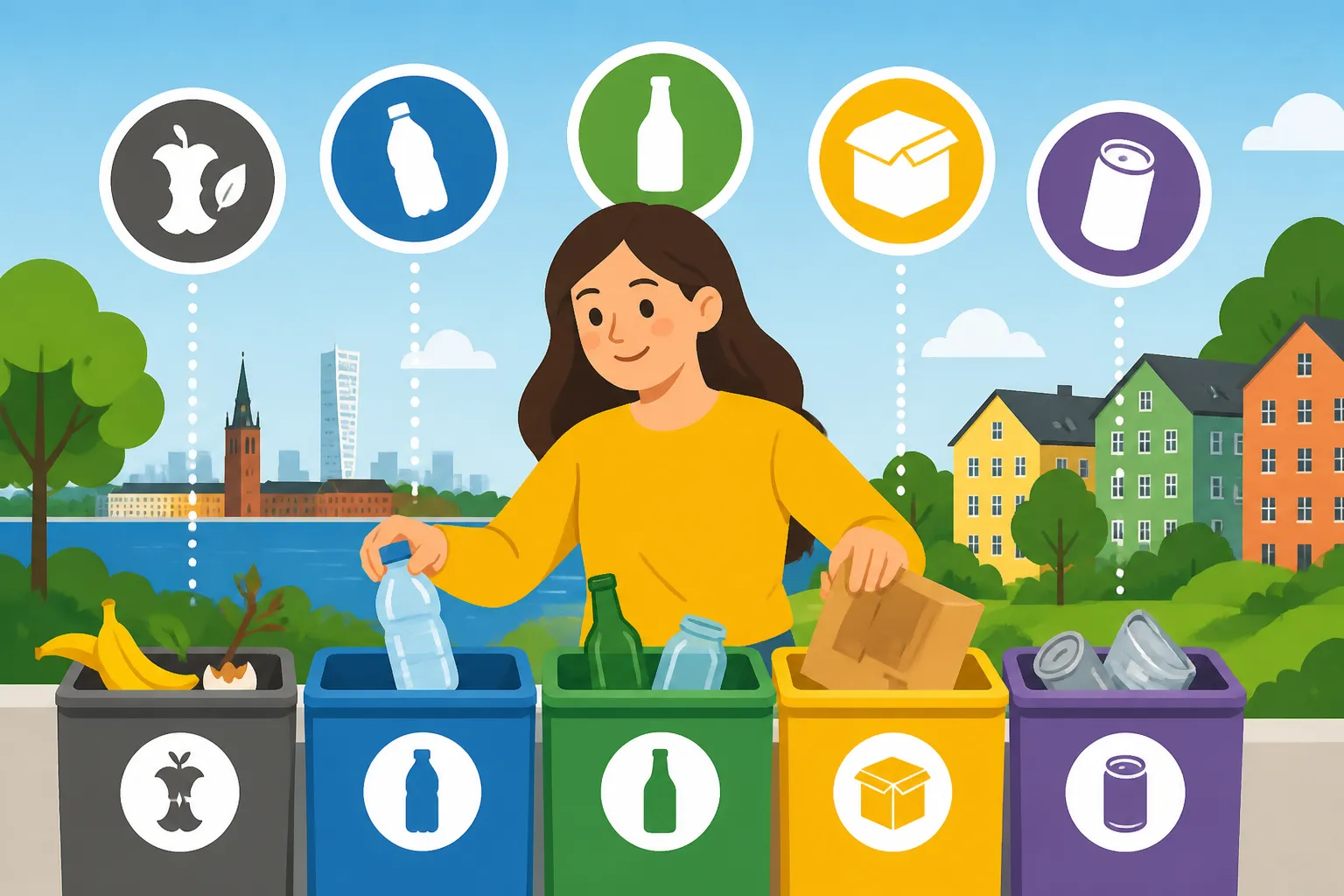
Your Everyday Recycling: The Categories Explained
Let's get down to the brass tacks of what goes where. This is where most expats face their biggest challenges, but with a bit of practice, it becomes second nature.
Paper Packaging (Pappersförpackningar)
This category is for all kinds of paper-based packaging. Think about what your groceries come in.
- What goes in: Cardboard boxes (cereal, moving boxes), milk and juice cartons, paper bags (flour, sugar), egg cartons, toilet paper rolls, paper tubes, wrapping paper (but not glossy gift wrap, which often has plastic coating). Always make sure to flatten boxes to save space in the bins.
- What doesn't: Newspapers and magazines (they have their own category!), books (these are usually treated as residual waste or taken to a larger recycling centre if for pulp), paper towels, tissues, and anything heavily soiled or wet. These typically go into residual waste. Padded envelopes, because of the mixed materials, generally go to residual waste.
- Detail: For food-related packaging like milk cartons, a quick rinse is often appreciated, but it doesn't need to be sparkling clean. Just get rid of any significant food residue. Flattening everything saves an incredible amount of space in the bins, which is a big deal in shared miljörum.
Plastic Packaging (Plastförpackningar)
This is perhaps the trickiest category due to the sheer variety of plastics. The key word here is packaging.
- What goes in: This includes both hard plastics (yogurt containers, shampoo bottles, plastic tubs for butter, cleaning products) and soft plastics (plastic bags, cling film, crisp packets, plastic wrappers from cheese or cold cuts). Generally, if it's plastic and it contained something you bought, it's plastic packaging.
- What doesn't: Anything that isn't packaging. This means toys, plastic furniture, toothbrushes, CD cases, or other plastic products should not go in this bin. Also, items made of PVC (often found in older toys or certain household items) are generally not accepted. Anything with electrical components is elavfall (electronic waste).
- Detail: Like paper packaging, a quick rinse is good for food containers. Separate lids from bottles if they are of a different material (e.g., metal lid on a plastic bottle) or if the collection point specifically asks for it. Squeeze out air from plastic bottles and containers to compact them as much as possible – again, it's all about saving space!
Metal Packaging (Metallförpackningar)
This category is for metal that encased food or other products.
- What goes in: Aluminum foil and trays, metal lids from jars, tin cans (e.g., canned tomatoes, cat food), metal tubes (like for Kalles Kaviar or paté).
- What doesn't: Electronic waste (e.g., an old iron or toaster, even if made of metal), hazardous waste (like spray paint cans that still contain product), or metal objects that aren't packaging (e.g., tools, cutlery).
- Detail: Rinse out food cans thoroughly. Flatten cans and foil if possible. If a lid is plastic and the container is metal, separate them into their respective bins.
Glass Packaging (Glasförpackningar)
Glass packaging is almost universally sorted by color.
- What goes in: Glass bottles (wine, juice), glass jars (jam, pickles). These are usually divided into clear/white glass (färglöst glas) and colored glass (färgat glas).
- What doesn't: Drinking glasses, porcelain, ceramics, light bulbs (these are elavfall), mirrors, or heat-resistant glass like Pyrex. These items melt at different temperatures than packaging glass and contaminate the recycling stream. These usually go to residual waste or a larger återvinningscentral.
- Detail: Remove lids and caps (these go into plastic or metal packaging as appropriate). Give jars and bottles a quick rinse. If you're unsure if a glass item is clear or colored, err on the side of colored; it's generally less problematic to mix a clear bottle into colored than vice-versa. For more specific guidance, you can refer to resources like Where Do I Take Packaging and Glass for Recycling in Sweden?.
Newspapers and Magazines (Tidningar och Returpapper)
This is a separate category from paper packaging.
- What goes in: Newspapers, weekly magazines, advertising leaflets, brochures, phone books, and other similar printed paper.
- What doesn't: Books (hardcovers, softcovers – these aren't primarily for pulp recycling), envelopes (especially padded ones), glossy gift wrap (which often has plastic), or wet/dirty paper. These generally go to residual waste or, for books, some återvinningscentraler have dedicated bins for them.
- Detail: Keep these dry and separate from any other paper.
Food Waste (Matavfall)
Many Swedish municipalities have a separate collection for food waste, turning it into biogas or compost.
- What goes in: All food scraps, whether cooked or raw – fruit and vegetable peels, coffee grounds and filters, tea bags, leftover meals, bread, meat, fish, eggs and eggshells. Even small bones are usually okay.
- What doesn't: Plastic bags (unless specifically designed for compostable waste, which your municipality will provide), liquids, large quantities of cooking oil (small amounts soaked into paper are okay, but larger volumes should be taken to an återvinningscentral as hazardous waste), garden waste (leaves, branches) – these typically have a separate collection or designated drop-off points.
- Detail: You will likely be provided with special paper bags for food waste. It's crucial to use only these bags as they are designed to break down. Tie the bag securely before placing it in the designated food waste bin. This prevents smells and vermin. Check your local municipal guidelines for specifics, as systems can vary.
Residual Waste (Restavfall/Brännbart)
This is the "everything else" bin, for things that cannot be recycled in any of the above categories. This waste is typically incinerated to produce energy.
- What goes in: Diapers, sanitary products, cotton swabs, dust, vacuum cleaner bags, dirty paper (like greasy pizza boxes or paper towels), broken non-recyclable items (e.g., shattered drinking glasses, old ceramics, plastic toys that are not packaging), ash (cold and bagged).
- What doesn't: Anything that can be recycled (as outlined above), hazardous waste, or electronic waste. Putting these items in residual waste is a big no-no.
- Detail: All residual waste should be bagged before being put into the bin. This keeps the collection points clean and hygienic.
Beyond the Basics: Special Waste and the Pant System
Beyond your daily sorting, there are a few other important categories and systems you’ll encounter in Sweden.
Hazardous Waste and Electronics (Farligt Avfall och Elavfall)
These are items that cannot be safely processed with regular waste and need special handling.
- Hazardous waste: This includes batteries (all types!), light bulbs (fluorescent, LED, incandescent), paints, solvents, chemicals, expired medicines (take these to a pharmacy, apotek), car oils, and anything flammable or toxic.
- Electronic waste: Old phones, computers, chargers, small household appliances (toasters, kettles), larger white goods (fridges, washing machines) – essentially anything with a plug or battery.
- Where to take them: For smaller items like batteries and light bulbs, many supermarkets and public återvinningsstationer have special collection points. For larger items and more complex hazardous waste, you'll need to go to your local återvinningscentral (recycling centre). Your municipality's website will provide details on locations and opening hours. Never put these in your regular bins; they pose a significant environmental and safety risk.
The Pant System for Bottles and Cans (Pantmaskiner)
This is one of Sweden's most iconic and effective recycling initiatives, and it’s a brilliant way to get a little money back while being environmentally conscious.
- How it works: Many plastic bottles and aluminum cans for soft drinks, water, and beer sold in Sweden have a deposit, or pant, added to their price. You pay this deposit when you buy the drink, and you get it back when you return the empty container to a reverse vending machine (pantmaskin) found in most supermarkets.
- What it applies to: Look for the pant symbol on the bottle or can. If it has it, it's part of the system! This means cans and plastic bottles that are typically used for beverages. Glass bottles are generally not part of the pant system (they go to glass recycling).
- The value: The deposit values are usually 1 SEK, 2 SEK, or 4 SEK per container. You can choose to get a voucher to use in the store or donate the amount to charity. It's a fantastic system that incentivizes recycling and keeps streets cleaner. You can learn more about this by reading Recycling and the Deposit System (Pant) in Sweden or Grocery Shopping in Sweden: ICA, Coop, Willys, and Saving Money.
Bulk Waste and Furniture (Grovavfall och Möbler)
Got an old sofa, a broken bicycle, or a pile of renovation debris? This is where your local återvinningscentral comes in.
- Where to take them: The återvinningscentral is a large recycling facility where you can dispose of pretty much anything too big or complex for your household bins. They have separate areas for wood, metal, textiles, plasterboard, garden waste, electronics, and various types of bulk waste.
- Consider donating: If your items are still in good condition, consider donating them to second-hand shops (like Myrorna, Stadsmissionen, Erikshjälpen, or local charities). It's a sustainable choice and helps others.
- Internal link: For more in-depth information on handling larger waste, check out How Do I Dispose of Large Items in Sweden?.
| Category | What Goes In | What Doesn't Go In | Key Tip |
|---|---|---|---|
| Paper Packaging | Cardboard, milk/juice cartons, paper bags, egg cartons, toilet paper rolls. | Newspapers, books, wet/dirty paper, padded envelopes. | Flatten everything. Rinse lightly if food residue. |
| Plastic Packaging | Yogurt pots, shampoo bottles, plastic bags, cling film, crisp packets. | Toys, toothbrushes, non-packaging plastic items, electronics. | Rinse, separate lids, compact to save space. |
| Metal Packaging | Aluminum foil, cans (food, drink, pet food), metal tubes. | Electronics, hazardous waste (e.g., full spray cans), non-packaging metal. | Rinse, flatten cans and foil. |
| Glass Packaging | Glass bottles, jars (clear/colored). | Drinking glasses, ceramics, light bulbs, mirrors, heat-resistant glass. | Separate by color (if bins allow), remove lids, rinse. |
| Newspapers | Newspapers, magazines, advertising flyers, brochures. | Paper packaging, books, envelopes. | Keep dry and separate from other paper. |
| Food Waste | All food scraps (cooked/raw), coffee grounds, tea bags. | Plastic bags (unless compostable), liquids, garden waste. | Use special paper bags provided by municipality, tie securely. |
| Residual Waste | Diapers, sanitary products, dirty paper, broken non-recyclable items. | Anything recyclable, hazardous waste, electronics. | Bag everything, dispose of cold ash. |
| Pant System | Plastic bottles & aluminum cans with 'pant' symbol. | Glass bottles, non-pant marked containers. | Return to supermarket pantmaskiner for deposit refund. |
| Hazardous Waste | Batteries, light bulbs, paint, chemicals, old medicines. | Anything else. | Take to apotek (medicines) or återvinningscentral (others). |
| Electronic Waste | Phones, laptops, small appliances, cables. | Non-electronic items. | Take to återvinningscentral or special collection points. |
Practical Tips for a Stress-Free Recycling Routine
Adopting Sweden's recycling habits might seem daunting at first, but with a few practical adjustments, it quickly becomes part of your daily rhythm.
Setting Up Your Home Recycling Station
The Swedish lifestyle often means smaller apartments, so clever organisation is key. You'll want to create a system in your kitchen or utility area that makes sorting easy and efficient. Many expats invest in a set of small, clearly labelled bins or sturdy reusable bags for different categories (plastic, metal, paper, glass, newspapers, food waste).
Think vertically if counter space is limited – stackable bins are a lifesaver. Keep the residual waste bin easily accessible for everyday items, and have a small, dedicated caddy for food waste, ideally with the special paper bags from your municipality. When you're finding your first place, perhaps through platforms like Spotahome, you might not be thinking about the sophus or recycling room, but trust me, understanding the waste management system of your building is a vital part of What Should I Know About Swedish Apartment Etiquette?!
Regular trips to your building's miljörum or the local återvinningsstation become a part of your routine. It's often easier to empty these smaller bins frequently rather than letting them overflow.
Navigating Local Information and Apps
Given the local variations, your municipality's website (kommunens hemsida) is your absolute best friend. Search for "avfall" (waste) or "återvinning" (recycling) on your specific kommun's site. Most will have detailed guides, sometimes in English, outlining exactly what goes where, where your nearest återvinningsstationer are, and the opening hours for återvinningscentraler. Some municipalities even offer apps that provide personalised schedules for curbside collection or notify you about special waste collection days.
Don't hesitate to ask your landlord, building manager, or even friendly neighbours if you're unsure about the specifics of your building's recycling facilities. They are usually more than happy to guide a newcomer through the intricacies of waste management, as they share the collective goal of proper sorting. This is also part of embracing Everyday Living in Sweden: Groceries, Recycling, and Local Customs.
The Social Aspect: Avoiding the 'Shame' of Bad Sorting
This might sound a bit dramatic, but in Sweden, recycling correctly isn't just about environmental responsibility; it's also a subtle social expectation. If you consistently misuse the bins in a shared miljörum, it's likely someone will notice. Swedes are generally non-confrontational, but a passive-aggressive note on the bin, or a knowing glance from a neighbour, can certainly make you feel the pressure!
Embrace the learning process. You’ll make mistakes – we all do. But showing effort and asking questions goes a long way. Soon, you'll find yourself instinctively separating everything, rinsing packaging, and enjoying the satisfying clink of a can in the pantmaskin. It's one of those small, everyday victories that make you feel truly settled into Swedish life.
Disclaimer
The information provided in this guide is intended for general informational purposes only and is subject to change. Waste management regulations and practices in Sweden can vary by municipality and may be updated. Always refer to your local municipality's official website or waste management authority for the most accurate and up-to-date information regarding recycling and waste disposal in your specific area.