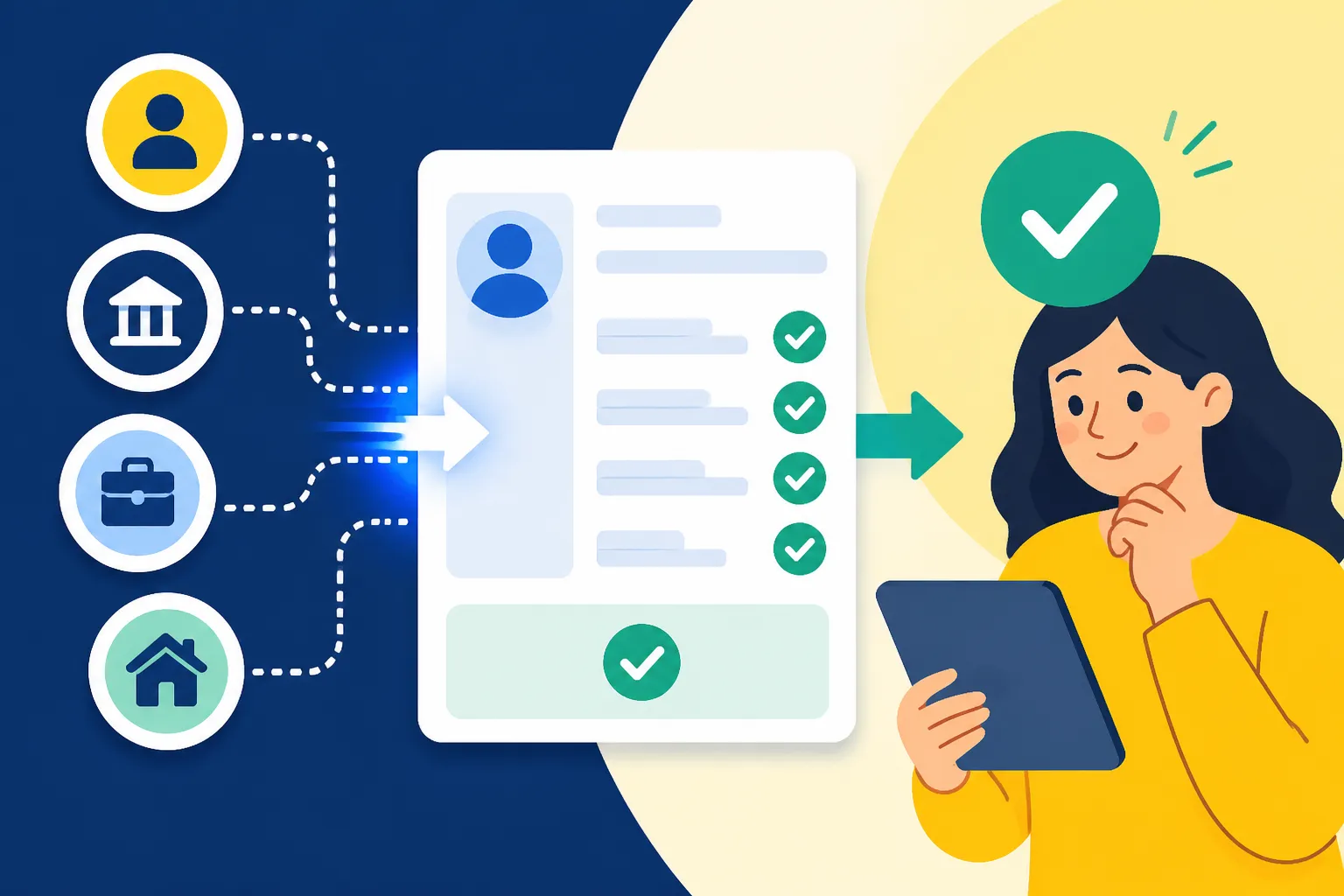
How Your Swedish Tax Return Is Pre-Filled by Skatteverket
Navigating your first tax season in Sweden can be an overwhelming experience, especially when a thick envelope from Skatteverket arrives at your door filled with complex Swedish terminology. Many expats fear they will accidentally break a law or miss a crucial deduction because they do not understand the system. This guide explains exactly how the pre-filled tax return works, ensuring you can verify your data and submit with confidence.
Understanding the Inkomstdeklaration 1 and the Pre-filled Concept
The Swedish tax system is built on a foundation of transparency and high-level automation that often shocks newcomers from more manual systems like those in the US or the UK. The document you receive, known as the Inkomstdeklaration 1, is not a blank canvas where you must list every cent you earned. Instead, it is a comprehensive draft prepared by the tax agency. This is possible because of the deep integration of your personal identity number into every facet of Swedish life.
When you first started working, your employer likely asked for your personal details to ensure they were reporting to the right place. Because you took the time to focus on Getting Your Personnummer: The Gateway to Swedish Healthcare, you enabled a chain of data reporting that culminates in this annual return. Every month, your employer sends an Individual Employer Declaration (AGI) to Skatteverket, detailing your salary and the tax they withheld on your behalf. By the time March rolls around, the tax agency already has twelve months of your financial history mapped out.
It is helpful to think of the pre-filled return as a "suggested" tax bill. Skatteverket is essentially saying, "Based on what your employer, your bank, and your insurance company told us, we think this is what you owe." For many residents with simple financial lives—one job, one bank account, and no property—the pre-filled data is 100% accurate. In these cases, the process of "filing" takes less than two minutes. However, as an expat, your life is rarely that simple, and assuming the government knows everything about your global finances is a common mistake.
The arrival of the declaration usually happens in mid-March. If you have a digital mailbox like Kivra, you will receive it as a PDF several days before the paper versions are mailed out. This digital-first approach is part of Sweden's push to be a cashless, paperless society. Receiving the document early gives you ample time to cross-reference the numbers with your own records, such as your final payslips of the year or your annual bank statements.
What Data Skatteverket Already Knows and Reports
The sheer volume of data pre-populated in your return can feel like a breach of privacy to those from more closed cultures, but in Sweden, it is seen as a service that reduces administrative burden. The primary source of data is your Swedish employer. They report your "Gross Salary" (Bruttolön), any taxable benefits like a company car or health insurance, and the "Preliminary Tax" (Preliminärskatt) they deducted. You can usually find these figures on your final December payslip. For a deeper look at how these monthly stubs work, you should review Understanding Your Swedish Payslip and Preliminärskatt to ensure you are reading the codes correctly.
Beyond employment, Swedish banks are legally required to report interest earned on savings accounts and interest paid on loans or mortgages. If you own a home in Sweden, your mortgage interest is pre-filled, which is vital because 30% of that interest is usually tax-deductible against your income tax. Similarly, if you have been investing in the local market, The ISK Account: Sweden's Tax-Smart Way to Invest makes reporting incredibly simple, as the bank calculates the tax based on the account's value and reports it directly to Skatteverket. You won't need to manually list every stock trade you made during the year.
Pension contributions also feature heavily in the pre-filled data. Both the public pension contributions and any private pension insurance premiums that are still deductible under older rules will appear automatically. However, be aware that most private pension savings are no longer deductible for the average employee. If you have an occupational pension, your employer handles those reports. This level of automation is why it is often said that Swedish taxes are "the easiest in the world," provided you don't have income sources that fall outside the Swedish digital net.
Finally, the system captures social benefits. If you received parental leave pay or took time off to care for a sick child, Försäkringskassan reports these payments as taxable income. Many expats are surprised to find these figures already listed, but since these benefits are considered a replacement for your salary, they are taxed at your marginal rate. Seeing these numbers pre-filled helps prevent the "nasty surprise" of a massive tax bill at the end of the year because of under-withholding on benefits.
The Verification Process: Why You Must Check Every Line
Just because the form is pre-filled does not mean it is infallible. The legal responsibility for the accuracy of the tax return rests solely on you, the taxpayer, not on Skatteverket or your employer. One of the most common issues occurs when an employer makes a typo in an end-of-year report or fails to account for a specific taxable benefit correctly. If you simply click "Approve" on an incorrect form, you could be liable for "tax surcharges" (Skattejtillägg) later if the error is discovered during an audit.
Expats face a unique challenge: foreign income. Skatteverket has no way of knowing about the rental income you earned from your flat in Madrid or the dividends from your stocks in a New York brokerage account unless those institutions participate in the Common Reporting Standard (CRS). Even then, the data often arrives too late to be pre-filled. If you have complex international obligations, using a service like Taxes for Expats can be a lifesaver. They specialize in the intersection of Swedish and foreign (especially US) tax law, ensuring you don't get double-taxed or miss a reporting requirement that Skatteverket isn't even aware of yet.
Another area to verify is your "Tax Residence" status. If you moved to Sweden halfway through the year, Skatteverket might have pre-filled your return as if you were a resident for the full twelve months. This can affect your "Basic Deduction" (Grundavdrag), which is the portion of your income that is tax-free. If you were only in Sweden for six months, this deduction should be pro-rated. Checking this requires a look at your entry date and understanding how Filing Your Swedish Tax Return (Deklaration): What You Need to Know applies to partial-year residents.
Finally, check for "double-reporting." Sometimes, if you changed jobs during the year, both the old and new employers might report the same transition bonus, or a bank might report the same interest under two different account numbers. It is a tedious task to sit with your bank's "Year-End Summary" (Årsbesked) and your payslips, but it is the only way to ensure the government isn't asking for more than its fair share. Remember, in Sweden, your income is often a matter of public record, so keeping your filings accurate is a matter of both legal and social standing. You can read more about this cultural quirk in Why Swedish Income Is Public Record (and What That Means for You).
Making Adjustments and Adding Deductions
Once you have verified the pre-filled numbers, the next step is to add the deductions that Skatteverket cannot possibly know about. The most famous of these is the "Travel Deduction" (Reseavdrag). If you commute a long distance to work and save a significant amount of time by driving or taking the train, you may be able to deduct a portion of these costs. However, there is a "floor" to this deduction; you can only deduct expenses that exceed 11,000 SEK per year. For a step-by-step on the math involved, consult the guide on Claiming the Travel Deduction (Reseavdrag) on Your Swedish Taxes.
Another significant area is the ROT and RUT deductions. These are credits for home renovations (ROT) and household services like cleaning or moving (RUT). Usually, the company providing the service deducts the amount directly from your invoice and reports it to Skatteverket. It should then appear as a pre-filled credit on your return. You must check that the total amount used doesn't exceed the annual cap (usually 75,000 SEK combined per person). If you hired a cleaner and the credit isn't showing up, you will need to manually enter the company's organization number and the amount paid.
For those who have sold a home or shares in a "K4" category (regular brokerage account), you will need to add these capital gains or losses manually. Skatteverket knows you sold the asset, but they often don't know what you originally paid for it (the "GAV" or cost basis). This is where the pre-filled system pauses and asks for your input. Calculating the "improvement costs" for a sold apartment can be complex, and getting it wrong can lead to a significant overpayment of tax.
| Submission Method | Required Tools | Best For | Speed of Refund |
|---|---|---|---|
| Skatteverket App | BankID | Simple returns with no changes | Fastest (often by Midsummer) |
| E-Service (Website) | BankID or Paper Code | Adding deductions/Foreign income | Fast |
| SMS/Phone | Codes on the paper form | Approval with zero changes | Moderate |
| Paper Form | Pen and a Postbox | Those without BankID | Slowest (can take until Dec) |
Digital Submission: From BankID to the "Approve" Button
Sweden's tax submission process is a marvel of digital engineering. If you have no changes to make, the process of "declaring" can be as simple as sending a text message with your signature code or opening the Skatteverket app and swiping "Godkänn" (Approve). To use the app or the web portal effectively, you must have your digital identity sorted. If you are still struggling with this, please see How Do I Activate Mobile BankID in Sweden? as it is the key to almost all government interactions.
If you find that you owe money—perhaps because you had multiple income sources and each employer only taxed you at the base rate—you will see a figure for "Kvarskatt" (back tax). Paying this is also digital. You can use Swish or a bank transfer. For expats who may need to move money from a foreign account to cover a large Swedish tax bill, using a service like Wise is highly recommended. Traditional banks often charge high fees and offer poor exchange rates for international transfers; Wise allows you to pay your tax bill using the mid-market rate, which can save you thousands of kronor on a large balance.
One of the best incentives for filing digitally and early is the early refund. If you submit your return by the early April deadline (usually around the 2nd or 3rd) without making any changes to the pre-filled data, you can receive your tax refund in your bank account before the Easter holidays. If you make changes, such as adding travel deductions, your return is moved to a manual review queue, and you will typically receive your money in June. You can track the timeline in When Will I Get My Swedish Tax Refund? to manage your budget accordingly.
If you are one of the few who still prefers paper, be prepared for a wait. Paper returns must be manually scanned and verified by staff in offices like the one in Visby, which handles a high volume of mail. This can delay your refund until the end of the year. Furthermore, the risk of postal delays or handwriting errors makes the digital route far superior for anyone with access to a smartphone or computer.
Important Deadlines and Penalties for the Unprepared
The absolute deadline for submitting your tax return is typically the first weekday in May. In 2026, this date is likely May 4th. Missing this deadline is a serious matter in Sweden. Unlike some countries where you might get a gentle reminder, Skatteverket is strict. A late filing fee (Förseningsavgift) of 1,250 SEK is triggered the moment the clock strikes midnight on the deadline day. If you continue to delay, additional fees are added at the three-month and five-month marks.
If you realize that you cannot possibly gather all your foreign bank statements or receipts in time, you can apply for an "Anstånd" (extension). This is generally granted if you have a valid reason, such as a serious illness or a delay in receiving documentation from a foreign tax authority. You must apply for this extension before the May deadline. For Americans, this is a common point of friction, as the US tax year and Swedish tax year follow different reporting rhythms. Again, consulting with Taxes for Expats can help synchronize these deadlines so you aren't fighting two battles at once.
There is also the matter of "Kvarskatt" interest. If you know you owe a significant amount of money (over 30,000 SEK), interest starts accruing on that debt earlier than the final payment deadline. To avoid this, many savvy expats make a "discretionary payment" to their tax account (Skatteskonto) as early as February. If you need to move these funds from abroad, using Wise to send the money directly to your Swedish tax account's BG number is an efficient way to ensure the payment arrives on time without getting eaten by intermediary bank fees.
Ultimately, the pre-filled system is a tool designed to help you, but it requires your active participation. If you treat it like a bill that just needs to be paid, you might miss out on thousands of kronor in deductions. If you ignore it because it's in Swedish, you face fines and legal trouble. By taking an hour to sit down, translate the headers, and cross-reference your records, you can turn a stressful administrative hurdle into a smooth, predictable part of your life in Sweden. If things go wrong and you end up with a debt, stay calm and read What Happens If I Owe Back Taxes (Kvarskatt) in Sweden? to understand your options for payment plans.
Disclaimer
This article provides general information about the Swedish tax system and should not be construed as professional tax or legal advice. Tax laws and thresholds in Sweden change annually. Always consult with a qualified tax professional or the official Skatteverket website for guidance specific to your personal financial situation.