What Is the New Swedish Language Test for Citizenship?
Moving to Sweden and envisioning a future here, perhaps even becoming a Swedish citizen, is a big step. For years, one of the more unique aspects of Sweden's citizenship process was the absence of mandatory language or civics tests, a stark contrast to many other European nations. However, if you’ve been following the news or chatting in expat forums, you’ll know that change is on the horizon. This guide will walk you through the proposed new Swedish language test for citizenship, helping you understand what these changes mean for your journey.
The Road to Swedish Citizenship: Understanding the Upcoming Shifts
It’s no secret that administrative changes in Sweden can feel like navigating a constantly shifting labyrinth. Just when you think you’ve got a handle on the rules for something as fundamental as getting your personnummer or dealing with Migrationsverket, a new proposal or law change pops up. The recent discussions and legislative processes around citizenship requirements are a prime example, causing quite a bit of anxiety and confusion among expats. For a long time, the path to becoming a Swedish citizen focused primarily on residence time and good conduct, with no formal language or civics requirements. This was often seen as a welcoming gesture, trusting that integration would happen naturally through living, working, and raising families here.
Why the Changes? A Shift in Policy Direction
The push for mandatory language and civics tests stems from a political consensus that a deeper level of integration is necessary for citizenship. The argument often put forward is that these tests ensure new citizens have a foundational understanding of Swedish society, its values, and its language, fostering a more active and engaged citizenry. For many of us who've lived here, we know language proficiency often correlates with accessing better job opportunities, engaging with local communities, and truly feeling at home. However, the prospect of formal tests can feel daunting, especially for those who’ve already spent years contributing to Swedish society without such a requirement. The goal, according to policymakers, is to strengthen the status of Swedish citizenship by ensuring a common base of knowledge and language skills.
The Timeline and Legal Process
It's important to remember that these changes aren't in effect yet. While the proposals have been widely debated and largely agreed upon politically, the legislative process takes time. There's a government bill, which needs to be approved by the Riksdag (the Swedish parliament), and then a specific implementation date will be set. Original discussions suggested the tests could be introduced as early as 2024, but the legislative wheels turn slowly, and it's looking more likely that these requirements will come into force sometime in 2025 or even 2026. This means if you're close to meeting the current residency requirements for Becoming a Swedish Citizen: Requirements and the Application Process, you might still apply under the old rules. However, it's crucial to stay updated on the official announcements from Migrationsverket. Knowing How Long Does a Swedish Citizenship Application Take? will also help you strategize your application timing.
Decoding the Language Requirement: What to Expect from the Test
The introduction of a mandatory language test is perhaps the most significant change, as it directly impacts your everyday ability to function and communicate in Sweden. While most expats learn Swedish out of necessity and a desire to connect, formal testing is a different beast entirely. The proposed test will likely assess practical language skills, reflecting the ability to manage daily life and engage with society.
The Proposed Language Levels and Skills Assessed
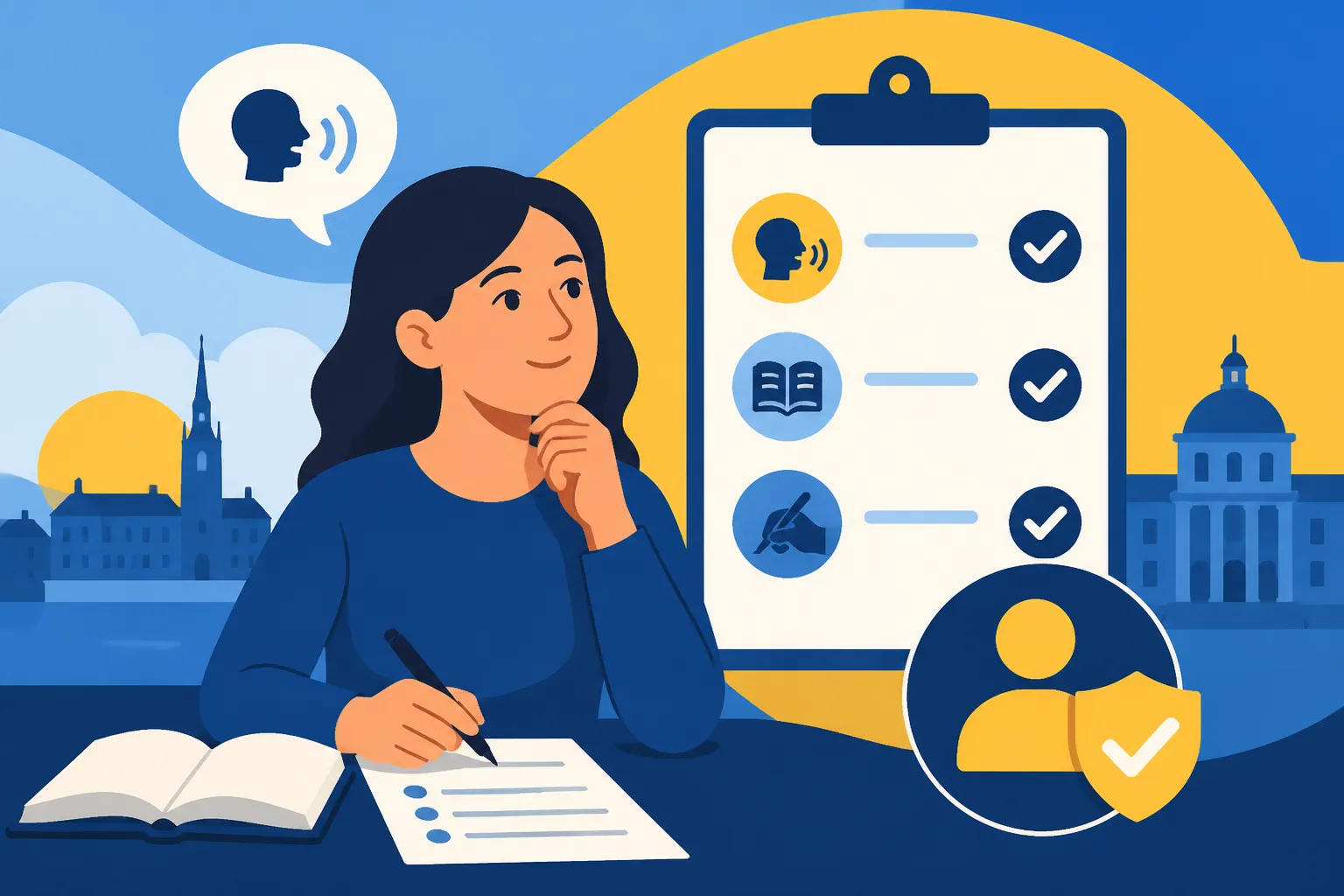
The current proposals suggest that applicants for Swedish citizenship will need to demonstrate proficiency at a level corresponding to A2 for speaking and listening, and B1 for reading and writing, according to the Common European Framework of Reference for Languages (CEFR). Let's break down what those levels actually mean in practical terms:
- A2 (Basic User – Waystage): At this level, you can understand sentences and frequently used expressions related to areas of most immediate relevance (e.g., very basic personal and family information, shopping, local geography, employment). You can communicate in simple and routine tasks requiring a direct exchange of information on familiar and routine matters. You can describe in simple terms aspects of your background, immediate environment, and matters in areas of immediate need. Think of it as being able to handle most common daily interactions without too much struggle.
- B1 (Independent User – Threshold): This level indicates you can understand the main points of clear standard input on familiar matters regularly encountered in work, school, leisure, etc. You can deal with most situations likely to arise whilst travelling in an area where the language is spoken. You can produce simple connected text on topics that are familiar or of personal interest. You can describe experiences and events, dreams, hopes, and ambitions, and briefly give reasons and explanations for opinions and plans. For writing, this means being able to fill out forms, write simple letters, or basic reports.
The test will likely be administered through specific agencies, possibly similar to how SFI (Swedish for Immigrants) courses are assessed, ensuring a standardized and fair evaluation process. It's not just about memorizing vocabulary; it's about proving you can use the language effectively in various real-world scenarios.
Potential Exemptions and Who Might Be Affected
Naturally, there’s a lot of discussion about who might be exempt from these new requirements. While the full details are still being finalized, it's expected there will be considerations for certain groups. For example, individuals with specific disabilities or significant health conditions that genuinely impede their ability to learn or take a test may be exempt. There might also be provisions for older applicants who have lived in Sweden for a very long time, or those who have already completed certain levels of Swedish education, such as grundskola (compulsory school) or gymnasieskola (upper secondary school).
It's crucial for you to understand the exact criteria once the law is passed. If you're a long-term resident who has How Long Until I Can Become a Swedish Citizen? and perhaps studied Swedish previously, keep records of any certificates or diplomas you might have, as they could prove relevant for exemptions. For those with special needs, make sure you understand the procedures for requesting accommodations once the details are published.
The Civics Component: Proving Your Knowledge of Swedish Society
Beyond language, the new legislation also introduces a civics test, designed to ensure that prospective citizens understand the fundamental aspects of Swedish society. This isn't just about knowing famous Swedes or where the Kungsleden trail is; it's about understanding the core functions of the country.
What Will the Civics Test Cover?
The civics test will aim to assess an applicant's knowledge of Swedish society, its history, geography, democratic system, legal framework, and fundamental values. Think about what a typical Swedish 9th-grader might learn about their country. Topics could include:
- The Political System: How the Riksdag, government, and municipalities function. Understanding concepts like democracy, voting rights, and the rule of law.
- Fundamental Rights and Freedoms: Knowledge of human rights, freedom of expression, and gender equality – cornerstones of Swedish society.
- Swedish History and Geography: Key historical events, major cities, and important geographical features.
- Social Model and Welfare State: Understanding the basics of the Swedish welfare system, including healthcare, education, and social security. This could involve knowing how Healthcare in Sweden for Foreign Residents: The Complete System Guide (2027) works, or the principles behind Family Benefits in Sweden: Child Allowance, Housing, and Parental Pay.
- Everyday Life and Social Norms: Basic understanding of public institutions, civic duties, and societal expectations.
The test format is likely to be multiple-choice, similar to driving theory tests, to allow for standardized and objective assessment. The overall goal is to gauge your understanding of what it means to be a contributing member of Swedish society, beyond just living here.
Why a Civics Test? Integration and Shared Values
The reasoning behind a civics test is closely tied to the broader integration policy. It's about establishing a common framework of understanding and shared values. Swedish society, while often perceived as very open, has strong underlying principles of democracy, equality, and collective responsibility. The test aims to ensure that new citizens actively acknowledge and understand these principles, which are considered vital for social cohesion.
For long-term expats, many of these concepts are probably already second nature. You live them every day, whether it's through the transparent tax system, the highly functional public transport, or the emphasis on lagom. However, formalizing this knowledge into a test means you'll need to articulate what you intuitively know. This might involve revisiting Swedish history books or brushing up on political structures. The government intends for this test to be accessible and reflective of knowledge that can reasonably be expected of someone living and integrating into Sweden.
Navigating Your Preparation: Resources and Practical Steps
Okay, so the prospect of tests can be a bit intimidating, but Sweden is also excellent at providing resources for integration. The key is to start preparing now, even if the exact implementation date is still a moving target.
Language Learning Paths: SFI, Komvux, and Beyond
If you're looking to brush up on your Swedish or start from scratch, there are several well-established routes:
- SFI (Swedish for Immigrants): This is the most common starting point for many newcomers. SFI courses are generally free for those registered in the population register (Folkbokföring) and provide structured language education from beginner levels up to the A2/B1 range. Many regions offer flexible schedules, and some even have options for online learning. Make sure you understand the criteria for Learning Swedish: SFI, Courses, and Language Paths for Newcomers.
- Komvux (Adult Education): For those who have progressed beyond SFI or need more advanced Swedish, Komvux offers municipal adult education courses that can take you through B2 and C1 levels. These courses are also often free for eligible residents and provide more in-depth study of grammar, literature, and academic Swedish. You can find more information on Adult Education in Sweden: Komvux, SFI, and Yrkeshögskola.
- Folkuniversitetet and Other Private Schools: If you prefer a more intensive or tailored approach, private language schools like Folkuniversitetet offer a wide range of courses, often with smaller class sizes and more flexible schedules, though these come with a fee.
- Self-Study and Immersion: Don't underestimate the power of everyday immersion! Watch Swedish TV, listen to Swedish radio, read Swedish news, and practice speaking with Swedish friends or colleagues. Apps like Duolingo, Memrise, and Babbel can supplement your formal learning. Join local groups, go to fika, and push yourself to use Swedish even if it feels awkward at first.
Gathering Documentation and Official Translations
Regardless of the new tests, applying for Swedish citizenship will always require a robust set of documents to prove your identity, residence history, and good conduct. This typically includes:
- Your passport and residence permit details.
- Proof of your Getting Registered in the Population Register (Folkbokföring) and continuous residence in Sweden.
- Income statements to show you can support yourself.
- Criminal record checks from Sweden and potentially your home country.
Any documents not originally in Swedish or English will almost certainly need to be officially translated. This is where services like RushTranslate or Translayte become incredibly useful. They provide certified translations that are accepted by Swedish authorities like Migrationsverket and Skatteverket. Don't just use any online translator; official documents require certified translators to be valid for legal purposes. Plan this in advance, as getting certified translations can take a bit of time and isn't something to leave until the last minute. This applies not only to your citizenship application but generally when you are Applying for a Swedish Residence Permit Online with Migrationsverket or even just doing everyday administrative tasks like registering your marriage.
Resources for the Civics Test
For the civics test, it's expected that official study materials will be provided or recommended by the government. Keep an eye on websites like Migrationsverket.se, Integrationsverket.se (or successor agencies), and local municipal websites. In the meantime, general resources on Swedish society can be helpful:
- Official Websites: The Swedish Institute (si.se) has excellent English-language resources about Sweden, its society, and democracy. The government's official website (government.se) also provides detailed information on the political system.
- Libraries: Your local library (bibliotek) is a treasure trove of information, with books on Swedish history, society, and language learning.
- News and Current Events: Staying informed about Swedish news in Swedish (if possible) will naturally build your knowledge of current societal issues and political discourse.
- SFI/Komvux Social Studies: Many SFI and Komvux courses incorporate elements of Swedish society and civics into their curriculum, which will be a great head start.
Here's a quick comparison of the current and proposed requirements:
| Aspect | Current Citizenship Requirements (Before new law) | Proposed Citizenship Requirements (After new law, expected 2025/2026) |
|---|---|---|
| Language Test | Not required | Mandatory: A2 (speaking/listening), B1 (reading/writing) – with some exemptions |
| Civics Test | Not required | Mandatory: Test on Swedish society, history, democracy, and values |
| Residence Time | Generally 5 years (3 for Nordic citizens, 2-3 for spouses) | Largely unchanged (still a primary requirement) |
| Good Conduct | Required (no serious crimes, outstanding debts with Kronofogden) | Largely unchanged (still a primary requirement) |
| Financial Self-Sufficiency | Generally required for permanent residence, implicitly for citizenship | Strengthened, likely a formal requirement for citizenship |
The implementation of these new tests, alongside potential changes to the financial self-sufficiency requirement, will collectively redefine The New Citizenship Requirements in Sweden: Language and Civics. It's a significant shift, but with the right information and preparation, you can navigate it successfully.
Disclaimer
The information provided in this article is intended for general guidance and informational purposes only and does not constitute legal advice. While we strive to keep the information up-to-date and correct, the immigration laws and regulations in Sweden are subject to change. For the most accurate and current information regarding Swedish citizenship requirements, language tests, civics tests, and any potential exemptions, please always refer to the official sources, such as Migrationsverket (Swedish Migration Agency), Skatteverket (Swedish Tax Agency), and the Swedish government's official websites. You may also consider consulting with a legal professional specializing in immigration law in Sweden.